
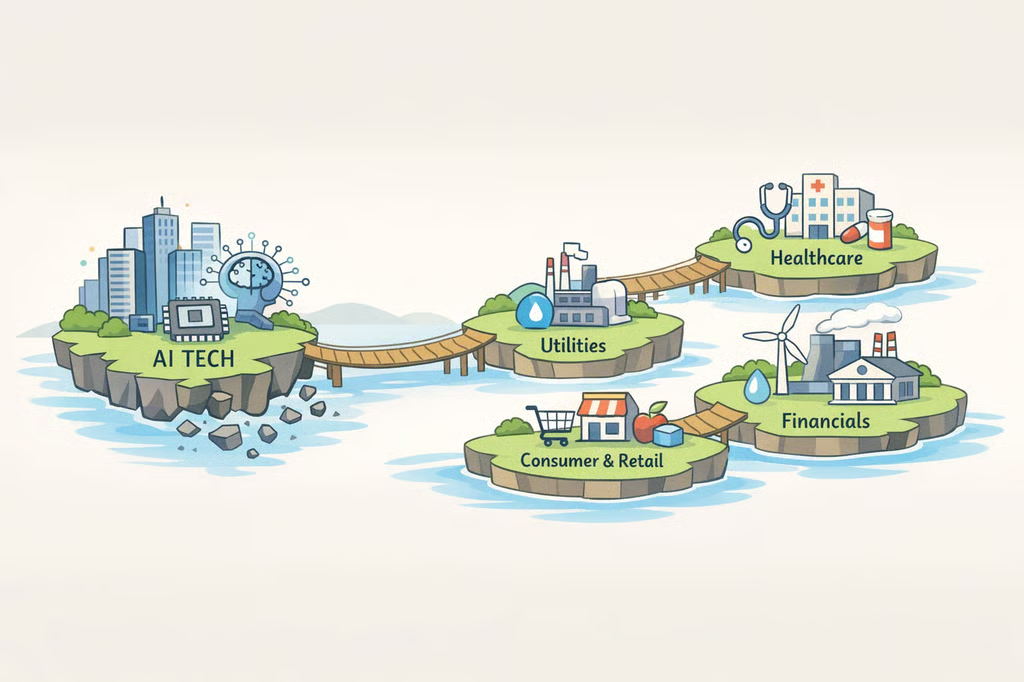
- How to invest defensively before the AI bubble pops: portfolio repositioning guide
- Your index fund may already be making a concentrated AI bet
- Step 1: Measure how much AI exposure you really own
- Step 2: Judge the risk as a spending problem, not a technology problem
- Step 3: Shift from concentration to balance
- Step 4: Keep the hedge honest
- A simple rule for what to do next
How to invest defensively before the AI bubble pops: portfolio repositioning guide
If your portfolio looks diversified on paper but still rises and falls with a handful of mega-cap tech names, this guide shows how to fix that. You’ll learn how to spot the concentration, judge the real AI risk, and make practical changes to build a sturdier portfolio without making a dramatic market call.
Your index fund may already be making a concentrated AI bet
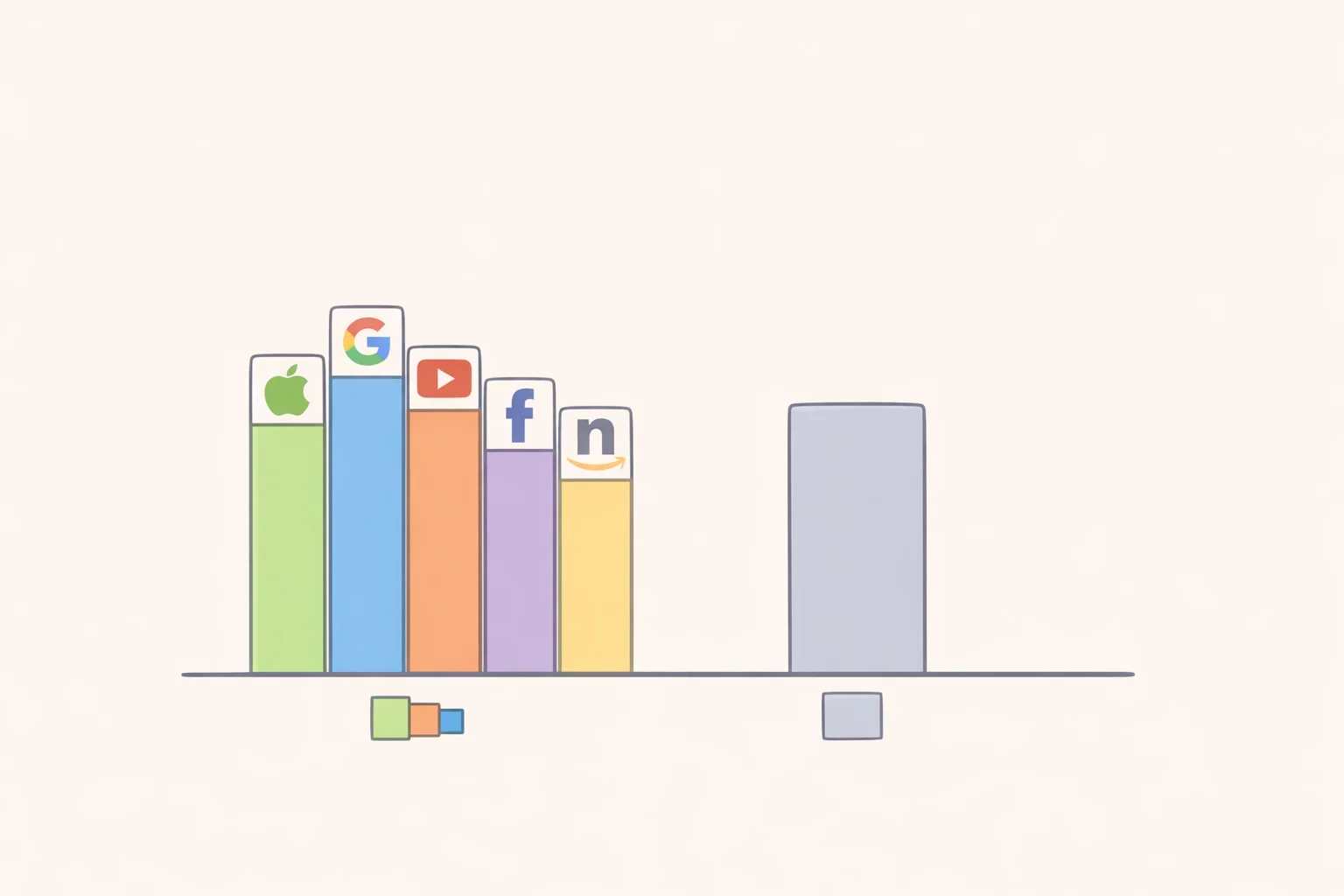
Most investors who think they are diversified are not, at least not in the way they imagine. Tech stocks now make up 37.5% of the U.S. stock market as of May 31, 2026, topping the concentration seen in the late-1990s internet bubble, and J.P. Morgan Asset Management said in June that the Magnificent 7 account for 34% of the S&P 500 by market value (J.P. Morgan Asset Management, June 2026). That means a plain-vanilla index fund is no longer the sleepy, neutral position many investors assume it is.
This is the practical problem behind how to invest defensively before the AI bubble pops. You do not need to believe the boom is doomed to see that a lot of portfolios are already tied to uninterrupted AI momentum. The question is not whether AI matters. It is whether your portfolio can take a hit if the trade gets crowded and the enthusiasm cools.
Prerequisites: A standard investment portfolio with some exposure to U.S. equities, whether through individual stocks, index funds, ETFs, or a target-date retirement fund. No trading floor certification required, just access to your brokerage or retirement account.
Step 1: Measure how much AI exposure you really own

Start with the holdings, not the headlines. If a portfolio owns the market by market cap, it also owns the market’s biggest concentrations, which is where the AI risk has been hiding in plain sight.
A broad S&P 500 fund is not evenly spread across 500 names. J.P. Morgan said in June that the Magnificent 7 account for 34% of the index’s total market value, which turns broad-market exposure into a much narrower bet than the label suggests (J.P. Morgan Asset Management, June 2026). Morningstar also reported this week that tech’s 37.5% share of the U.S. stock market now exceeds late-1990s bubble-era concentration (Morningstar, July 2026).
What to do:
- Log into your brokerage or retirement account and list every equity fund you own.
- Check each fund’s top holdings on the fund company’s website.
- Add up your direct holdings in Apple, Microsoft, Nvidia, Alphabet, Amazon, Meta, and Tesla.
- Do the same for funds with large top-10 concentrations in those names.
- If you use a target-date fund, check that too. Those funds are not magically exempt from market concentration.
What you should see after this step: A rough sense of how much of your portfolio depends on a narrow group of AI-linked stocks. If that number is larger than you expected, good. That is the point of looking.
Step 2: Judge the risk as a spending problem, not a technology problem
This part matters because it keeps the argument honest. The case for a defensive portfolio does not rest on claiming AI is fake or useless. The stronger case is simpler: the market may be assuming that the spending spree will produce profits fast enough to justify it, and that is a much harder bar to clear.
J.P. Morgan said in June that hyperscaler capital expenditure is likely to reach $700 billion in 2026, up 70% from 2025, while also warning that the risk is not fake demand but investment outrunning near-term monetization (J.P. Morgan Asset Management, June 2026). Morningstar reported this week that one major AI company’s revenue generation required $2.22 of spending for every $1 of revenue, a neat reminder that excitement and economics are not always friends (Morningstar, July 2026).
GQG Partners, which manages $160 billion, argues the current AI buildout rhymes with telecom in the late 1990s and shale oil a decade ago, both periods when real demand did not stop investors from earning lousy long-term returns (Morningstar/GQG, June 2026). GQG also points to a shift toward smaller language models and cheaper local processing, which could reduce the need for expensive frontier-scale compute and data-center spending (Morningstar/GQG, June 2026).
Vanguard’s 2026 outlook is more constructive on the technology itself, saying AI investment has added roughly $250 billion to U.S. GDP since ChatGPT emerged in late 2022 (Vanguard, December 2025). That is real economic activity. It still does not guarantee that the stocks tied to it will deliver the same result for shareholders. Markets are generous right up until they are not.
Step 3: Shift from concentration to balance
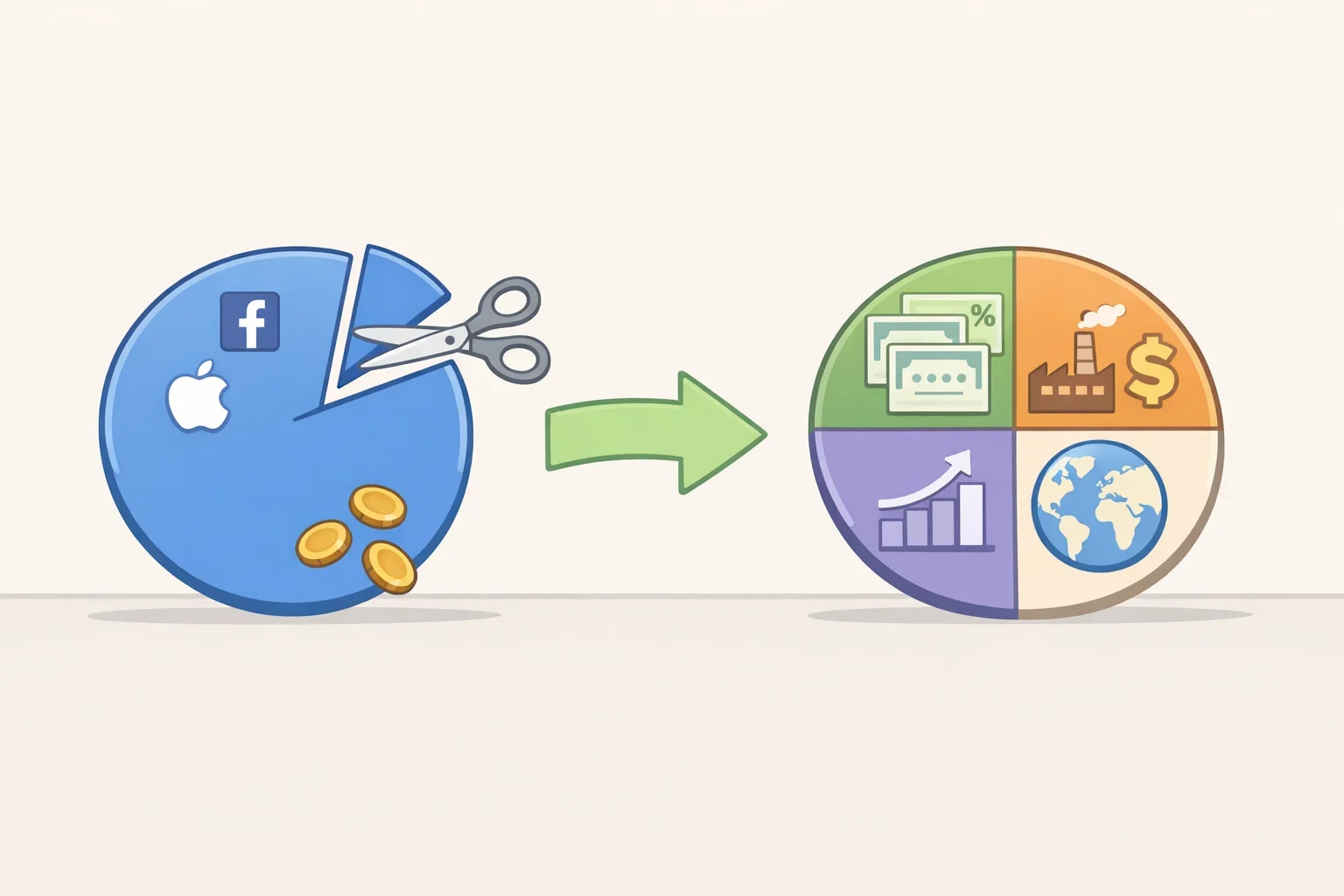
This is where the repositioning happens. Defensive portfolio positioning in a tech bubble does not mean fleeing to cash and hiding under the bed. It means reducing dependence on one theme and adding assets that behave differently when growth stocks wobble.
Vanguard’s capital markets outlook ranks the strongest public-market risk-return profiles over the next five to 10 years as high-quality U.S. fixed income first, U.S. value-oriented equities second, and non-U.S. developed markets equities third (Vanguard, December 2025). Fidelity says low-volatility stocks and investment-grade bonds have historically fallen less in volatile markets than lower-quality alternatives, though the trade-off is smaller gains in strong ones (Fidelity, March 2026).
Concrete rebalancing moves to consider:
-
Trim concentrated mega-cap tech positions.
If one stock or a small cluster of AI names makes up more than 10% to 15% of your total portfolio, scale it back toward a more neutral weight. That applies whether you own the shares directly or own a fund with heavy exposure at the top. -
Add high-quality bond exposure.
Vanguard expects high-quality U.S. bonds to offer compelling real returns over the coming decade and says fixed income should also provide diversification if AI disappoints, a scenario it puts at 25% to 30% odds (Vanguard, December 2025). In practice, that means looking at investment-grade corporate bonds or intermediate-term Treasuries. -
Tilt some U.S. equity exposure toward value.
Vanguard says it favors fixed income and value stocks, and that U.S. value-oriented equities offer more attractive prospects than U.S. growth stocks from a risk-return perspective (Vanguard, December 2025). A broad U.S. fund paired with a value tilt is a clean way to do that without abandoning domestic equities. -
Add non-U.S. developed markets.
Europe, Japan, and Australia carry less AI mega-cap concentration by construction. Vanguard places non-U.S. developed markets equities third among its best public-market opportunities over the next five to 10 years (Vanguard, December 2025). -
Consider low-volatility equity strategies.
Fidelity notes that portfolios built around lower-volatility stocks may reduce losses in down markets, even if they do not eliminate them (Fidelity, March 2026). Minimum-volatility ETFs and similar funds are built for exactly that sort of behavior.
Warning: Rebalancing a taxable account can trigger capital gains on appreciated positions. If selling would create a large tax bill, consider staging the move over time or focusing first on tax-advantaged accounts where reallocations do not create an immediate tax event.
Step 4: Keep the hedge honest
Defensive positioning has a price. If AI stocks keep climbing, a portfolio tilted toward bonds, value, and international equities will likely lag a concentrated growth-heavy portfolio, sometimes by a lot. That is not a flaw in the strategy. It is the strategy.
Fidelity’s Callum Henderson puts it plainly: a defensive portfolio is meant to limit losses in down markets, but it will usually trail in a strong up market, with the goal of capturing much of the market’s growth with a smoother ride (Fidelity, March 2026). That smoother ride matters more than it sounds. Investors do not usually blow up because they owned the wrong asset class in a spreadsheet. They blow up because they cannot sit still when volatility shows up.
Morningstar’s latest concentration data makes the timing argument less abstract. Tech’s share of the U.S. market is already above the dot-com-era peak (Morningstar, July 2026). You do not need to call a top to decide that’s a lot of eggs in one very shiny basket.
A simple rule for what to do next
If your portfolio is highly concentrated in AI-linked mega-cap stocks, rebalance gradually rather than all at once, especially in a taxable account. If your portfolio is already balanced across stocks, bonds, value, and international equities, the job is smaller than it looks, and maybe already done.
What matters now is not predicting the exact moment the AI trade rolls over. It is making sure your portfolio does not require AI stocks to stay perfect in order for your plan to work. That is the whole game, and it is a lot easier to play before the crowd discovers there is no second exit.