
- Student loan repayment mistakes: avoid costly errors in 2026
- Common student loan repayment mistakes: choosing the wrong plan
- Student loan repayment mistakes that cost you money: focusing on the monthly bill alone
- Watch your servicer before it watches your wallet
- Do not refinance federal loans without counting the cost of what disappears
- The checklist that avoids the expensive mistakes
Student loan repayment mistakes: avoid costly errors in 2026
Federal student loan repayment got a hard reset this summer, and the biggest student loan repayment mistakes now start with doing nothing. As of July 1, 2026, most federal borrowers can choose between the Tiered Standard repayment plan and the income-driven Repayment Assistance Plan, or RAP, a simpler setup than the old spread of repayment options, according to the U.S. Department of Education's July 2026 fact sheet.
That matters most for borrowers who were in SAVE. The U.S. Department of Education said in March those borrowers would get at least 90 days to move into a legal repayment plan of their choice, and anyone who does not make the switch in time will be automatically enrolled into either the Standard Repayment Plan or the new Tiered Standard Plan. No mystery. No mercy. The clock is the point.
This guide walks through the student loan repayment mistakes that cost borrowers real money, from choosing the wrong plan to letting interest pile up to trusting a servicer a little too much.
Prerequisite: This guide covers federal student loans. Private loan borrowers may still find the servicer and refinancing sections useful, but the plan choices here, including RAP, Tiered Standard, PSLF, and Teacher Loan Forgiveness, apply to federal loans only.
Common student loan repayment mistakes: choosing the wrong plan
The most time-sensitive mistake is inaction during the transition period. If you miss the 90-day deadline communicated by your servicer, you do not get a custom rescue plan. The Department says borrowers who do not transition in time will be automatically enrolled into either the Standard Repayment Plan or the new Tiered Standard Plan (U.S. Department of Education, March 2026).
Start by finding your deadline. Your servicer is supposed to notify you of the specific 90-day window, and borrowers who want to move sooner can contact their servicer now rather than waiting for that notice (U.S. Department of Education, March 2026). That may sound obvious, but obvious is not the same thing as done.
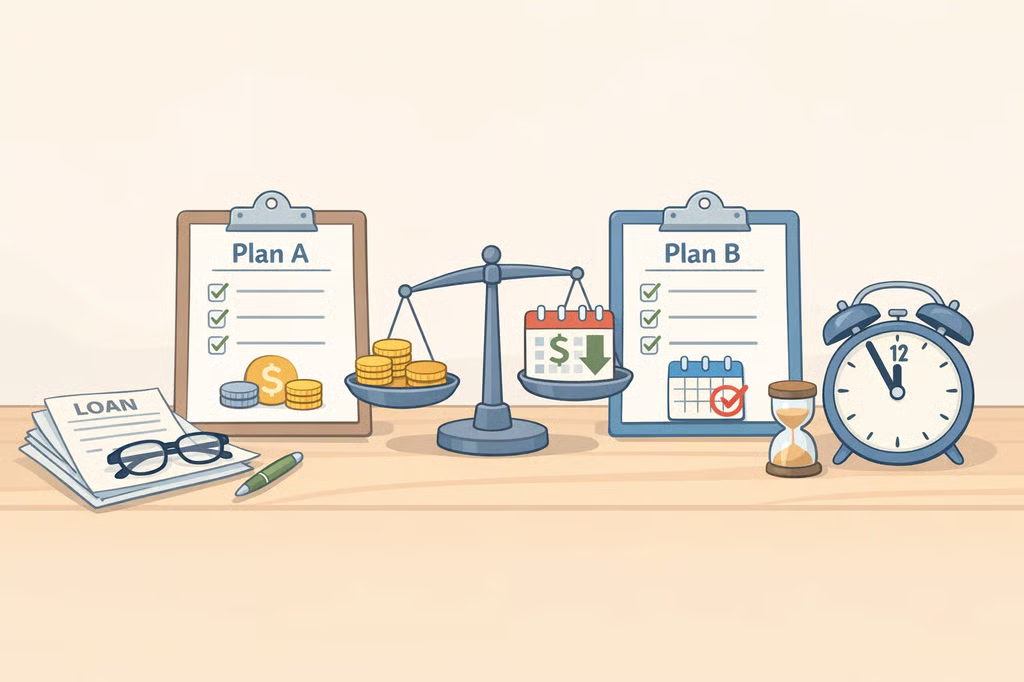
Then compare the two plans that now matter most. The Tiered Standard plan offers fixed terms of 10, 15, 20, or 25 years based on how much is borrowed, and higher balances get longer terms and lower monthly payments (U.S. Department of Education, July 2026). RAP sets payments from 1% to 10% of income, reduces payments by $50 a month for each dependent, and can bring the monthly bill as low as $10 (U.S. Department of Education, July 2026).
If you choose RAP, consent for the Department to pull your tax information from the IRS can speed processing and eliminate manual document uploads (U.S. Department of Education, March 2026). That is not a trivial detail when time is the thing standing between you and a default assignment you never asked for.
Student loan repayment mistakes that cost you money: focusing on the monthly bill alone
The next mistake is more subtle and usually more expensive over time. A low monthly payment looks helpful until the borrower notices the balance barely moves. That is where the math gets unfriendly.
Interest on federal student loans begins accruing on the day of disbursement and continues daily until the loan is paid in full, and capitalization adds unpaid interest back to principal (Edfinancial Services FAQ). Once that happens, future interest is calculated on a bigger number. The snowball gets a little larger, then a little faster.
RAP changes that dynamic for borrowers who stay current. The Department says on-time monthly payments will have any remaining unpaid interest waived, and if a payment reduces principal by less than $50, the federal government contributes up to $50 toward principal each month (U.S. Department of Education, July 2026). The April final rule says RAP eliminates negative amortization, which is the ugly little setup where a borrower pays on time and still owes more later.
That creates the framework borrowers actually need to use:
- Monthly payment: Can you afford it without falling behind?
- Total interest: How much will the loan cost over the full term?
- Forgiveness eligibility: Are you on a path that depends on qualifying payments?
- Time to debt-free: Do you want the loan gone fast, or is a lower payment worth a longer tail?
Use all four together. A plan with a lower monthly bill is not automatically the better plan. Sometimes it is just a longer, more expensive route to the same destination.
A practical move still helps here: borrowers who sign up for auto pay receive a 1% interest rate reduction, according to the Department’s July fact sheet (U.S. Department of Education, July 2026). And borrowers can always pay more than the required amount; Edfinancial Services FAQ says paying more now could mean paying less over the life of the loan. That extra payment should be directed to principal if the servicer allows it.
The rule of thumb is blunt: if a plan looks cheap because the monthly payment is small, check what it does to interest, forgiveness, and time. Cheap on paper has a way of getting expensive in the footnotes.
Watch your servicer before it watches your wallet
Not every student loan repayment mistake begins with the borrower. Some begin with the company handling the account.
The CFPB said in December 2024 that federal loan servicers had issued deceptive billing statements with wrong payment amounts and due dates, and in some cases debited unauthorized amounts. Examiners also found recurring problems in how servicers processed income-driven repayment applications. That kind of mess is not just annoying. It can keep borrowers in more expensive plans longer than they should be.
Navient is the clearest example in the record. In September 2024, the CFPB said the company steered borrowers away from income-driven plans they qualified for, failed to adequately notify borrowers about annual recertification, and misallocated payments on accounts with multiple loans. Those errors led to late fees, interest accrual, and negative credit reporting.
The fix is less glamorous than the problem, which is usually how fixes work:
- Check every billing statement against your account. Do not assume the amount due is correct.
- Track recertification dates yourself. Servicer reminders are helpful when they arrive and useless when they do not.
- Review how payments are applied. If you have multiple loans, one bad allocation can do more damage than a missed cup of coffee ever could.
- Dispute errors in writing. Keep copies. Screenshots help. So does annoyance, within reason.
Edfinancial Services FAQ says delinquency is reported to the three major credit bureaus after 90 days, and continued delinquency can push a loan toward default. If the delinquency came from a servicer mistake, fight it early. Waiting is a hobby borrowers cannot afford.
Do not refinance federal loans without counting the cost of what disappears
Private refinancing can look tidy. One payment. Maybe a lower rate. Fewer moving parts. That is the sales pitch, anyway.
The tradeoff is brutal. Refinancing or consolidating federal loans through a private lender means losing federal protections, and the CFPB said in December 2024 that lenders gave borrowers misleading impressions that refinancing might not cost them access to federal cancellation programs. It does.
The protections at stake include Public Service Loan Forgiveness after 120 qualifying payments, Teacher Loan Forgiveness of up to $17,500 for qualifying educators, military interest relief, and deferment rights that private lenders are not required to offer (Edfinancial Services FAQ). For a borrower already partway through a PSLF-qualifying career, that loss can dwarf the savings from a slightly better interest rate.
The decision rule is plain: if any federal forgiveness path, deferment right, or special repayment benefit still matters to you, do not refinance blindly. Calculate what you would give up before you calculate what you might save.
One distinction is worth keeping straight. Federal consolidation is not the same as private refinancing. Consolidation within the federal system can preserve federal protections, though it may reset payment counts toward forgiveness. That is a very different animal.
The checklist that avoids the expensive mistakes
The cleanest way to avoid student loan repayment mistakes is to treat the loan like a standing monthly project, not a bill that arrives and gets paid on autopilot. That sounds dull. It is also cheaper.
First, check whether you are in the SAVE transition window and confirm your 90-day deadline with your servicer (U.S. Department of Education, March 2026). Then compare RAP and Tiered Standard using StudentAid.gov, with a real eye on monthly payment, total interest, forgiveness eligibility, and how long you want to stay in debt. If RAP fits, use IRS data-sharing consent to keep the application moving (U.S. Department of Education, March 2026).
After that, turn on auto pay for the 1% interest rate reduction, check your servicer statements against your account, and keep your own recertification deadlines. If refinancing is even on the table, strip away the sales language and ask a harder question: what federal protections disappear if the loan leaves the system?
That is the real shape of the problem. Not one huge blunder, but a series of small ones that compound nicely for the lender and terribly for the borrower.
Next steps: Visit StudentAid.gov to compare RAP and Tiered Standard, review your recertification date, and sign up for auto pay. If you work in public service, verify your PSLF qualifying payment count before changing plans.