
- Learn AI for your career: the training gap employers create
- The expectation gap
- AI skills for jobs have quietly become a baseline
- Why employers expect workers to learn AI for work, but not much else
- Who needs AI upskilling, and who is least likely to get it
- How to learn AI for work when employers won't teach it
- What this means for careers, and for employers
Learn AI for your career: the training gap employers create
The expectation gap
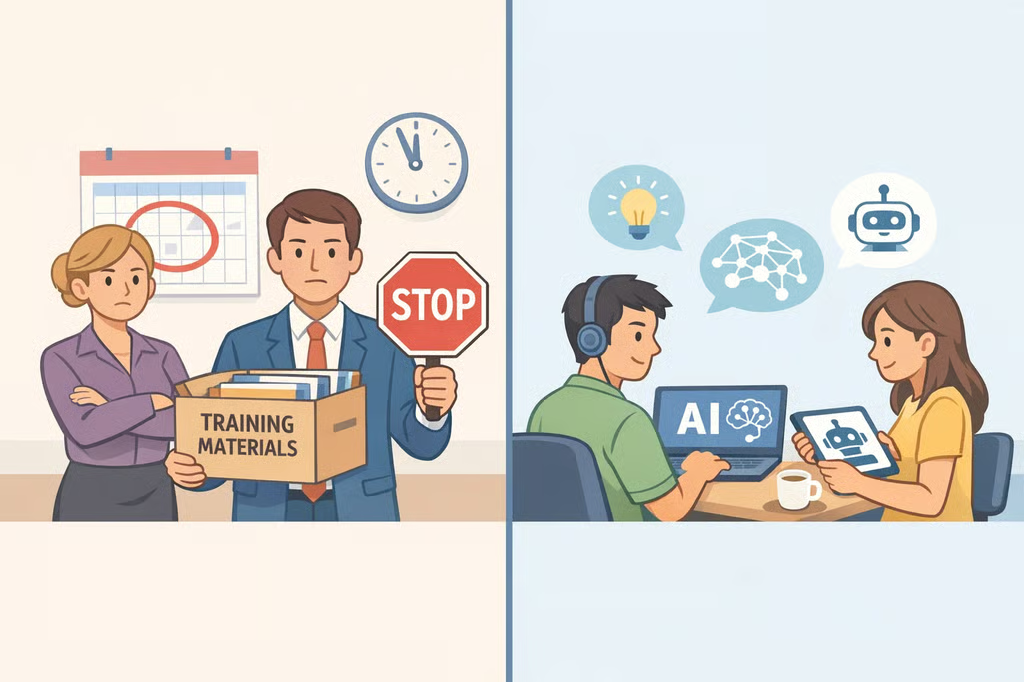
Two-thirds of leaders say they would not hire someone without AI skills, while only 39% of users have received AI training from their company and just 25% of companies expect to offer it this year Microsoft/LinkedIn reported last year. That is the split screen behind the current rush to learn AI for your career. Employers want the skill. Most are not building the classroom.
The labor market has been telegraphing that shift for years. Close to 628,000 U.S. job postings in 2024 required at least one AI skill, and the share of all postings carrying that requirement rose from about 0.5% in 2010 to 1.7% in 2024 Federal Reserve Bank of Atlanta showed in May 2025. If that sounds modest, it is only because labor markets move in the slow, unsentimental way that makes small percentages look harmless right up until they are not.
This article looks at who is being pushed to learn AI for work, why employers are signaling demand without supplying much training, and what the evidence says about who can close that gap on their own.
AI skills for jobs have quietly become a baseline
The simplest way to read the data is this: AI competency is no longer confined to the software aisle. It is spreading across the economy, unevenly but unmistakably.
The Atlanta Fed found that the share of U.S. postings requiring at least one AI skill climbed from about 0.5% in 2010 to 1.7% in 2024 Federal Reserve Bank of Atlanta reported in May 2025. Demand is still heavier in jobs that require a bachelor's degree or more, but the pattern is not limited to those roles. Postings aimed at workers with an associate degree also saw AI skill demand rise, from 0.4% to 1.4%, mostly in Computer and Mathematical occupations Federal Reserve Bank of Atlanta showed.
The lower end of the credential ladder matters too. Nearly 19% of public sector AI jobs are posted at the high school or associate degree level, compared with 9% in the private sector Federal Reserve Bank of Atlanta found. The message there is hard to miss: workers trained at two-year and technical colleges are competing for jobs where some knowledge of AI is expected.
None of this means every posting reflects a hard operational need. Some of it is aspirational hiring copy, the sort of language that makes managers feel modern. Still, the direction is clear. Employers are not describing AI as a niche specialty anymore. They are treating it as part of the job.
That is the real hinge in the story. The market raised the bar. The next question is who bothered to build a ramp.
Why employers expect workers to learn AI for work, but not much else
This is where the article stops being about demand and starts being about responsibility. Employers benefit from a market signal they helped create, then act surprised when workers have to sort out the training on their own. That is not a glitch. It is the business model, or at least the convenient version of it.
The Microsoft and LinkedIn Work Trend Index makes the contradiction plain. Nearly 80% of leaders say AI adoption is critical to staying competitive, but 60% also say their company lacks a clear vision or implementation plan Microsoft/LinkedIn reported in May 2024. Sixty-six percent say they would not hire someone without AI skills, yet only 39% of users have received training from their company and only 25% of companies expect to offer it this year Microsoft/LinkedIn reported.
Workers noticed the gap and started improvising. Three-quarters of knowledge workers now use AI at work, and 78% of AI users are bringing their own tools, a pattern Microsoft and LinkedIn described as Bring Your Own AI Microsoft/LinkedIn reported last year. That solves the immediate problem of getting work done. It also creates a familiar corporate headache, since company data does not become safer just because it wandered into a chatbot with good manners.
LinkedIn also reported a 142x increase in members adding AI skills like Copilot and ChatGPT to their profiles, along with a 160% increase in nontechnical professionals using LinkedIn Learning courses to build their AI aptitude Microsoft/LinkedIn reported in May 2024. So workers are not waiting for a neat training program to arrive. They are building the resume version of competence themselves.
The charitable reading is that generative AI has moved faster than most learning teams can handle, and nobody is sure which skills will last. The harsher reading is more ordinary. Training costs money, and passing the cost to employees is cheap. Both are true often enough to be dangerous.
Who needs AI upskilling, and who is least likely to get it
The ugly part is that the workers most exposed to automation are the least likely to retrain. That is the opposite of what a tidy labor-market story would predict, and it is one reason the “just learn it yourself” line has such obvious limits.
A peer-reviewed study published in 2025 found a negative relationship between how automatable a job is and whether a worker engages in work-related learning. The result held even after accounting for motivation, intention, and supportive workplace environments, and roughly 43% of the effect still remained unexplained European Journal of Industrial Relations reported in April 2025. The study also cited earlier cross-country research showing that workers in fully automatable jobs were more than three times less likely to have participated in on-the-job training than workers in jobs with low automation risk European Journal of Industrial Relations reported.
The sample does not suggest a workforce asleep at the wheel. Just over half of employees, 49.7%, had done nothing in the previous year to build skills in response to technological change European Journal of Industrial Relations found. That figure matters because it is not evenly distributed across all workers. It is concentrated among the people employers are already least likely to train.
The study has one important limit. Its survey data came from June 2020, before generative AI became widely available. The exact numbers are dated, but the underlying pattern is the useful part: automation exposure and access to training tend to move in opposite directions. The paper does not fully explain why. Less employer investment, less money for course fees, less time to learn, and less confidence that retraining will pay off all seem plausible. The research identifies the trap without pretending to solve it.
So the problem is not simply that some workers are slow to adapt. It is that the workers who most need AI upskilling are often the ones with the least help and the least room to absorb the cost. That is a structural problem, not a motivational pep talk.
How to learn AI for work when employers won't teach it
For workers who have time, money, and a forgiving schedule, self-teaching is possible. For everyone else, it is a nicer phrase than “good luck.”
The practical version of learn AI for your career is narrower than the marketing around it. In most nontechnical jobs, it means knowing what current tools do well and badly, using them inside an existing workflow, and being able to explain what you did and why. The credential matters less than the proof that you can use the thing without breaking the wheel.
LinkedIn’s numbers suggest that nontechnical workers are finding entry points. Enrollment in AI learning courses among nontechnical professionals rose 160% year over year Microsoft/LinkedIn reported in May 2024. That is real momentum, and it also says something awkward about the market: the easiest AI skills to signal are the most applied ones, such as familiarity with Copilot or ChatGPT, not a grand theory of machine intelligence.
That is probably where the barrier sits for most people. The workers most able to self-teach are the ones with broadband, spare hours, some tolerance for experimentation at work, and enough money to buy courses if they need them. People in automatable roles often have the least of all four. They are expected to climb the same ladder, only after the rungs have been rearranged.
For them, the advice to just keep up can sound less like strategy than a shrug. There is a difference between access and encouragement. The labor market keeps confusing the two.
What this means for careers, and for employers
The career signal is already visible. AI skills demand in job postings has grown steadily since 2010 and now reaches jobs at the associate-degree and high-school level Federal Reserve Bank of Atlanta showed in May 2025. This is not a niche demand story, and it is not confined to software teams.
The employer response has been slower and messier. Leaders say AI matters, but many have not built a plan, and far fewer have made training routine Microsoft/LinkedIn reported last year. That leaves workers to do what workers always do when the institution moves too slowly, which is improvise and hope the improvisation gets counted as initiative.
The deeper problem is inequality. The people most exposed to automation are least likely to retrain, and the research suggests missing support is part of the reason European Journal of Industrial Relations reported in April 2025. So yes, learning AI for your career is smart for individual workers who can do it. But the bigger lesson is not a self-help slogan. It is that a labor market can demand new skills without supplying them, and then act as if the resulting scramble is everyone’s personal growth plan.