
Buy Now Pay Later for Groceries: Rising Missed Payments
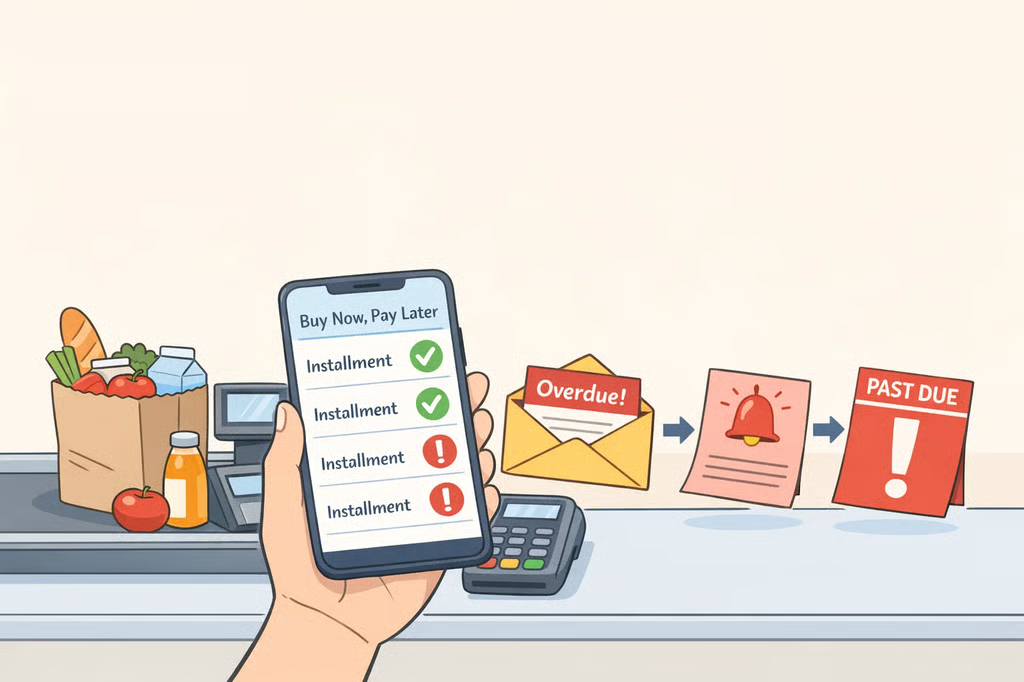
Nearly 1 in 10 working-age adults used buy now pay later for groceries in 2025, and 34.8% of those users missed a payment, according to Urban Institute findings published yesterday. That is a different kind of BNPL story from the one built around sneakers and sale tables. It is about food, which makes the numbers harder to shrug off.
The Urban Institute’s survey points to why the product is turning up in grocery carts. Just over half of working-age adults, 51.3%, said their grocery costs increased a lot in the past year, and the institute said families with low incomes and sharp price increases were the most likely to take on debt to buy food, according to the report published yesterday. Groceries are one of the biggest household budget items. When that bill climbs, families start reaching for whatever credit still works.
Why buy now pay later for groceries is spreading
The appeal is easy to see. BNPL’s pay-in-four structure is a short-term, no-interest loan, and that can look cleaner than revolving a credit card balance at rates that often run from 18% to 30%, according to the Richmond Fed in February. Split a grocery run into four installments and the bill feels smaller, at least for the moment.
That does not make it harmless. The Urban Institute found that nearly 1 in 5 working-age adults, 19.6%, paid for groceries with savings not meant for daily expenses, while 5.2% used cash from a recent payday loan, the report showed yesterday. More than 1 in 4 used a credit card for food and then ran into repayment trouble, either carrying a balance or missing a minimum payment.
The same survey shows the pressure is not evenly shared. Adults who said grocery costs rose a lot were more than twice as likely to miss a minimum credit card payment on groceries, at 12.4%, compared with 4.8% among those who saw little or no increase, the Urban Institute found yesterday. A food bill that lands on an already-stretched card is not a budgeting quirk. It is the budget talking back.
Missed BNPL payments point to tighter finances
The 34.8% missed-payment rate among grocery BNPL users is the sharpest sign that these loans are landing where money is already tight, the Urban Institute found yesterday. It is also much higher than the roughly 18% late-payment rate the Kansas City Fed reported for BNPL users overall in 2023, in research published in May 2025. Same product. Rougher terrain.
That research sketches the borrower profile in unglamorous detail. Among BNPL users who missed a payment, 96% had at least one indicator of financial constraint, and more than 15% were severely constrained, compared with just 2% of users who paid on time, the Kansas City Fed found in May 2025. Missed payments are not random noise in that data. They cluster among people already juggling too much.
Income matters too. Low- and moderate-income adults who used credit cards for groceries failed to pay the full balance more than half the time, while just over a third of higher-income adults did the same, the Urban Institute reported yesterday. That gap is about more than payment habits. It shows who is least able to absorb a price shock without borrowing their way through dinner.
One figure from the Kansas City Fed gets at the underlying fragility. 51% of BNPL users said they had no means to cover three months of expenses, compared with 28% of non-users, the Fed found in May 2025. Put bluntly, some households are using a checkout-line loan because they do not have much left to check out with.
Missed BNPL payments and grocery debt are stacking up
BNPL also rarely sits alone. In months when consumers took out at least one BNPL loan, they carried more non-BNPL debt than people who did not use BNPL that month, including $871 more in credit card balances, $5,734 more in student loans and $453 more in personal loans, according to the CFPB in January 2025. The bureau is careful not to call that causal. Already-stressed borrowers may be turning to BNPL because their other credit is maxed out. Either way, the picture is the same: one more bill on a crowded kitchen table.
Credit card utilization tells a similar story. BNPL borrowers carried utilization rates of 60% to 66%, versus 34% among consumers who never used BNPL, the CFPB reported in January 2025. That is a wide gap. A borrower already leaning that hard on a card and then adding a grocery installment plan is not creating breathing room. They are borrowing time.
Multiple loans at once are common as well. In 2022, approximately 63% of BNPL borrowers originated multiple simultaneous loans at some point during the year, and 33% did so across multiple firms, the CFPB found in January 2025. Each loan is short-term and interest-free on paper. Stack a few together, though, and it starts to look less like convenience and more like a relay race with no baton.
The broader market keeps growing, which helps explain why the product is now reaching into essential spending. The total transaction value of BNPL loans has risen by roughly 20% a year since 2021, reaching an estimated $70 billion in 2025, according to the Richmond Fed in February. The Fed said that, given the market’s scale and observed default rates, financial-stability risks still appear limited. That is fair enough at the system level. At the household level, the stress looks less tidy.
Consumer surveys cited by the Richmond Fed suggest late payments are also becoming more common. LendingTree’s 2025 survey found 41% of BNPL users made at least one late payment in the past year, up from 34% a year earlier, the Richmond Fed noted in February. The trend is not dramatic in the way a crisis is dramatic. It is more annoying than that. It keeps creeping.
What changed since 2023, and what to watch next
The biggest shift in the Urban data is not just that BNPL is being used for groceries. It is that repayment trouble has worsened since 2023. More working-age adults reported using a credit card to pay for groceries and not always making the minimum payment in 2025 than in 2023, rising from 7.1% to 8.7%, the Urban Institute found yesterday. That is not a collapse. It is a steady erosion, which can be worse because it is easier to ignore.
Two things are worth watching from here. First, the Richmond Fed said in February that Affirm’s move in 2025 to begin reporting BNPL loans to credit bureaus could extend the consequences of missed payments into credit files. Second, the Urban Institute’s work is still mostly about groceries. The same coping pattern may be showing up in utilities, medical bills and rent, but those categories remain largely unmeasured.
That is where the next evidence probably lives. For now, the grocery data is enough to show the shape of the problem: BNPL can smooth a week’s shopping trip, but for households already short on cash, it also makes the strain visible one installment at a time.