
- How AI is affecting older workers: exits to unemployment
- What the latest data says about job exits
- Why displacement hurts more after 55
- Older workers and AI job loss are not the whole picture
- What the research suggests older workers should pay attention to
- The broader lesson for how AI is changing careers for older workers
How AI is affecting older workers: exits to unemployment
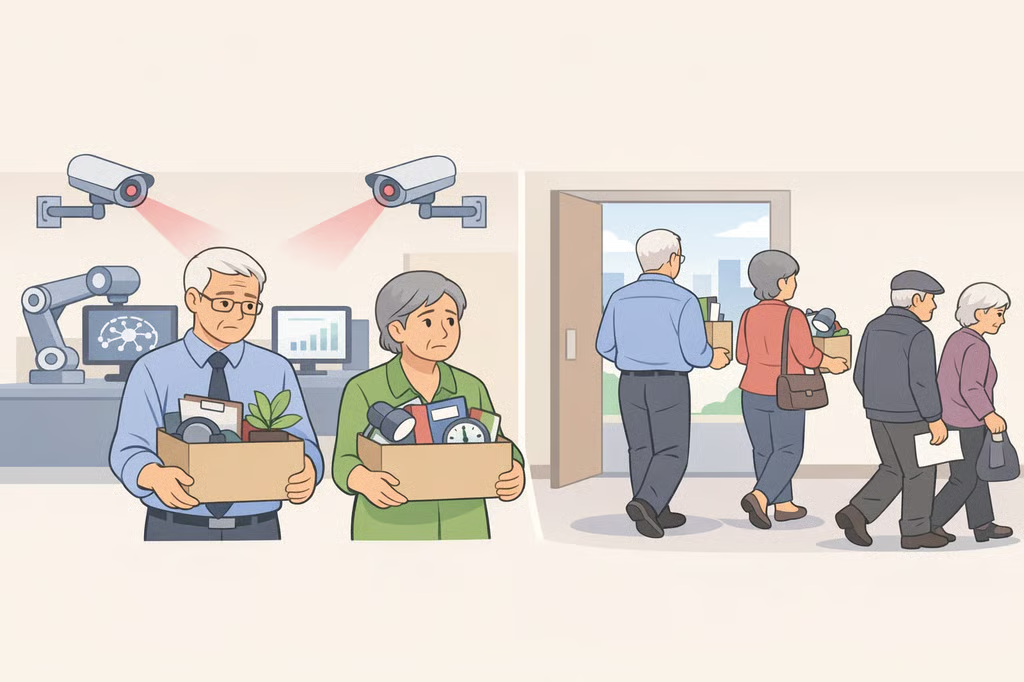
Since ChatGPT launched in November 2022, the most interesting question about how AI is affecting older workers has not been whether they are exposed. It is what happens when that exposure turns into a break in employment. A new Center for Retirement Research brief says older workers in highly AI-exposed jobs have been leaving work at higher rates since then, and those exits have gone to unemployment rather than out of the labor force, which is a different and less gentle story (Center for Retirement Research, June 30, 2026).
That is the part worth watching. Workers ages 55 and older are just as exposed to AI as mid-career workers, so there is no age-based shield built into the technology’s reach (CRR, June 30, 2026). The real divide is downstream: older workers who lose jobs tend to face lower mobility and weaker re-employment chances, so the same shock is harder to absorb late in a career (Wharton PRC, 2025).
What the latest data says about job exits
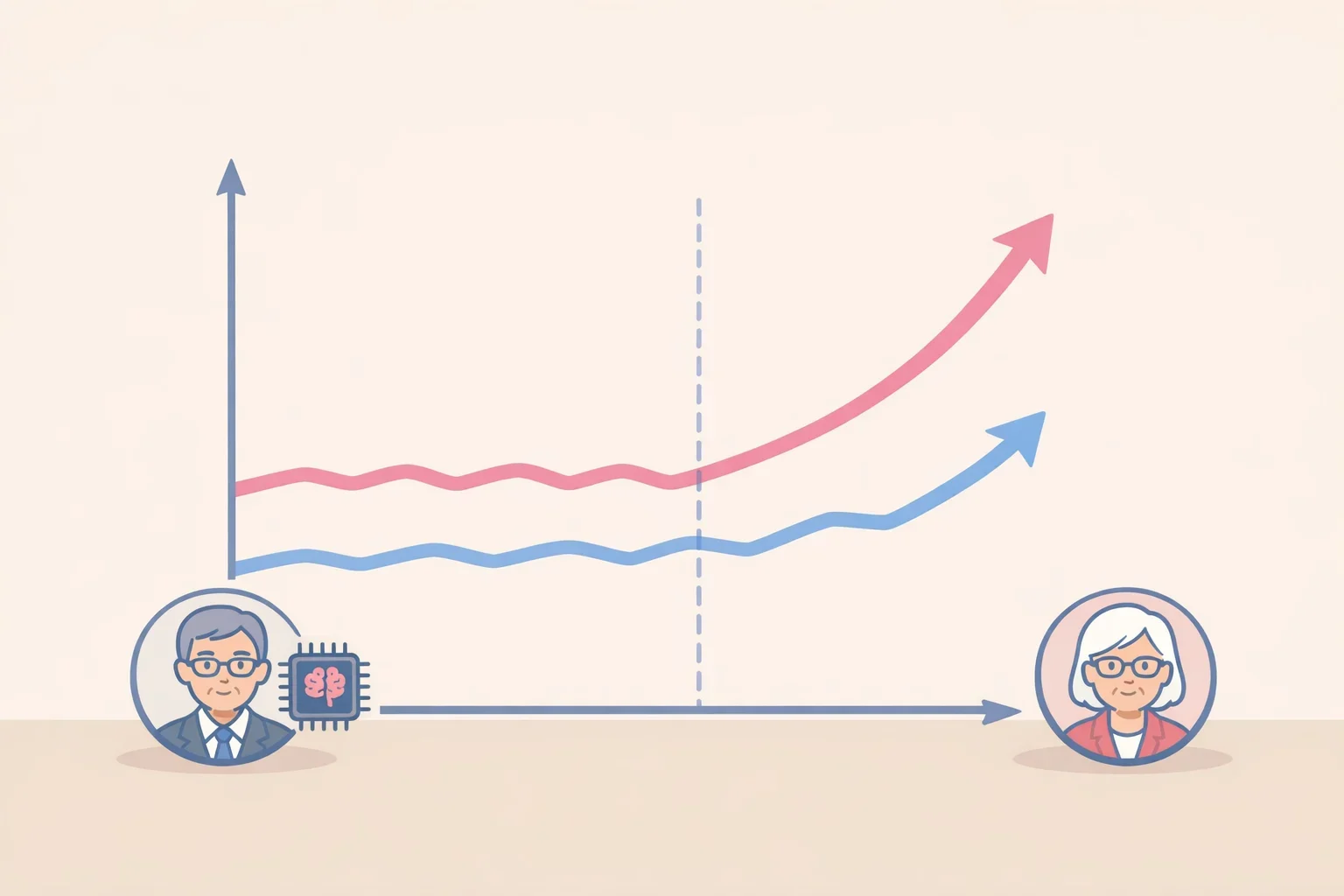
The CRR brief combines Current Population Survey data with occupation-level AI exposure scores from Tufts University’s Digital Planet Initiative, using ChatGPT’s November 2022 launch as the dividing line (CRR, June 30, 2026). Its main finding is straightforward: since the AI surge began, older workers in more exposed occupations have seen larger increases in job exits, and those exits have shown up specifically as transitions to unemployment (CRR, June 30, 2026).
The size of the change matters, but so does the comparison. CRR says painters, a low-exposure occupation, saw just a 2 percent increase in exits, while computer programmers saw an increase of over 25 percent (CRR, June 30, 2026). That is not proof that AI caused every one of those departures. It is evidence that the pattern moved sharply in the expected direction once AI arrived in the labor market conversation.
Still, the picture is not clean enough to declare victory for a simple AI-did-this explanation. Brookings says early research on AI and labor demand is still inconclusive, and one study using ADP payroll records found employment fell more for younger workers in high-exposure occupations while differences for older workers were minimal (Brookings, March 10, 2026). Another paper Brookings reviews found job postings declined more in exposed occupations, but the decline began in 2022 before ChatGPT was publicly released, which points as much to rising interest rates and broader labor-market cooling as to AI itself (Brookings, March 10, 2026).
That is the right place to put the caution tape. The CRR result is an association, not a courtroom verdict. It shows something is shifting for older workers in exposed jobs; it does not prove AI is the only force doing the pushing.
Why displacement hurts more after 55
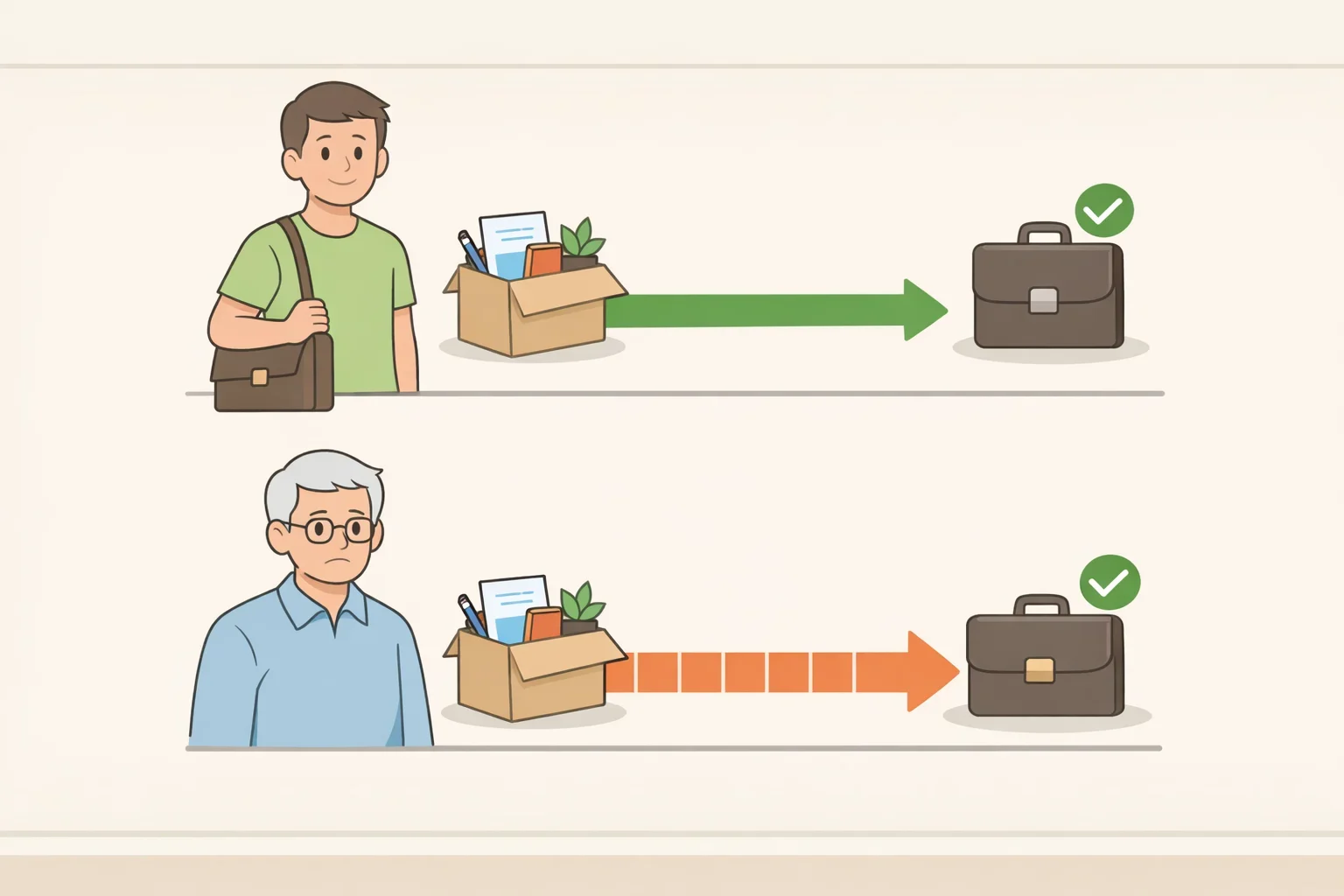
If the first question is whether AI is moving older workers out of jobs, the second is why that matters so much. Wharton’s Pension Research Council argues that older workers already have lower fluidity across employers, industries, and occupations, and that they face lower re-employment chances when they do lose work (Wharton PRC, 2025). That is the structural weakness in the story.
The gap shows up plainly in job-finding rates. Wharton says a young college-educated worker finds a job in just under three months on average, while an older one takes about two additional months (Wharton PRC, 2025). Two months is not a lifetime, but at 58 it can feel like one. Time is stingier at that end of the scale.
That is why the CRR finding matters more than the raw exit numbers suggest. The study’s own conclusion is that, since ChatGPT’s launch, older workers in more exposed jobs are somewhat more likely to exit work and move to unemployment (CRR, June 30, 2026). For a younger worker, that might be a detour. For someone closer to retirement, it can become the main road.
The demographic backdrop makes the pressure even sharper. Wharton notes that the old-age dependency ratio rose from 19 percent in 1990 to 25 percent in 2020 and is projected to reach 36 percent by 2050 (Wharton PRC, 2025). Economists and policymakers have been arguing for longer work lives for years. AI may be nudging some workers in the opposite direction at exactly the wrong moment.
Older workers and AI job loss are not the whole picture
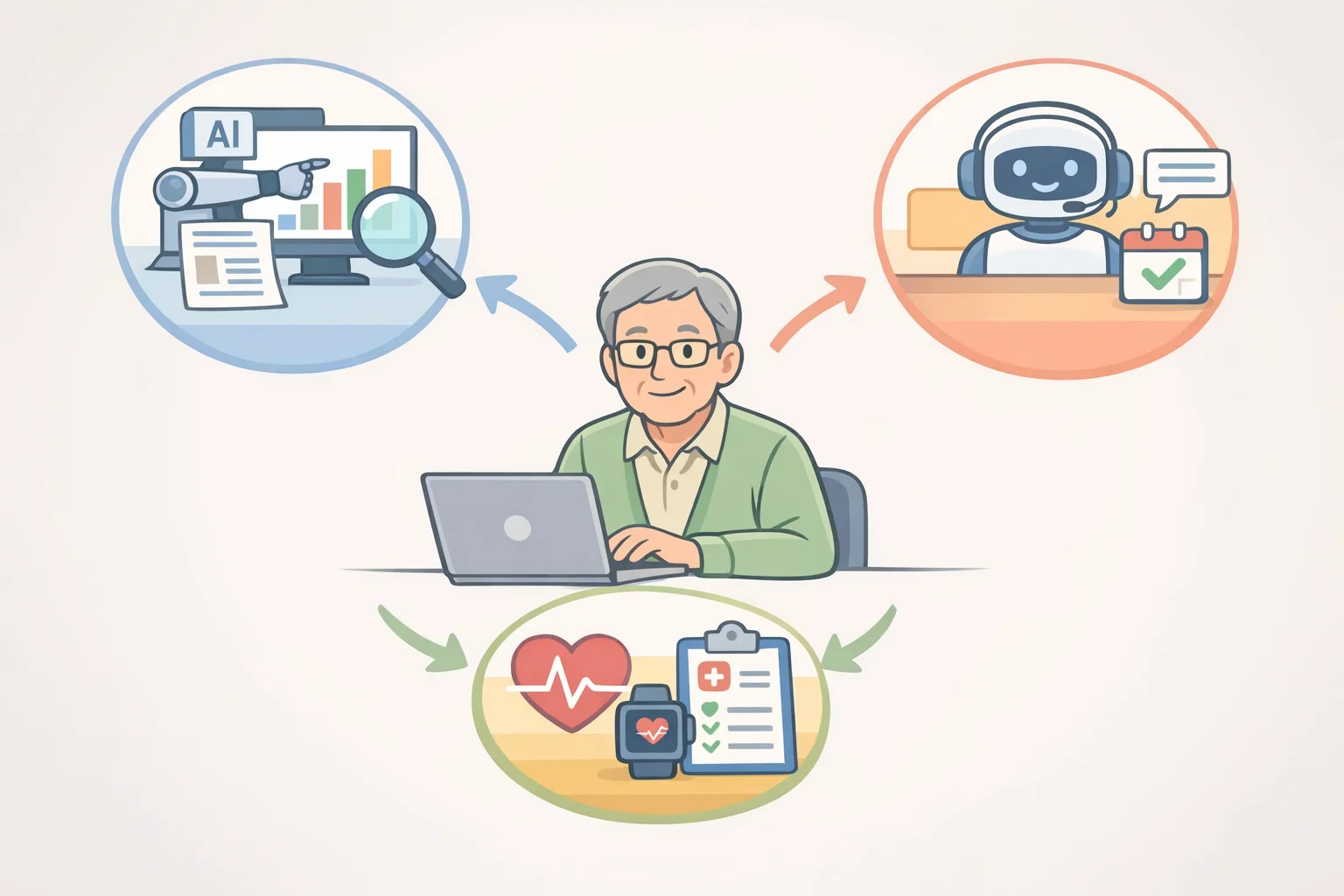
There is a catch, and it is an important one. Older workers are not simply sitting in the blast zone waiting for the next layoff memo. Wharton finds that workers age 55 and older are employed in high-complementarity occupations in larger shares than younger and prime-age workers with the same education level (Wharton PRC, 2025). In plain English, a larger share of older workers is already in jobs where AI is more likely to help than to replace.
That is the part of the story that gets flattened when AI is treated like one giant red threat meter. Complementarity means AI can boost productivity, not just subtract headcount. Wharton says workers in high-complementarity occupations are more likely to experience a productivity lift from AI, while low-complementarity roles face a higher risk of labor-demand decline (Wharton PRC, 2025).
The field also points to a more practical advantage: some of these jobs allow telework, which Wharton says lines up with senior workers’ preferences and may support longer employment at older ages (Wharton PRC, 2025). That does not sound like a revolution. It sounds like a less punishing Tuesday, which is often how labor-market change actually arrives.
AARP’s survey data, cited by CRR, captures the ambivalence. Among workers 55 and older, 18 percent saw AI solely as an opportunity, while 28 percent saw it solely as a threat (CRR, June 30, 2026). The rest presumably live in the more accurate middle. AI can be a tool, a threat, or both before lunch.
The caveat is simple. Complementarity only helps if the worker stays in the job long enough to benefit from it. If layoffs, restructuring, or early exits push someone out of a complementary role, the theoretical upside does not pay the bills. The market is not sentimental that way.
What the research suggests older workers should pay attention to
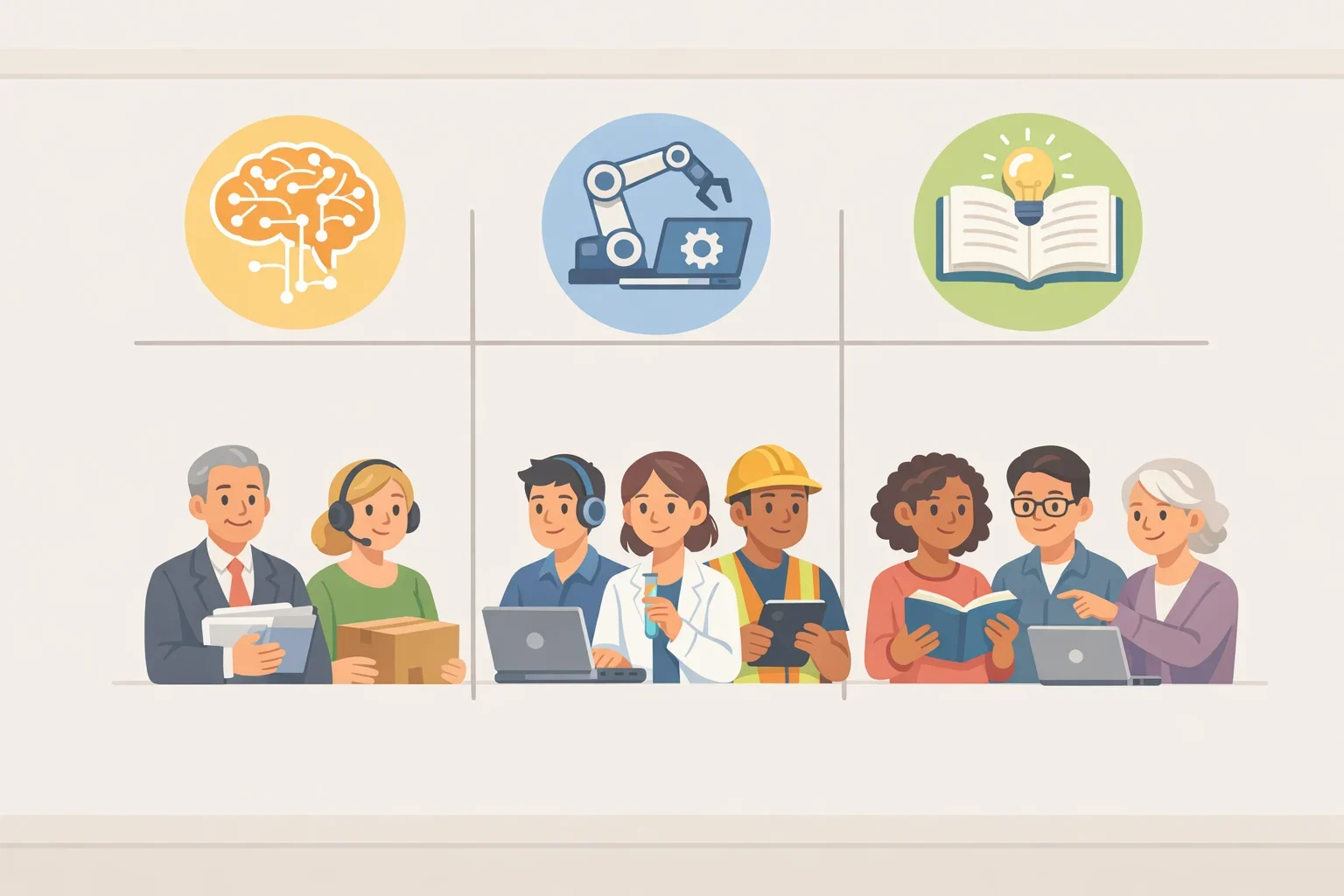
For workers in the back half of their careers, the useful question is not whether AI is coming for the whole labor market. Brookings is clear that the evidence is still early and often inconclusive, and current AI adoption remains concentrated among early adopters, with fewer than one-fifth of firms using AI in any capacity (Brookings, March 10, 2026). The better question is whether a particular role is exposed, complementary, or some uneasy mix of both.
That distinction matters because exposure and usage are not the same thing. Brookings defines exposure as the likelihood that a job’s tasks could be augmented or replaced by AI, while usage is how much people in that job are already using AI (Brookings, March 10, 2026). A role can be highly exposed on paper and only lightly touched in practice. That gap is where a lot of bad forecasting lives.
Wharton’s definition of AI literacy is useful here. It describes AI literacy as being a productive and conscious user of AI technologies, both in broad terms and in the specific context of one’s field (Wharton PRC, 2025). The point is not to become a technician. It is to understand enough to use the tool without handing it the steering wheel.
There is also a more old-fashioned kind of insurance that still matters. Older workers who are visible inside an organization, who have cross-functional relationships, and who can move between tasks are less exposed to the sudden emptying-out effect that comes with a restructuring. None of that is glamorous. All of it beats discovering that the market has decided your job is a neat idea whose time has passed.
The broader lesson for how AI is changing careers for older workers
The most careful conclusion from the current research is not that AI is wiping out late careers across the board. It is that older workers in highly exposed jobs are already showing higher rates of exit since 2022, and those exits are more likely to land in unemployment than in retirement (CRR, June 30, 2026). That is a meaningful warning sign, even if the causal chain is still fuzzy.
The other half of the story is less bleak. Older workers are also more likely than younger ones to be in complementary roles that AI can support rather than replace, and some of those roles fit the preferences that make longer work lives possible (Wharton PRC, 2025). So the threat is real, but it is uneven. That matters.
Brookings is right to keep some skepticism in the frame. The AI labor-market literature is still in the first inning, the data are incomplete, and some of the strongest-looking results may shift as adoption widens and measurement improves (Brookings, March 10, 2026). For now, though, the pattern is clear enough to deserve attention. AI exposure may be similar across ages, but the cost of being pushed out is not. Older workers have less runway, fewer transition options, and a narrower margin for error. That is where the real risk lives.