

Nurse Turnover Intention Peaks at 2–5 Years: Study
Nurse turnover intention is not just a first-year problem. A study published this month found that medical-surgical nurses with two to five years of experience reported higher intent to leave than nurses in every other tenure group measured, including those in their first year, while also scoring lowest on engagement across the board.
That matters because intent to leave is a strong warning sign even when it is not the same thing as an actual resignation. The research points to a career stage that looks quiet on the surface and is anything but.
Why nurse turnover intention spikes in the two-to-five-year window
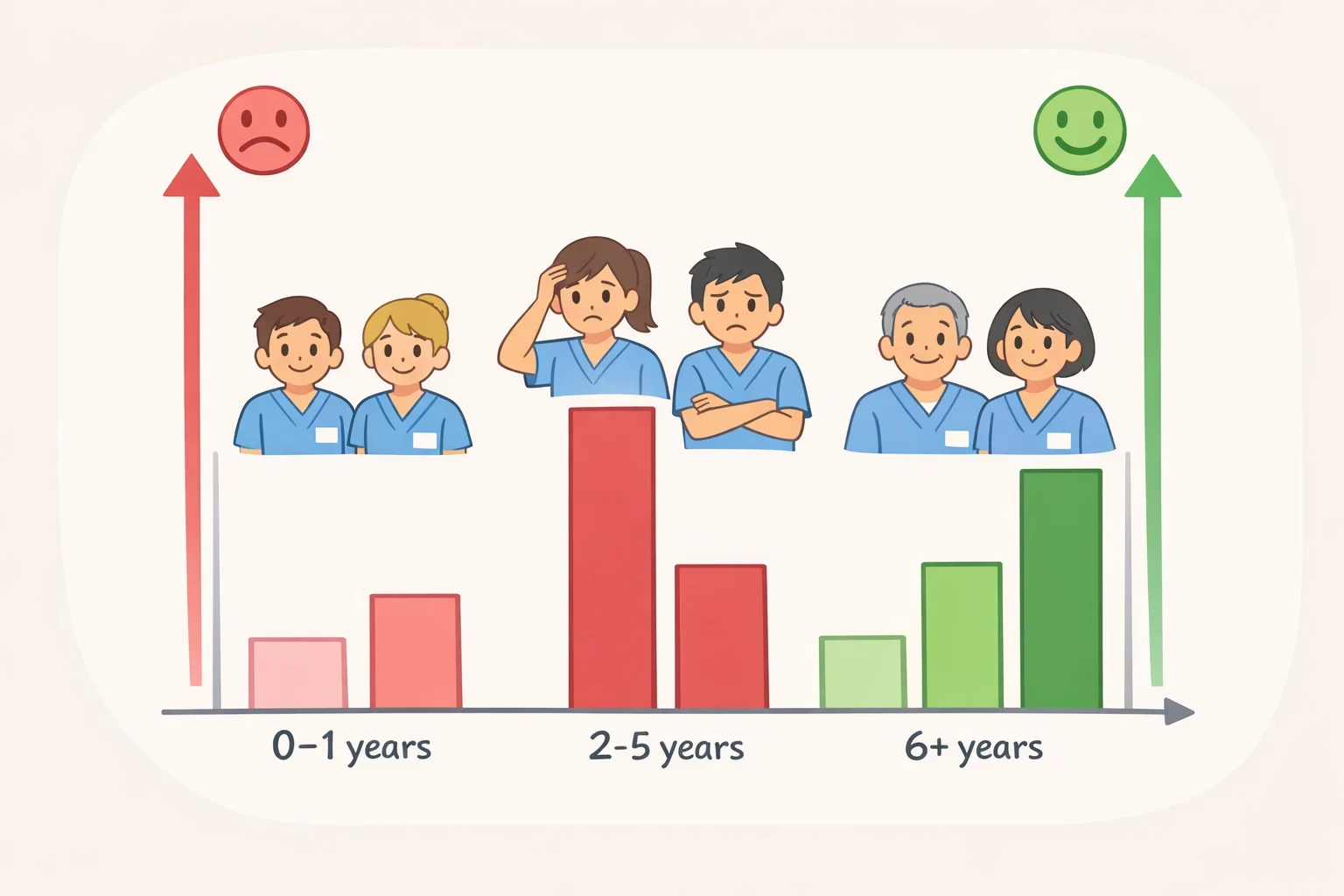
In a survey of nurses across eight acute care hospitals in a Midwest health system, nurses with two to five years of experience reported significantly higher turnover intention than colleagues with one year, six to ten years, and 21 or more years of experience, with all three comparisons statistically significant (PubMed).
The same group also scored lower on vigor, dedication and absorption, the three subscales of work engagement, compared with nurses who had 21 or more years on the job (PubMed). The study’s conclusion was blunt: nurses with two to five years of experience posed the highest risk for turnover because of high turnover intentions and low engagement (PubMed).
That does not mean every nurse in that band is about to walk out. It does mean the middle of the early career arc is doing a lot of damage quietly, long after the onboarding handouts have been filed away.
What drives job dissatisfaction nurse turnover

The two-to-five-year group sits in a sticky middle. The early shock of the first months is over, but the payoff of staying has not necessarily arrived. On the evidence in hand, the pressure comes through burnout, distress and stress rather than simple impatience.
An evaluation of the WE CARE workplace program found that higher levels of burnout and distress significantly increased the likelihood that nurses intended to leave, while greater trust in leadership and perceived organisational support were protective factors (PubMed, January 2026). The same study also reported that job satisfaction was positively correlated with a supportive work environment, recognition and trust in supervisors, and negatively correlated with burnout, compassion fatigue and distress (PubMed, January 2026).
A separate cross-sectional study of nurses in Saudi Arabia found that job stress was positively associated with turnover intention, with a regression coefficient of B = 0.357 and p = 0.012 (PubMed, May 2026). Emotional intelligence was negatively associated with both job stress and turnover intention, and the indirect effect through job stress showed partial mediation (PubMed, May 2026).
Taken together, the studies suggest that nurse engagement and turnover are linked to a fairly ordinary-looking set of workplace conditions: how stressful the job feels, whether managers are trusted, and whether nurses feel recognized rather than merely staffed.
Which nurses are at elevated risk
Demographics do not explain everything, but they do help map the terrain. An umbrella review of nursing retention studies found that being young, male, highly educated, single and without children was highly associated with nurse turnover across the literature (PMC, October 2025).
The same review also noted that educational level was one of the factors associated with turnover in several studies, and that retention is not a one-lever problem. No single intervention works in isolation, the review said; a network of strategies is needed to reduce turnover and keep nurses in place (PMC, October 2025).
A Saudi Arabian study found educational level, years of experience, nationality and working area were significantly associated with turnover intention in adjusted models, while educational level and years of experience were also associated with nurses’ perceptions of leadership styles (PubMed, April 2026). The setting is not a U.S. hospital system, so the finding should be read as a pattern, not a universal law. Still, it reinforces the idea that education and tenure matter together, not separately.
What measurably reduces nurse turnover intention

If the diagnosis is mixed engagement, stress and weak support, the response has to be broader than a pep talk. Several interventions in the research base produced measurable gains.
Meaningful recognition is one of them. A quality improvement initiative increased active unit-based recognition programs from 25% to 62%, raised DAISY Award nominations from 54 to 170, and reduced turnover rates from 22.7% to 15.7% (PubMed, February 2026). Recognition works partly because it tells nurses they are visible, which may sound small until the alternative is feeling like another name on the staffing grid.
Orientation and preceptorship also matter beyond the first days on the job. In the umbrella review, orientation programs reduced nurse turnover by an average of 18% and improved retention by 13% across 15 studies (PMC, October 2025). Three interventional studies showed turnover falling from 12% in control groups to 9% in intervention groups, and extending orientation to eight weeks for experienced nurses and 12 weeks for new hires reduced turnover by 17.6% over four years (PMC, October 2025).
Leadership style also showed up in the data. In adjusted models from the Saudi Arabian study, directive leadership, the kind that provides clear expectations and consistent guidance, was independently associated with lower turnover intention, with β = -0.15 and p = 0.022 (PubMed, April 2026). That is not a grand theory of management. It is a reminder that vague support is not the same as clear direction.
What healthcare leaders can do now

The practical lesson is fairly plain. Hospitals should stop treating turnover in the second through fifth years as a background issue that will sort itself out. It will not.
The research points to a few priorities: track engagement as closely as satisfaction; identify the two-to-five-year cohort as a retention target; build trust in supervisors and unit-level leadership; extend development beyond initial orientation; and use recognition as part of the retention strategy, not as decorative morale theater. The umbrella review is clear that effective retention depends on a mix of strategies, not a single fix (PMC, October 2025).
That mix matters because the stakes are not limited to HR spreadsheets. Nursing turnover affects retention and patient care, according to the medical-surgical study’s background statement (PubMed). The umbrella review goes further, noting that turnover places extra burdens on remaining staff, leading to burnout, job dissatisfaction and further turnover, a cycle that can jeopardize the stability and functionality of healthcare systems (PMC, October 2025).
The bigger picture
The clearest signal in the current research is timing. Two to five years in is when medical-surgical nurses in one U.S. health system showed the highest turnover intention and the lowest engagement, a combination the authors identified as the greatest turnover risk in their sample (PubMed, June 2026).
The evidence base still has limits. Much of it measures intention rather than resignation, and cross-sectional studies cannot prove cause and effect. Even so, the pattern is hard to ignore. Nurse turnover intention is not random noise in the middle of a career. It is a predictable pressure point, and hospitals have enough evidence now to stop pretending otherwise.