
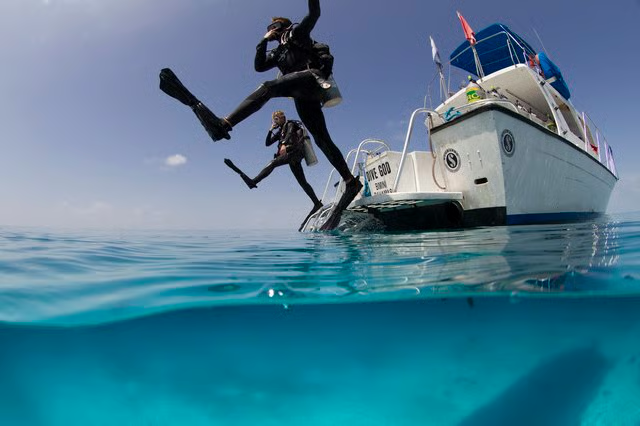


While a diver salary can be on the low side for those who work at resorts or scuba diving schools, scientific divers can earn more because they are highly trained, must earn certifications and do different kinds of technical work. Many divers work with scientific research teams as biological scientists, and the work is more rigorous. It can be more rewarding as well, especially when new discoveries are made and significantly higher salaries are offered.
Scientific Diver Certification
These commercial divers can get trained and certified by the experts at the National Oceanic and Atmospheric Association's (NOAA) Office of Marine and Aviation Operations, but this isn't an option for everyone. NOAA dives are primarily scientific in nature, but these divers also work on OSHA-regulated projects. This training isn't open to members of the public; it's designed explicitly for NOAA employees and local, state and federal government employees.
The other and more standard choice for members of the general public is to get a scientific diver certification from the educators at the American Academy of Underwater Sciences (AAUS); this program undergoes renovations from time to time, though, so requirements will change over time. They offer internships and scholarships, which can be a great help for students. Employers who hire scientific divers will want to see a NOAA or AAUS certification when considering job applicants for open positions, and not having one may limit your job prospects.
What Does a Professional Diver Do?
These divers work down deep in bodies of water, wearing scuba gear like helmets, oxygen tanks and goggles, plus communication equipment and recording devices. They maintain and monitor underwater scientific testing instruments and photographs and observe marine life and other underwater features. They also conduct tests and experiments and gather samples. Anyone who works as a commercial diver must be in tip-top shape since the work requires strength and stamina.
Not everyone can be a diver, and there aren't many people who possess the necessary abilities, skills and desire to become one. As of May 2021, there were only 2,670 of them employed in the United States. Besides being physically and mentally able to handle the work, scientific divers must have clear, concise written and verbal communication skills. They need self-discipline and patience for their detailed responsibilities and to be able to work independently and with teams.
Other professional divers work at other jobs; for example, there's a particular career for underwater nuclear welders, a specialized job that requires considerable skill. These individuals have to be diving experts. They must know how to use underwater welding equipment and work well under pressure (from the water and make essential repairs under time constraints).
Commercial Diver Salary
Commercial divers work for government agencies on water transportation and construction and demolition projects. Some also end up on projects funded by museums, sea exploration companies, environmental organizations and historical sites. The experts at the U.S. Bureau of Labor Statistics estimate that a commercial diving salary ranges from $37,130 to $160,110, with a median pay of $60,360.
The BLS also shows the states that employ the most commercial divers, and it makes sense that they are on the east and west coasts. Florida is coming in at number one, followed by Louisiana, Washington State, New Jersey, and Virginia, respectively. They also mentioned California, Alaska, Louisiana, South Carolina and New Hampshire; the highest salaries were in Washington, California and New Jersey.
Nuclear welders are likely on the higher end since the work can be more inherently dangerous. The American Welding Society estimated that these salaries could range from $100,000 to $200,000, and people who work in this capacity complete extensive training at underwater welding schools. Welders who aren't divers can earn decent livings; the median pay for this work is $87,650 a year, according to 2020 estimates.