


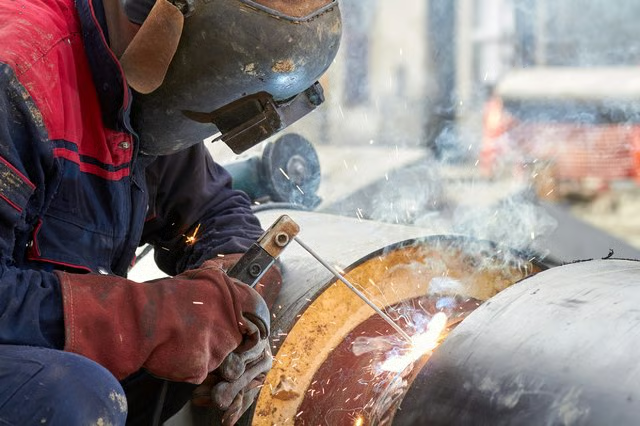

If you're interested in an exciting career that pays well, nuclear welding may be a perfect choice. Nuclear welders use electricity rather than heat to fuse similar metals. They are responsible for guaranteeing the safety of nuclear power plants and their critical infrastructure. Although there is no specific school for nuclear welding, certified welders can find work in this field relatively quickly.
Some risks associated with becoming a nuclear welder include the necessity of working with radioactive materials. However, the salary of a nuclear welder is also quite good, making it a desirable profession with nuclear welder jobs becoming available all the time.
Job Description
Nuclear welders are responsible for welding together pipes and equipment in places with nuclear components. The risk is higher or lower depending on whether those components are present when completing your portion of the job. Nuclear welders also perform routine maintenance on nuclear or radioactive equipment. They use tools that help them test connections throughout the plant or facility and help repair damaged parts of the plant.
These welders often work at nuclear power plants or shipyards, where they may work as underwater welders. Some of these jobs may be highly secretive and require a further security clearance along with the need for secret blueprints. The United States Nuclear Regulatory Commission points out that if you are denied clearance for one plant, you may still apply for other positions at different plants.
Education Requirements
While there are no formal education requirements, a few things will significantly help your chances of becoming a nuclear welder. First, it's generally recommended to obtain your high school diploma. You can also become a welding engineer, which requires much more schooling. Much of your training will be on the job, but having a solid education foundation is a good idea. Training can take weeks or months.
Several trade schools offer courses and welding certifications, though not all offer the niche of nuclear welding. There may be associate degrees available for welding. In addition to welding certifications, there are security clearances that nuclear welders may need to obtain. These are generally run through the government, which will approve or deny those applications.
Industry
The nuclear welding industry is not for the faint of heart. These welders are exposed to radiation, work in confined spaces and are subject to high water temperatures from underwater reactors at job sites. Welders of all types are in demand, with the U.S. Bureau of Labor Statistics (BLS) reporting a growth of 8 percent in the next 10 years. However, there is a slight decline in the job outlook for nuclear technicians. In any case, nuclear underwater welders have no trouble finding work with their very niche expertise.
There are a few benefits when it comes to taxes and nuclear welding. Several welding-related items, like uniforms or welding equipment, can be used as tax deductions. Make sure to consult with an accountant to ensure you're claiming everything appropriately.
Years of Experience
Typically, welders who transition to nuclear welding have many years of experience under their belt throughout their welding career. Since there are no official education requirements and no career path, nuclear welders usually have many options for work. Nuclear welders will often complete a thorough apprenticeship under a master welder. These apprenticeships teach everything from theory to practical applications.
Nuclear welders must earn safety and clearance requirements before stepping foot in an underwater reactor. Often, master welders will take apprentices under their wing in exchange for help around the shop. Welders can even climb the ranks and earn the job title of welding inspector, increasing the average salary.
Job Outlook
While the BLS reports a growth decline for nuclear technicians, the rise of job opportunities for nuclear welders is growing. While it's not the highest paying welding job, which goes to rigs welders, nuclear welder salaries are comparable. According to the BLS, welders earn an average salary of $47,010 per year, or $22.60 hourly. This figure has been up over the last decade, meaning that the market is steadily growing.
When you look at the salary for nuclear technicians, however, it rises dramatically. The average salary for nuclear technicians is $99,340 per year. You can deduce that a nuclear welder will make somewhere in the middle of those two figures.