
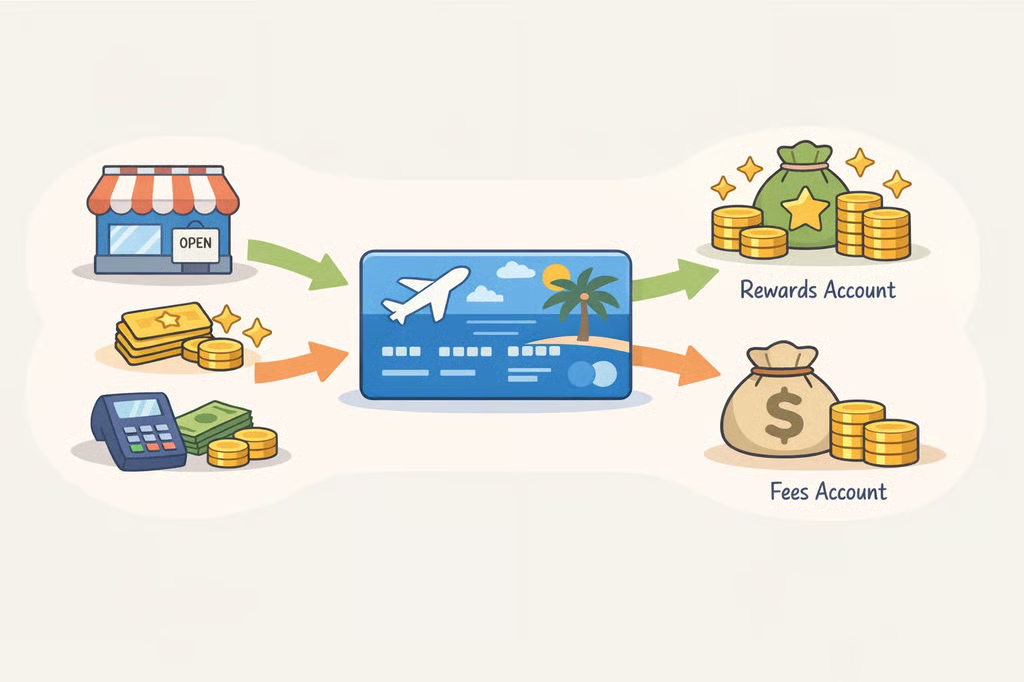
How Travel Rewards Credit Cards Make Money: The Model
The free flight on a travel rewards card is usually paid for in pieces, not out of generosity. If you want to understand how travel rewards credit cards make money, the short version is this: merchants, annual fees, and interest payments all help fund the points that look so attractive in the ad.
That matters because the marketing tells one story and the accounting tells another. Travel rewards cards are built to drive spending, keep accounts open, and pull revenue from more than one direction. American Express says as much in its Annual Report 2025, published in March, describing a model that generates revenues primarily by driving spending on its cards and secondarily through finance charges and fees.
Where the money comes from
The first and biggest source is merchant fees. When a customer pays with a card, the merchant does not keep the full amount of the sale. The payment is split among the network, the card issuer, and the merchant’s bank. The Federal Reserve’s Who Pays For Your Rewards? lays out a simple example of a $100 transaction in which the issuer keeps $2 in interchange and the merchant ends up with about $97.70 after other charges are taken out.
That may sound small, but it adds up fast. Research summarized by Northwestern’s Kellogg Insight says U.S. merchant fees currently sit at about 2.2 percent on average. For issuers like AmEx, merchant discount revenue is the largest revenue source, not an accessory to the business.
The second source is annual fees. American Express says net card fees represent revenue from annual membership fees that vary by product, and its Annual Report 2025 says net card fee revenues reached a record $10 billion in 2025, growing double digits for the 30th consecutive quarter. The same report says more than 70 percent of the 12.5 million new proprietary cards added that year were fee-paying products.
That is not an accident. Premium cards are priced to feel expensive because the fee helps support the rewards and perks attached to them. Whether a cardholder sees that fee as a burden or as a badge is partly the point.
The third source is interest income. American Express defines that as interest earned on outstanding loan balances. Across the broader credit card market, the Federal Reserve’s Credit Card Banking found that credit card lending earned a 6.8 percent return on assets, more than four times the banking sector’s average. The same paper says credit card interest rates currently average 23 percent, which is one reason a balance carried for even a month can swamp the value of a few points.
These pieces work together. Merchant fees help fund rewards. Annual fees help finance richer perks and sign-up offers. Interest income cleans up after the customers who do not pay in full.
How credit card companies make money from rewards
The rewards system works because not all cardholders behave the same way. Some pay in full every month and treat points like a rebate. Others carry balances and end up paying for the privilege of earning them.
The Federal Reserve’s Who Pays For Your Rewards? found that super-prime cardholders, those with FICO scores above 780, earn an average of $9.50 a month in rewards on rewards cards and pay less interest than they would on comparable non-rewards cards. Their net position is positive. Subprime cardholders, by contrast, earn only $1.80 in rewards but pay $6.40 more in interest than they would on a classic card.
That is the basic redistribution at work. The card looks identical at the checkout counter, but the economics are not identical once the bill arrives. The same Federal Reserve paper estimates roughly $15 billion in annual redistribution from less educated, poorer, and higher-minority areas toward wealthier, more educated ones.
The CFPB reached a similar conclusion in its Credit Card Rewards Issue Spotlight, published in May 2024. It said revolving cardholders account for 94 percent of total interest and fee payments but receive less than 30 percent of rewards benefits. That is the part of the business model most glossy brochures leave out. The rewards are marketed as a perk. The cost is distributed much more widely.
Merchants help shoulder that cost too. The Kellogg analysis says merchants generally cannot surcharge card users, so they tend to pass processing costs into prices. Cash and debit users then help pay for a system that gives them no miles, no lounge access, and no faux-sophisticated silver card to slide across the counter. Retailers are not charities, after all.
Why airlines and banks tolerate the game
The co-brand side of the business is where travel rewards get especially sticky. An airline card is not just a payment tool with a logo on it. It is a contract between a bank and a loyalty program.
In a co-brand relationship, banks bid for the right to use a merchant’s brand recognition and loyalty program to promote spending on a card product that will later generate revenue, according to the CFPB’s Issue Spotlight. The same report says issuers often make large payments to merchants for rewards and related benefits, including revenue sharing, origination bounties, baggage fees, and free nights. In plain English, the bank pays the airline so it can sell the airline’s miles to cardholders and recoup the cost later through spending, fees, and interest.
The airline gets a ready-made source of demand for its currency. The bank gets a product that is easier to market than a generic card. The cardholder gets miles that look interchangeable until redemption day, when they turn out to be tied to rules, blackout dates, and the occasional small-print headache.
That arrangement also gives the airline use. The CFPB says large co-brand partners with strong customer bases can negotiate greater concessions from issuers and may wield considerable influence over product terms, marketing commitments, and servicing standards. That helps explain why an airline can devalue an award chart and the card issuer has limited room to resist. The loyalty program matters more to the bank than any single redemption.
The complaint data points in the same direction. The CFPB says it received over 1,200 complaints involving credit card rewards in 2023, more than 70 percent above pre-pandemic levels. The common complaints were familiar: rewards devalued after they were earned, redemption blocked by technical problems or fine print, and points revoked when accounts closed.
There is also a quiet management exercise behind all of this. Banks typically amortize the cost of large sign-up bonuses over several years, expecting future interchange, interest, and fee revenue to cover the upfront expense. If a card is opened just to grab a bonus and then closed, the bank likely loses money on that account. That is why issuers use clawbacks, anti-gaming rules, and expiration policies. The game is not subtle. The terms just are.
What the points are really worth
Points are not cash sitting in a jar somewhere with your name on it. They are a liability on the issuer’s books, measured as an estimate of what the company expects to pay out later.
American Express says it records a Membership Rewards liability that represents its best estimate of the cost of points expected to be redeemed in the future. That is a useful reminder that the bank is managing a financial obligation, not storing your future vacation. The number is shaped by redemption behavior, program terms, and partner arrangements.
The CFPB says major issuers typically estimate a point at about one cent, though the actual value can vary by redemption option. That variation is the catch. A point is not a point in the abstract. It is a claim on a redemption system that can change, and often does.
This is why rewards can feel generous at the moment they are earned and much stingier when it is time to use them. The issuer wants to keep the cost of that liability under control. The traveler wants the lie-flat seat. Only one side gets to set the accounting assumptions.
What it means for cardholders
The practical lesson is not complicated.
If a cardholder pays the balance in full every month, uses the benefits, and actually gets enough value from the annual fee to justify it, the math can work. The Federal Reserve’s research shows that super-prime cardholders tend to come out ahead on rewards cards.
If a cardholder carries a balance, the math usually falls apart. A few points do not matter much once interest starts compounding at rates that average 23 percent. The CFPB’s finding that revolving borrowers pay 94 percent of interest and fees but get less than 30 percent of the rewards benefits is not a side effect. It is how the product is built.
The smarter way to think about a travel card is as a pricing package, not a gift. You are prepaying part of your own spending behavior and, in some cases, helping finance someone else’s bonus too. That does not make the card bad. It just makes it a business.
The broader debate over whether merchant fees should be capped is still open. Kellogg’s analysis says a 1 percent cap could raise total consumer and merchant welfare by about $29 billion, though it would cut network profits and shrink rewards programs. That is a policy question for another day. For now, the useful thing is simpler: the miles in your account are not free, even when they look that way on the screen.