
How Much to Invest in SCHD to Make $1,000 a Month in Passive Income
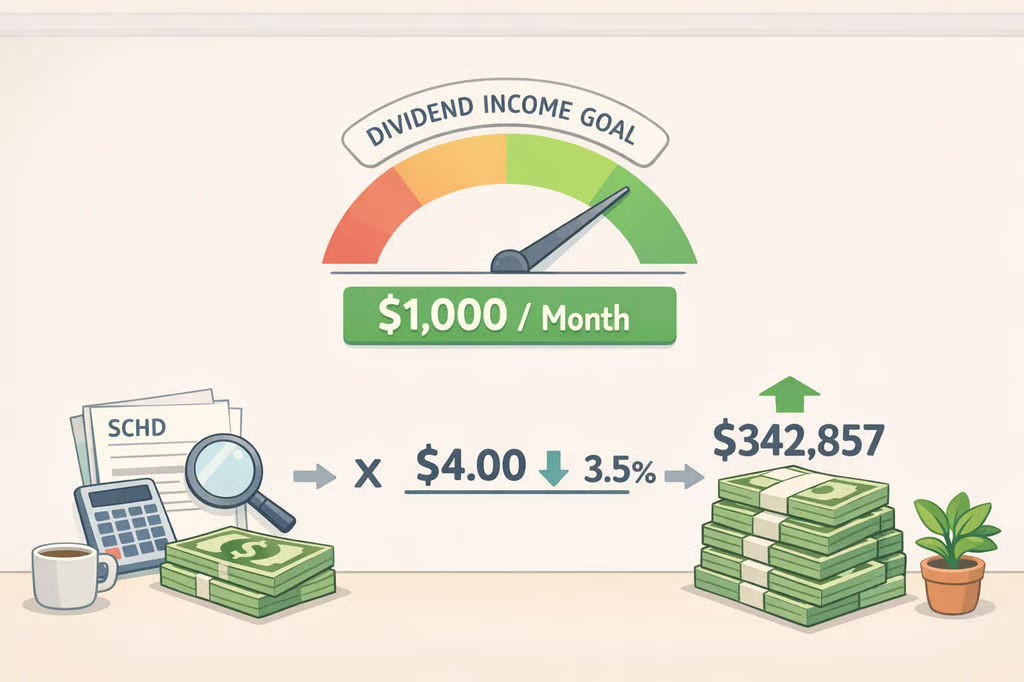
If the goal is SCHD passive income, the first number that matters is not the monthly figure. It is the annual one. $1,000 a month means $12,000 a year, and SCHD pays every three months, not every month, so the math has to be built around annual income first.
At SCHD’s current yield, that usually means somewhere around $360,000 to $380,000 invested. Stock Analysis shows a 3.18% dividend yield, while Schwab lists a 3.30% trailing 12-month distribution yield and a 3.33% SEC yield as of this week. Schwab Asset Management That spread is why the answer comes in a range, not a neat little number that behaves itself.
SCHD also has a way of reminding investors that “monthly income” is really just a budgeting convention. The fund’s last ex-dividend date was Jun 24, 2026, and its payouts land quarterly. Stock Analysis Anyone building around a monthly spending goal still needs the full annual income target first. The months are just when the cash shows up.
How many shares of SCHD to earn $1,000 per month
The easiest way to run the calculation is to start with the income target and work backward.
- $1,000 a month equals $12,000 a year.
- At a 3.30% yield, $12,000 divided by 0.033 comes to about $363,636. Schwab Asset Management
- At a 3.18% yield, the same target comes to about $377,358. Stock Analysis
That is the investing equivalent of checking the weather before leaving the house. The answer changes a bit depending on which yield gets used, but not enough to turn a six-figure sum into pocket change.
The share-count version tells the same story in a different outfit. SCHD paid $1.05 per share over the past year, so generating $12,000 annually requires roughly 11,400 shares. Stock Analysis With the fund’s 52-week range at $26.21 to $33.50, that implies a portfolio value broadly in line with the dollar estimate above. Schwab Asset Management Share price moves, of course. The market has a poor habit of refusing to sit still long enough for a clean spreadsheet.
A concrete example helps. If SCHD is yielding 3.30% and an investor wants $12,000 in annual dividend income, the required capital is about $363,636. If the yield later falls to 3.18%, the same income target would require more capital for a new buyer. Schwab Asset Management; Stock Analysis The income target did not change. The price of getting there did.
Run the math with real SCHD dividend income
The trailing dividend figures make the calculation less abstract.
SCHD’s most recent four quarterly payments were $0.2525, $0.2569, $0.2782, and $0.2604 per share. Schwab Asset Management Stock Analysis says the fund paid about $1.05 per share over the past year, and its one-year dividend growth was 2.24%. Stock Analysis That puts the fund’s income profile in a pretty ordinary place for a dividend ETF, not in miracle territory.
For planning, that means the investor is not buying a stream of equal checks. SCHD pays quarterly, and the payments vary. The December payout has tended to be larger than the others, which is why a portfolio that averages $1,000 a month in annual dividend income may still produce a lopsided cash calendar through the year. Schwab Asset Management; Stock Analysis
The practical takeaway is simple. If the portfolio is sized to generate $12,000 a year, the investor should expect roughly $3,000 a quarter, not twelve equal monthly checks. Schwab Asset Management That is the same income target, just paid on SCHD’s timetable instead of the household budget’s preferred one.
Reinvestment changes the pace, but not the basic rule. If dividends are reinvested, the account grows faster, yet the cash target is still not being paid out monthly. Reinvestment helps the income engine get bigger over time. It does not hand over neat monthly paychecks like some overenthusiastic financial ad.
What happens when the share price changes
This is where the calculator part becomes useful.
Yield is not fixed. If SCHD’s share price rises while dividends stay roughly the same, the yield falls. Schwab lists the fund’s 52-week range at $26.21 to $33.50, which is enough movement to change the yield math in a meaningful way. Schwab Asset Management
That matters for anyone trying to build SCHD monthly dividend income over time. A portfolio assembled today at one yield may need more capital later if the investor is still adding shares after the price has moved higher. The income target has not changed, but the cost of buying that income has.
A simple example makes the point. If an investor starts planning around a 3.30% yield and the yield later compresses because SCHD’s price has climbed, the number of shares needed to produce $12,000 a year rises. The reverse is true if the yield moves higher. No fund escapes arithmetic. Not even one as widely held as SCHD.
That is why dividend investors should recalculate periodically instead of treating a one-time estimate like stone tablets. The math is only as good as the yield and share price on the day it is run. A calculator is useful. A time machine would be nicer, but no one is handing those out.
What SCHD is built to do
SCHD is not a yield-maximizing fund. It tracks the Dow Jones U.S. Dividend 100 Index, and the method leans toward dividend sustainability and financial health rather than the highest payout on the shelf. Schwab Asset Management; Seeking Alpha
Morningstar says the underlying index holds 100 stocks that have paid dividends for at least 10 consecutive years and have the financial strength to keep doing it. Morningstar That is the difference between income and noise. A high yield can be easy to find. A durable one is harder.
The fund is also cheap. Schwab lists SCHD’s total expense ratio at 0.060%. Schwab Asset Management Morningstar says the fund limits each stock to 4% of the portfolio and each sector to 25%. Morningstar Those controls matter more than they sound, because concentration is where a lot of dividend stories go sour.
That quality tilt comes with a trade-off. SCHD’s yield is solid, but it is not the kind of number that lets someone retire on a modest account balance and a prayer. Morningstar says the fund has captured only 85% of the Russell 1000 Value Index’s downside since inception, and its Sharpe ratio ranked in the top decile of large-value peers over the 10 years through August 2025. Morningstar Lower drawdowns are not glamorous, but they matter when the income stream has to survive market tantrums.
That same style also explains why SCHD has had awkward stretches. Morningstar says it ranked in the bottom quartile of its peer group in both 2023 and 2024, as it lagged the big-tech boom and was weighed down by holdings such as United Parcel Service and Pepsi. Morningstar Quality funds can still look dull when the market is chasing momentum. That is the bargain investors make.
The part most income calculators skip
The headline answer is simple enough: SCHD requires a very large portfolio to generate $1,000 a month in dividend income. The more useful answer is that the income arrives quarterly, the yield moves, and the share count required to hit the goal changes with it. Stock Analysis; Schwab Asset Management
As of this week, SCHD also has a big enough base to matter. Schwab lists total net assets at $100,586,327,637.92 and shares outstanding at 3,065,700,000. Schwab Asset Management That scale helps explain why the fund keeps showing up in passive income conversations. It is not a niche product. It is one of the standard answers.
There is one more wrinkle worth keeping in view. Schwab says SCHD completed a 3-for-1 share split effective Oct. 10, 2024, and the split did not change the total value of a shareholder’s investment. Schwab Asset Management Older dividend tables can look strange if that split is ignored, which is how investors end up comparing apples, oranges, and a very confusing spreadsheet.
Bottom line
If the goal is how much to invest in SCHD to make $1,000 a month, the useful planning range is about $360,000 to $380,000 right now. That estimate comes from SCHD’s current yield measures, including Stock Analysis at 3.18%, Schwab’s 3.30% trailing distribution yield, and Schwab’s 3.33% SEC yield. Stock Analysis; Schwab Asset Management
The cash flow is quarterly, not monthly, so the real target is $12,000 a year, delivered in uneven chunks. SCHD can still be a reasonable dividend income vehicle for long-term savers, especially given its low fee and quality screen. Schwab Asset Management; Morningstar
What it is not, at least not at current yields, is a shortcut. The math is plain. The trick is deciding whether the portfolio size needed to make it work is the part of the plan that still feels realistic.