
How to find the next meme stock: A market structure screening guide
Before a stock turns into the next meme stock, it usually leaves a trail in the plumbing. Short interest, days to cover, borrow conditions, float changes, options activity, and the catalyst calendar all show up before the crowd does. This guide walks through how to spot a meme stock before it spikes, build a watchlist, and avoid confusing a real setup with a social-media fever dream.
Why chasing hype is the wrong starting point
Most people looking for the next meme stock are asking the wrong question. They want the ticker that will go viral. The better question is simpler and more useful: which crowded short has the mechanical conditions to break higher before anyone is talking about it?
The SEC’s staff report on the 2021 meme-stock episode treated GameStop less like a miracle and more like a market structure event. GME showed a confluence of large price moves, large volume changes, large short interest, frequent Reddit mentions, and significant mainstream coverage. The first three are the ones worth hunting for early. The last two are what usually show up after the fire has already started.
That is the point of this guide. In practice, a squeeze happens when short sellers are forced to buy shares back into a rising market, which can intensify upward momentum, Shares.news says this month. That makes squeeze risk a market structure question, not a storytelling question.
How to identify short squeeze stocks before they spike
Step 1: Screen for the three-factor confluence
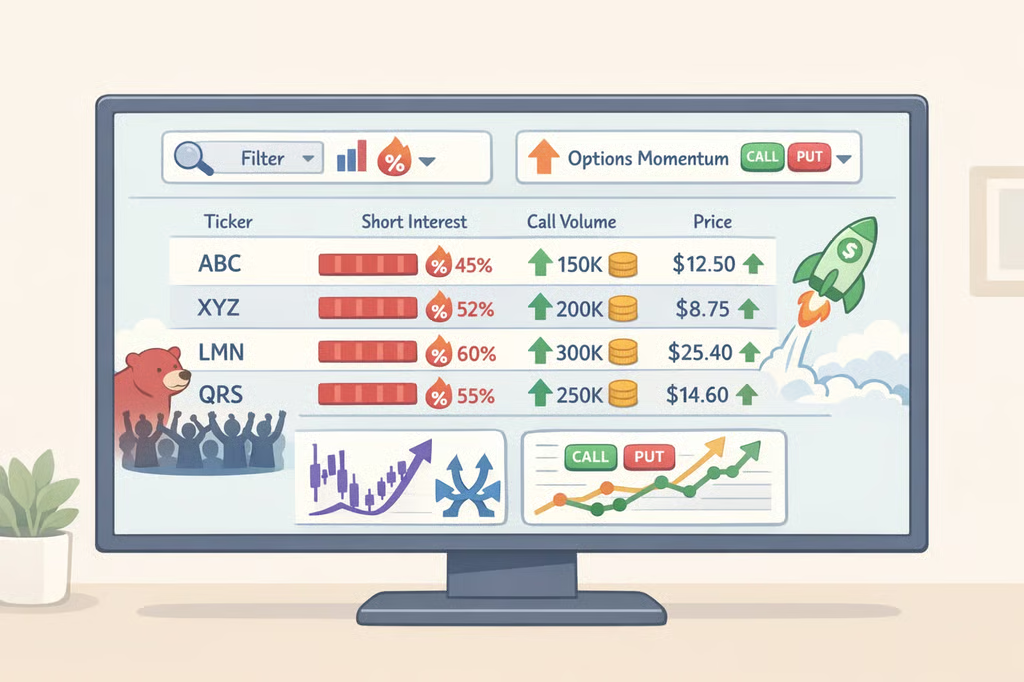
High short interest by itself is not enough. Plenty of stocks are heavily shorted for good reason, and some just drift lower because the market has already voted. The cleaner setup appears when three conditions line up together, Framler showed in April.
Start with elevated short interest. A practical screen is short interest above 15% to 20% of float, with days to cover at five or more. Days to cover estimates how long it would take shorts to buy back shares based on average trading volume, so a higher figure means a tighter exit if the stock starts running, Shares.news says this month.
Then check momentum. The stock should already be moving higher over the past one to three months, not just sitting there looking cheap. Framler found that stocks where price had already started rising over the past 30 days outperformed by about 15% over the following 60 days, while names with flat or declining momentum kept falling. The message is plain enough: momentum is the spark, not the bonus feature.
The third leg is bullish options activity. When call buying picks up, market makers may hedge by buying shares as price rises, which adds another layer of buying pressure on top of any short covering already underway, Shares.news says this month. If short interest is high but momentum is flat, or momentum is rising but options flow is bearish, the setup is weaker, Framler showed in April.
Borrow data is the other check that matters. If shorts can still borrow shares cheaply and easily, pressure to cover is lower. Rising borrow cost or shrinking share availability tells you the short is becoming harder to maintain, which days to cover alone will not show, Shares.news says this month.
Step 2: Check float quality and map the catalyst calendar
Once a stock clears the first screen, the next question is whether the float can actually snap. Float is often treated as a simple number, but in practice its quality matters, Shares.news says this month. A small float held by passive owners behaves differently from one with active sellers standing in the way. Recent secondary offerings, dilution risk, or insider lock-up expirations can expand the float and blunt squeeze potential.
Then map the calendar. This is where many traders go wrong. They screen for high short interest stocks but do not map the calendar, Shares.news says this month. Most durable squeeze setups need a reason for the market to reprice the stock, whether that is earnings, a product announcement, a regulatory decision, or a sector-wide shift.
Build that into the screen before anything gets too clever. Note the next earnings date, any pending regulatory or licensing date, and any sector catalyst that could lift peer names. A crowded short with a catalyst two weeks out is a different animal from one with nothing on the calendar for months.
Step 3: Track the setup on a weekly sheet
The same stock can move from ordinary short interest stocks territory into true squeeze risk as its float changes, average volume changes, options activity ramps, or a key event appears on the calendar, Shares.news says this month. That is why a one-time screen is not enough. The inputs keep moving while the story around the stock usually lags behind.
Keep a simple worksheet for every ticker on the list:
- Structure: short interest, float, days to cover, borrow status.
- Catalyst: next earnings date, known event risk, sector news.
- Liquidity: average volume, spread quality, options activity.
- Behavior: support and resistance, gap zones, recent reactions to news.
- Plan: what would improve the setup, what would invalidate it, and what price action would keep you out.
Once a week, refresh the list and update the basics. Shares.news recommends checking short-interest trend, float changes or corporate actions, average volume and relative volume behavior, borrow availability and borrow cost, sector strength or weakness, and upcoming catalysts within the next two weeks. That is the minimum.
Around earnings, product announcements, or regulatory dates, the checklist should get more tactical. Is the stock moving in premarket or after-hours trading? Is the move driven by an identifiable catalyst or pure speculation? Is volume tracking well above normal before the open? Are spreads widening enough to change execution risk? Is the move holding key levels or fading immediately? Those are the questions that matter when a watchlist name starts breathing.
Re-rank names whenever new short-interest data appears, borrow cost or share availability changes materially, the company announces earnings or a corporate action, relative volume jumps far above normal, the stock appears repeatedly among premarket or unusual-volume movers, or a sector-wide catalyst changes sentiment across peers, Shares.news says this month.
Once a move is under way, watch the short-interest trend. If it starts falling quickly, covering is probably happening, and that is often where the fuel starts to run out, Framler said in April.
Separate a real setup from a promotional trap
This part is not optional. The same screen that finds legitimate squeeze candidates can also catch stocks being pushed through coordinated promotion, and the difference can be hard to see when the volume is loudest.
The mechanics of a pump-and-dump are blunt. Promoters buy large amounts of inexpensive and often illiquid shares, spread false information through email, newsletters, or online forums, spark a buying spree, and then sell into the rally. Harvard Business School research published last month and covering 470 pump-and-dump schemes found that participants lose one-third of their investment, on average, HBS Working Knowledge reported. The same research also found that some investors actively seek out such schemes, with warnings sometimes functioning as buy signals rather than deterrents.
Two checks help separate structure from theater. First, ask whether the buzz is proportional to a real change in the stock, rising short interest, a new catalyst, or a genuine shift in volume, or whether it appeared out of nowhere on social media. Second, look at what is being sold. A stock promoted with vague talk about transformation, partnerships, or disruption, but no real event on the calendar, deserves skepticism.
That problem has only gotten easier to manufacture. HBS Working Knowledge says digital channels such as email, newsletters, and social media have made pump-and-dump schemes cheaper and easier to execute, and stock spam that seems more polished and credible is more likely to lure investors. Clean packaging is not the same thing as real information. That distinction still matters, annoying as it is.
What the screen gets you, and what it does not
Used consistently, this process builds a watchlist of crowded trades where the mechanics are worth your attention. That is already a better starting point than chasing whatever is loudest on Reddit or already flashing across financial TV.
It does not predict the winner. The SEC’s staff report also noted that several retail broker-dealers temporarily prohibited certain activity in some of these stocks and options as the 2021 episode unfolded, alongside clearing and settlement pressures that affected what retail investors could actually do. Even a clean setup can run into execution risk, spread widening, or trading restrictions at exactly the wrong moment.
So treat the screen as a filter, not a prophecy. Build the watchlist, review it weekly, and only get serious when short interest, momentum, options flow, float, and the calendar line up. That is the next meme stock playbook, such as it is, and it is a better use of time than waiting for a miracle to trend.