
Millennials Refusing to Care for Boomer Parents: The Real Housing and Care Story
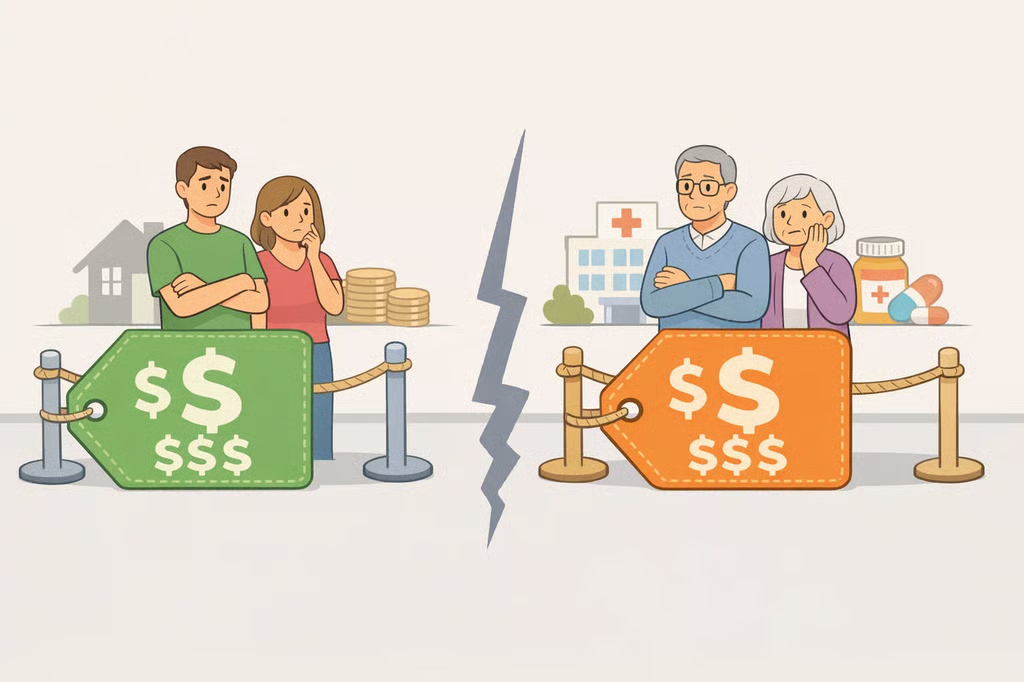
The loudest version of the millennial caregiving debate sounds like a family feud. Younger adults say they are done bailing out boomer parents. Older adults hear abandonment. That misses the real story. The phrase millennials refusing to care for boomer parents is less a moral stance than a description of how housing costs, long-term care prices, and weak public financing have cornered both generations at once.
The numbers are blunt. AARP reported this week that home care inflation has risen 7.9 percent a year over the past five years, nearly double overall inflation and more than triple the rate of medical inflation. The same report said median long-term care costs jumped significantly from 2019 to 2024, led by nearly a 50 percent increase in home care and assisted living. Families are getting squeezed from both sides, with adult children often expected to cover gaps while juggling work.
That strain is not a vibe. It is a financing problem with a social media soundtrack.
Long-term care costs have outrun the people who need them
The core problem is simple enough to state and ugly enough to linger. Long-term care has become expensive faster than older adults’ incomes, savings, or public supports can keep up. AARP reported this week that the median annual cost of home care for someone receiving 30 hours a week is $51,480, more than twice the average annual Social Security benefit of about $23,700.
That is before the higher-end costs show up. AARP said adult day services run about $26,000 a year, while a private nursing home room approaches $128,000. The median household income for adults 65 and older is around $60,000, and median financial assets for households 75 and older are about $50,000. There is not much cushion there. The arithmetic is relentless.
The squeeze lands hardest in the middle. AARP noted that middle-income older adults earn too much for Medicaid but not enough to comfortably keep pace with escalating costs. That is the trap. Too poor to self-fund. Too well-off to qualify easily for public support.
A further wrinkle matters here: the burden does not stop at the care recipient. About 60 percent of households headed by someone age 65 or older include more than one person, so the strain often lands on the whole household, not just one older adult. AARP also said family caregivers already provide most long-term care in the United States, with that labor valued at more than $1 trillion in 2024. When paid care gets out of reach, the bill migrates to the household. Often it arrives as lost hours, reduced wages, or the quiet collapse of a second income.
Geography makes all of this worse. AARP reported that care can cost as much as twice as much in states such as Maine, West Virginia and Oregon as in lower-cost states including Louisiana, Maryland, Utah and Texas. So even before a family starts arguing about responsibility, it is already living inside a map of unequal options.
The housing crisis narrows the options for millennials vs boomers housing market
The housing market does not just make people feel poorer. It changes what they can actually do. That is why this debate is not simply about attitudes toward aging parents. It is about whether younger adults have the financial slack to help, and whether older adults have the home equity or housing conditions to age without blowing up the family budget.
Start with millennials. At age 30, only 42 percent of millennials were homeowners, compared with 51 percent of baby boomers and about 60 percent of the Silent Generation at the same age, Urban Institute reported in late 2024. That matters because households that buy their first home before age 35 gain substantially more housing wealth by age 60 than those who buy later, Urban Institute found. Earlier ownership gives families more room to absorb shocks later. Fewer millennials got that head start.
The broader market has made catching up harder. Brookings reported in late 2025 that national housing stock growth slowed from 4 percent in the 1950s to 0.6 percent in the 2010s, while inflation-adjusted prices are now more than 15 percent above the previous bubble peak. AEI reached a similar conclusion in early 2025, arguing that weakened supply is central to today’s high prices. Higher rates and higher costs matter, but they do not fully explain what happened.
That shortage matters for caregiving in a very specific way. If an adult child wants to help a parent age in place, the menu is small and expensive. Move closer and absorb a higher rent. Buy or remodel a place with extra room. Cut back work hours to provide direct care. Send cash. None of those are easy when housing consumes most of the paycheck. A person without equity cannot borrow against it. A renter cannot tap it at all. Geography becomes a trap, not a choice.
The old escape hatch is also closing. Brookings reported that Phoenix’s housing stock grew at a 9.1 percent annual rate in the 1970s, but only 1.0 percent in the 2010s, nearly converging with Los Angeles at 0.5 percent. Joseph Gyourko put it plainly: if affordable, high-job-growth metros disappear, that would be the first time in American history the U.S. lacks that combination. For families, that means there are fewer places to send a relocating parent, fewer cheap metros to move toward, and fewer workarounds when a local market gets too expensive.
Older adults are not all sitting on piles of untouchable home equity either. Urban Institute reported earlier this year that the number of senior households spending more than half their income on housing has nearly doubled over two decades, rising from 5.2 million to nearly 11.7 million. By 2020, more than 16 percent of households headed by someone 50 or older were severely cost burdened, up from 11.5 percent in 2000.
The renter-homeowner split is brutal. Urban Institute found that 58 percent of older renting households lack the resources to cover median home-modification costs, compared with 27 percent of older homeowners. Only 10 percent of the country’s housing units are ready to accommodate older people. That means the common advice to age in place often assumes a house that can be adapted and a bank account that can pay for it. Plenty of households have neither.
So the housing crisis cuts in two directions. It limits the resources adult children would need to help, and it leaves many older adults with homes that are too expensive, too hard to modify, or both. The argument between generations is real, but the pressure is coming from the same place.
A policy gap dressed up as a family problem
The political history matters because it shows this was built, not ordained. Urban Institute reported in late 2024 that the postwar homeownership boom was the result of public policy, not market magic, including low-cost mortgages for veterans, FHA-backed lending, and the creation of Fannie Mae and Freddie Mac. By 1955, the VA had made more than 4 million home loans. The wealth that now cushions many older homeowners was, in substantial part, a public project.
Long-term care never got that kind of system. Medicaid covers the poorest older adults. Private long-term care insurance exists, but only a small fraction of people hold it. Between those two poles, families were left to improvise. That is why unpaid caregiving became the default financing mechanism, and why a burden of this size can still hide in plain sight.
The political incentives have also been lopsided. Urban Institute quoted researchers saying homeowners are a very, very, very well-organized political group, while renters are not nearly as coherent. That matters because housing policy shapes who builds wealth, who gets stuck, and who has the use to ask for help later. The result is a system that has been generous to ownership, stingy about care, and comfortable pretending family labor is free.
This is where the generational anger gets both sharper and less useful. Many individual boomers did not design these rules, and plenty are getting squeezed by them too, especially renters and lower-income seniors. But the resentment is not invented. Younger adults entered a housing market with less supply, less mobility, and less ownership than earlier generations, then found themselves expected to bridge a long-term care gap that policy never covered. That is not a personal failure. It is a policy inheritance.
What the debate is really signaling
The point is not that millennials are uniquely selfish, or that boomers are uniquely entitled. The point is that the family is being asked to absorb costs that used to be spread, subsidized, or simply ignored. When paid care rises faster than income and housing wealth is concentrated unevenly, refusal starts to look less like a cultural posture and more like a balance sheet.
There is one encouraging sign in the housing data. Brookings Metro Monitor reported earlier this year that of the nation’s 195 largest metro areas, 10 managed strong growth between 2013 and 2023 while keeping housing cost increases below the national average. Every one of those metros expanded housing supply faster than population growth. That does not solve elder care. It does show that housing scarcity is a choice embedded in policy, not a law of nature.
The broader fix is not mysterious, just politically awkward. AARP points to a care system that pushes families toward unpaid labor and drained savings. Urban Institute shows that older adults need more accessible homes and support for aging in place. Brookings and AEI both point to the same housing supply bottleneck. Put those together and the outline is obvious: more housing, more accessible housing, and some public financing for long-term care that does not assume the next generation can just absorb the bill.
The millennial caregiving debate is not the disease. It is the fever. The underlying illness is a system that made housing wealth for one generation, blocked it for the next, and then treated elder care as a private family chore. That arrangement was always fragile. It is getting harder to pretend otherwise.