
Do Trump Accounts Affect Student Aid? FAFSA Guidance Yet
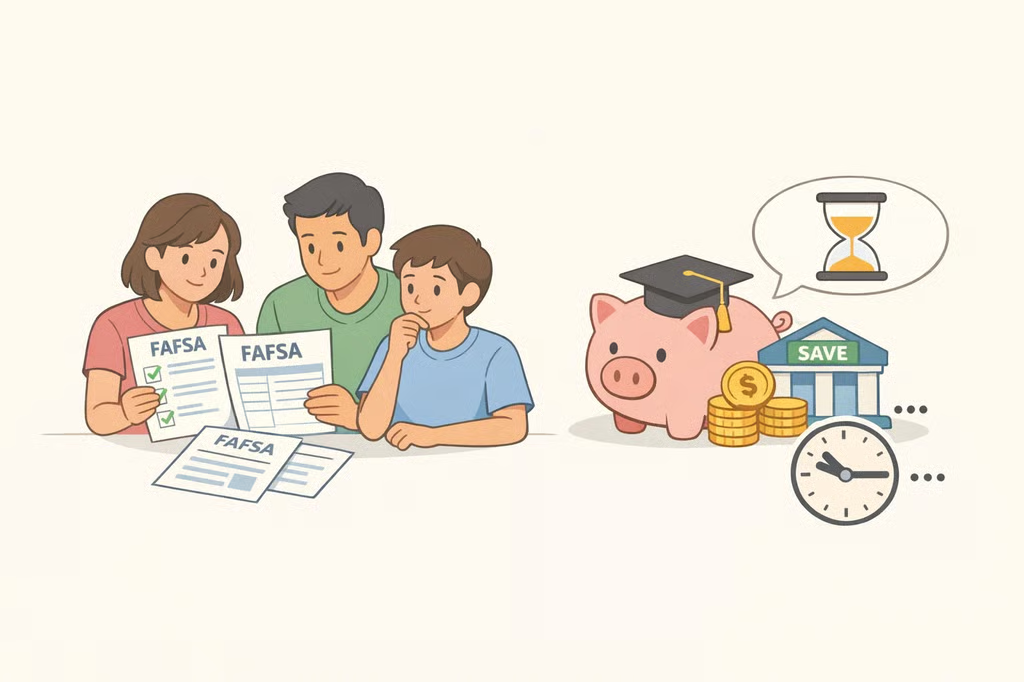
Parents opening a Trump Account now are making a bet on the future, and one of the biggest unknowns is whether that account will change student aid later. The plain answer to do Trump Accounts affect student aid is: maybe, but federal rules have not caught up.
Trump Accounts were created by the 2025 reconciliation law as a new form of traditional IRA for children, with contributions available starting July 4, 2026, according to the Congressional Research Service in June 2026. The law also created a one-time refundable tax credit of $1,000 for each qualifying child, with the U.S. Treasury to deposit the money directly into the child’s Trump Account once an authorized individual opens one, CRS reported in June 2026.
That is the practical problem. Federal student aid is one of the means-tested programs CRS says Trump Account assets, income, contributions, and withdrawals could potentially affect, yet the statute generally did not say how those accounts should be counted, CRS reported in June 2026. The result is a savings vehicle that is open for business before the rulebook for FAFSA treatment exists.
What Trump Accounts are and why FAFSA cares
Trump Accounts are treated as IRAs, which means contributions are made with after-tax dollars, earnings grow tax-deferred, and withdrawals are taxed later as ordinary income, Senate bill text, Sec. 530A said in May 2026. Think of it as a locked retirement account with a child beneficiary, not a college savings plan with a different label.
That difference matters because FAFSA does not treat every asset the same way. If a Trump Account is eventually counted like a parent asset, the aid impact is usually smaller; if it is treated like a student asset, the hit can be much harder. That classification question is the whole game.
Parents and employers can contribute up to $5,000 per year per child, indexed for inflation, regardless of household income, Brookings reported in December 2025. Employer contributions are capped separately at $2,500 a year and do not count toward employees’ taxable income, while parent contributions are not tax-deductible, Brookings reported in December 2025.
The account is also locked during the growth period. Families generally cannot withdraw funds before that period ends, except to roll the money into an ABLE account for a disabled beneficiary, and that transfer window opens only in the year the child turns 17, CRS PDF reported in June 2026. After the growth period, traditional IRA withdrawal rules apply.
Who gets the $1,000 and how the account opens
The seed deposit is not automatic. An authorized adult, such as a parent or guardian, has to open the account and make the election before Treasury sends the $1,000 directly to the child’s Trump Account, Senate bill text, Sec. 6434 said in May 2026. The election also requires Social Security numbers for both the taxpayer and the child, Senate bill text said in May 2026.
Eligibility for that one-time credit is narrow. The child must be a U.S. citizen born between January 1, 2025, and December 31, 2028, and at least one parent must have been a U.S. citizen at the time of birth, CRS reported in June 2026. So the account may be available to a child, but the credit only arrives if a parent actually takes the step to open it.
That setup can lead to very different outcomes over time. Brookings reported in December 2025 that the Council of Economic Advisers projected a balance of $303,000 by age 18 if the account receives maximum annual contributions, while the same projection puts the balance at roughly $5,800 if the child gets only the initial $1,000 seed deposit and nothing more, Brookings reported in December 2025. That gap is not a rounding error. It is the difference between a modest nest egg and real wealth.
How Trump Accounts impact financial aid and FAFSA
CRS says federal student aid is among the means-tested programs that Trump Accounts could potentially affect, including the amount a family receives, CRS reported in June 2026. That is as far as the official guidance goes for now: possible impact, no clear treatment.
The law that created Trump Accounts did not spell out how federal means-tested programs should handle them in eligibility or benefit calculations. CRS concluded that it is unclear whether or in what cases Trump Accounts will influence an individual’s or household’s eligibility for those programs, CRS reported in June 2026. No published guidance from the Department of Education or Treasury has settled the FAFSA question as of this writing.
That leaves several unresolved points that matter on a financial aid form. Nobody has said whether Trump Account balances should be reported as a parent asset or a student asset, whether earnings inside the account should count as income before withdrawal, whether education-related withdrawals would count as student income in the aid year they are taken, or how ownership should be reported on FAFSA. Those are not small technicalities. They are the formula.
A useful comparison exists. 529 college savings plans already have explicit federal treatment, and Brookings reported in December 2025 that parental 529 assets are assessed at a maximum rate of 5.64% in the federal aid formula, while qualified withdrawals do not count as income. Trump Accounts have no equivalent published treatment yet, which is why treating them like a 529 is premature.
The honest answer is also the least dramatic one. No evidence in the available research supports saying Trump Accounts will definitely hurt or definitely help a student’s aid package. Anything stronger is running ahead of the facts.
Trump Accounts and means-tested benefits: who faces the most exposure
The size of the account is what turns this from a policy question into a family budget question. Brookings reported in December 2025 that the Council of Economic Advisers estimated Trump Accounts could reach $303,000 by age 18 if maximum contributions are made, assuming medium returns, while an account that receives nothing beyond the $1,000 seed deposit would reach about $5,800 by age 18, Brookings reported in December 2025.
If regulators ultimately classify a Trump Account as an asset that FAFSA cares about, larger balances would create more exposure. That does not mean those families are doomed to worse aid outcomes. It does mean the potential effect could be meaningful, especially if the account is treated less like retirement savings and more like a countable resource.
The distributional issue is hard to ignore. Connecticut Treasurer Erick Russell said in Brookings’ December 2025 coverage that a wealthy family could build a $150,000 nest egg by the time a child turns 30, while a child from a low-income family would likely be left with about $2,500, Brookings reported in December 2025. The exact numbers matter less than the shape of the problem. The families with the biggest balances will also be the families with the most to lose if FAFSA treats the accounts unfavorably.
There is one detail that could matter later. CRS notes that Trump Accounts are locked during the growth period, except for the ABLE rollover option, which may influence how regulators think about them. Retirement accounts such as 401(k)s and IRAs are currently excluded from federal student aid asset calculations on FAFSA. Whether Trump Accounts receive similar treatment because of the IRA structure, or different treatment because the beneficiary is a child and the account has a hybrid design, is exactly the gap that Education and Treasury would need to close.
Tax Foundation analysts Alex Muresianu and Sam Cluggish concluded the accounts may not add much extra saving incentive beyond existing vehicles, Brookings reported in December 2025. That matters because families already using a 529 or custodial account will want to think carefully before switching into a new vehicle whose FAFSA treatment is still unknown.
What families should watch next
The first thing to watch is whether the Department of Education or Treasury issues guidance on how Trump Accounts will be reported and counted. That will be the real answer to the FAFSA question, not guesswork with a spreadsheet. Until then, the best answer to do Trump Accounts affect student aid is still: possibly, and the range of outcomes is wide.
Families should also be careful about comparisons. Trump Accounts are not 529 plans, even if both are designed to help children over a long horizon. They are closer to IRA-style accounts, and that makes the student aid question more complicated, not less.
The practical point is straightforward. Parents of eligible children can open accounts starting July 4, 2026, and the $1,000 credit is available only after they take the required steps, CRS reported in June 2026. But nobody should assume the account is neutral for student aid, and nobody should assume it is harmful either. The rulebook is still missing.
For now, that is the honest answer. Trump Accounts might affect student aid, potentially in a meaningful way, but federal agencies have not yet said how.