
- Trump Accounts for kids explained: who qualifies, how to claim the $1,000, and whether it’s worth it
- Who qualifies for the $1,000 deposit
- What are Trump Accounts for children?
- Trump Accounts contribution limits and tax rules
- What you cannot do with the account
- What the projections say, and why to treat them carefully
- Should you open one?
Trump Accounts for kids explained: who qualifies, how to claim the $1,000, and whether it’s worth it
Trump Accounts for kids are about to open, and the part that matters is not the political branding. It is the eligibility window, the paperwork, and the fact that this is a tightly restricted retirement account for children, not a flexible savings stash with a fresh coat of paint.
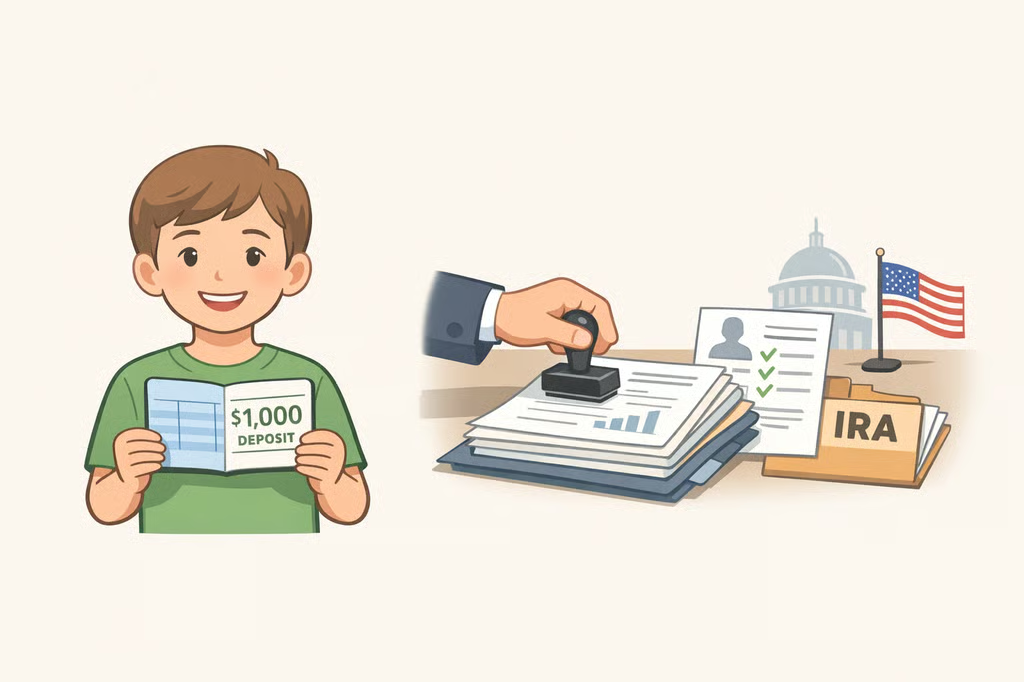
In plain English, a Trump Account is a tax-deferred IRA for children under 18, created by the 2025 reconciliation law (Congressional Research Service, June 2026). Contributions can begin on July 4, 2026 (Congressional Research Service, June 2026). The federal $1,000 seed is real, but it is not automatic.
Who qualifies for the $1,000 deposit
The one-time federal contribution is a refundable tax credit that the Treasury pays directly into a child’s Trump Account once an authorized adult opens the account and elects to receive it (Congressional Research Service, June 2026). To qualify, the child must be a U.S. citizen born between January 1, 2025, and December 31, 2028, and must have a work-authorized Social Security number (Congressional Research Service, June 2026; IRS, May 2026).
That window is narrower than the marketing slogan suggests. Children born before 2025 or after 2028 may still be able to have an account, but they do not get the federal seed contribution (Congressional Research Service, June 2026). So “for newborns” is more slogan than statute.
Nothing happens on autopilot. Households have to elect to receive the credit, and the account has to exist first (Congressional Research Service, June 2026). No election, no deposit. Washington still loves a form.
What are Trump Accounts for children?
A Trump Account is a new form of traditional IRA for children under 18, with special rules layered on top (Congressional Research Service, June 2026). Traditional IRAs usually help people save retirement income from work; this version drops the earned-income requirement so children can receive contributions even if they have no wages of their own (Congressional Research Service, June 2026).
That makes it different from the IRA most adults know. It is not built around a paycheck. It is built around time.
Authorized adults can open one for an eligible child. Vanguard says legal guardians, parents, adult siblings, or grandparents, in that order of priority, can elect to open a Trump Account by submitting IRS Form 4547 through the online portal or, at launch, through trumpaccounts.gov (Vanguard, January 2026). The IRS says the same form is the way to get started and says the process should take 5 to 10 minutes (IRS, May 2026).
Before filing, the IRS says to have a taxpayer identification number, an ID.me account, the child’s Social Security number, and the child’s date of birth and address ready (IRS, May 2026). It is not complicated, but it is administrative in the way only tax policy can be.
Trump Accounts contribution limits and tax rules
The annual contribution cap during the growth period is $5,000 in total, across all contributors combined (Congressional Research Service, June 2026). Parents, grandparents, family friends, employers, and certain governments or charities can all contribute, but the account cannot take in more than that combined limit from ordinary contributors. The cap rises with inflation after 2027 (Congressional Research Service, June 2026; IRS, December 2025).
The federal $1,000 seed does not count toward that cap (Congressional Research Service, June 2026). A qualifying child can receive the government contribution and still accept up to $5,000 a year in ordinary contributions.
The tax treatment is where people may get tangled. Contributions from individuals are after-tax and not deductible for either the contributor or the child (Congressional Research Service, June 2026; Vanguard, January 2026). That is unlike a standard traditional IRA for adults, which usually exists to shelter work income and may offer a deduction.
The benefit is deferral. Investment earnings inside the account are not taxed in the year they are earned, so they can compound without the annual tax drag that hits a regular brokerage account (Congressional Research Service, June 2026; Vanguard, January 2026). But those earnings are still taxed when the money comes out.
The source of the contribution matters too. Money contributed by individuals goes in after tax, so those contributions generally come back tax-free later, with only the earnings taxed on withdrawal (Vanguard, January 2026). Contributions from other sources, including the federal seed and employer contributions, are pre-tax, so the full value of those contributions and their earnings is taxed on withdrawal (Vanguard, January 2026).
Employers can contribute up to $2,500 per employee per year, tax-free, through a cafeteria-style program, and that amount counts toward the $5,000 annual limit (Congressional Research Service, June 2026; IRS, December 2025). State and local governments, along with 501(c)(3) organizations, may also make qualified general contributions if they give the same amount to every child in a defined group (Congressional Research Service, June 2026; IRS, December 2025).
One unresolved issue should not get lost in the small print: the law does not clarify how Trump Account balances will affect means-tested benefits (Congressional Research Service, June 2026). For families near eligibility cutoffs, that is not a minor omission.
What you cannot do with the account
This is not a rainy-day fund. During the growth period, which runs until January 1 of the year the child turns 18, withdrawals are generally prohibited (Congressional Research Service, June 2026; IRS, December 2025). Think of it less like a savings account and more like a locked investment wrapper. The money goes in, compounds, and stays put.
There is one exception: a direct rollover into an ABLE account for a beneficiary with a qualifying disability (Congressional Research Service, June 2026). That transfer can happen only in the year the child turns 17, must be trustee to trustee, and must move the full balance, not part of it (Congressional Research Service, June 2026).
Investment choices are narrow as well. During the growth period, the money must be invested in a diversified index fund of U.S. stocks, and the IRS says it intends to treat an index as “primarily” U.S. if at least 90% of its weighted value is in U.S. companies (Congressional Research Service, June 2026). Annual fees must stay at or below 0.1%, and use is not allowed (Congressional Research Service, June 2026). No sector bets, no international tilt, no clever little side quest.
At 18, the account generally becomes subject to the same rules as a traditional IRA (IRS, December 2025; Vanguard, January 2026). That means the tax treatment finally snaps into focus: pre-tax sources and their earnings are taxable, while after-tax individual contributions are not taxed again, except on the earnings they produced (Vanguard, January 2026).
What the projections say, and why to treat them carefully
The White House Council of Economic Advisers estimated that a child born in 2026 whose family makes maximum contributions could have about $303,800 by age 18 and $1,091,900 by age 28, assuming average U.S. stock market returns (White House CEA, August 2025). With no contributions beyond the $1,000 seed, the same analysis projected about $5,800 by age 18 and $18,100 by age 28 (White House CEA, August 2025).
Those figures are useful, but they are not prophecy. They assume uninterrupted max contributions and market returns behaving themselves, which markets rarely do out of politeness. Vanguard also says Trump Accounts are meant to complement other savings tools, not replace them (Vanguard, January 2026).
Should you open one?
Open a Trump Account if your child was born between 2025 and 2028, you can claim the $1,000 federal seed, and you are comfortable leaving the money untouched until adulthood. The account is also a reasonable add-on if you already have emergency savings, short-term college money, or other funds you may need before the child turns 18 (Vanguard, January 2026). In that case, the lock-up is a feature, not a trap.
Skip it, or wait, if flexibility matters more than long-term compounding. Families that may need the money for near-term expenses should think twice before parking it in an account that cannot be tapped during childhood (Congressional Research Service, June 2026). The same caution applies if the money is supposed to pay for education in the way a 529 plan is designed to do.
Age also draws a clean line. If the child was born before 2025, there is no $1,000 federal credit, though an account may still be possible. If the child is a teen with earned income, Vanguard notes that a Trump Account can sit alongside an IRA, but it does not replace the logic of using accounts built for education, retirement, or custodial transfers (Vanguard, January 2026).
The launch questions are narrower than the politics. Which institutions will actually offer the accounts, how smoothly the IRS portal will work, and how benefit programs will treat balances are the biggest unknowns still hanging over the rollout (Congressional Research Service, June 2026). For now, the rule is simple: if the child qualifies, the account can be opened starting July 4, and the seed money only arrives if someone does the paperwork.