
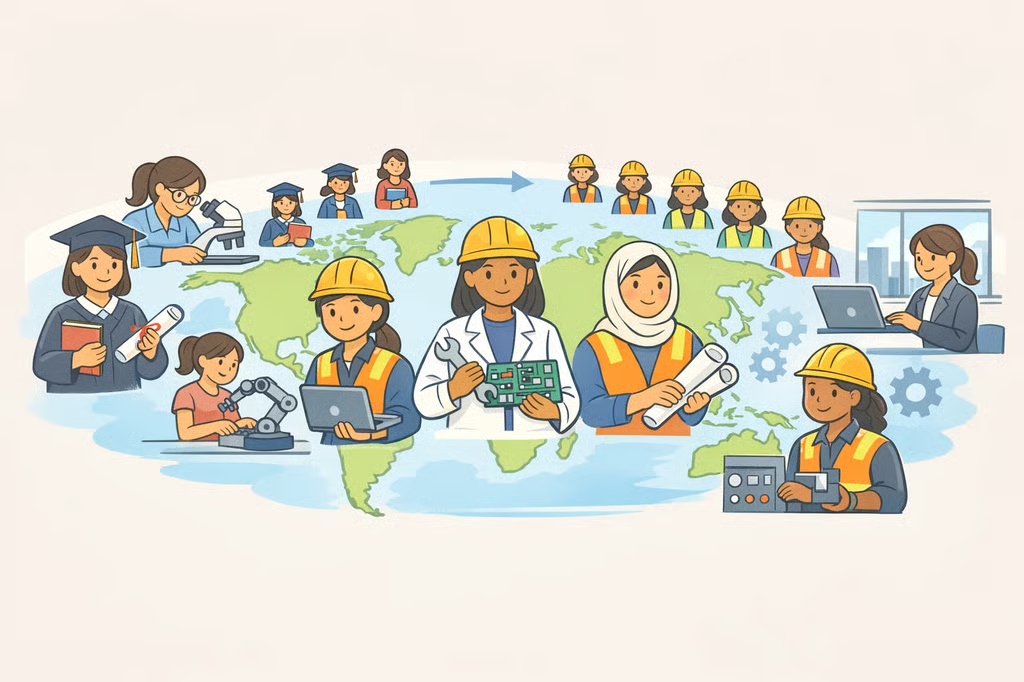
- Women in engineering statistics worldwide: how the global landscape has and hasn’t changed
- How the gap widens across women in STEM workforce statistics
- Where female representation in engineering remains weakest
- Women in engineering statistics worldwide by country
- Why workplace design changes the picture
- What the data actually say about change
Women in engineering statistics worldwide: how the global landscape has and hasn’t changed
The numbers in women in engineering statistics worldwide are best read as a proxy for the broader STEM workforce, because global engineering-only figures are harder to isolate than the headline debate suggests. That distinction matters. The best available data still show a stubborn gap: women made up 28.2% of the global STEM workforce in 2024, while they held 47.3% of jobs outside STEM (SWE, December 2025).
The pattern starts long before hiring. Women account for 35% of STEM graduates globally, a share UNESCO says has been unchanged for ten years (UNESCO, January 2026). From there, the numbers narrow again: 31.4% of researchers worldwide in 2023, and only 22% of STEM jobs in G20 countries (UNESCO UIS, March 2026; UNESCO, March 2026). The gap is not one leak. It is several.
UNESCO has also been blunt about what that means for engineering itself. Its engineering report says equal opportunity is key to building a gender-balanced profession that can help meet the shortage of engineers needed for the Sustainable Development Goals (UNESCO, January 2026). That is the real stakes line here. This is not only about representation. It is about whether the workforce building the next few decades of infrastructure has enough of the population in it to function properly.
How the gap widens across women in STEM workforce statistics
The cleanest way to read the data is as a descent. Women are present in education, present in research, and still underrepresented in jobs and leadership. UNESCO’s March 2026 release shows women at 31.4% of researchers globally in 2023, up from 29.5% in 2013 (UNESCO UIS, March 2026). That is progress, but only just. Less than two percentage points over a decade is not the kind of movement that changes an industry’s culture on its own.
Leadership is where the imbalance hardens. UNESCO says only one in ten STEM leaders is a woman, and in some countries fewer than one in ten researchers are women, with even fewer in STEM leadership roles (UNESCO, March 2026). The implication is straightforward enough: women do not disappear at a single point in the system. They are filtered out repeatedly, for different reasons at different stages.
That is why the familiar pipeline language is useful only up to a point. It explains the direction of travel, but not the mechanisms. The education data say women are entering STEM in meaningful numbers. The workforce data say they are not converting that presence into equal employment shares, and the leadership data say they are not climbing at the same rate once inside. The problem is cumulative, not linear.
Where female representation in engineering remains weakest
Sector matters. A great deal. In the industries researchers classify as “transforming sectors,” the ones central to the net-zero economy, women make up between 20% and 30% of the workforce across EU member states, far below the 46.5% share they held across the overall European labour force in 2023 (IOPscience, June 2026). Even within the same regional economy, the gap remains wide.
The energy sector shows slow movement, but not enough to change the picture. Women’s share has risen by 12 percentage points since 2013, yet women still made up only 26.7% of the total energy workforce in 2023 (IOPscience, June 2026). Globally, women hold 32% of jobs in renewable energy, compared with 22% in oil and gas (IOPscience, June 2026). Within renewables, the split is uneven again, with women at 40% in solar PV and 21% in wind (IOPscience, June 2026).
Mining sits at the bottom of the list. Women constituted just 14% of all people working in mining in 2022, the smallest share in the engineering-adjacent sectors tracked in the research (IOPscience, June 2026). That is not a rounding error. It is a sector definition written in gendered terms.
The sector split also points to a practical difference between old and newer industries. Solar PV is still nowhere near parity, but it is less closed off than extraction-heavy work. The sources do not prove why that is so. They do, however, show that the engineering world is not one monolith. Entry looks different depending on the sector, and the sector chooses back.
Proponents of the energy transition can point to renewables as evidence that change is happening. They would be right, up to a point. Critics can point out that 32% is still miles from parity, and they would also be right. The useful conclusion sits between the two: the transition is opening some doors, but it has not reset the house.
Women in engineering statistics worldwide by country
Geography complicates any easy global average. UNESCO’s March 2026 data show that Central Asia, Northern Africa, and Latin America and the Caribbean are each near 45% female researchers, close enough to parity to matter (UNESCO UIS, March 2026). At the other extreme, some countries remain below 10% (UNESCO, March 2026). The spread is too wide for any single explanation to hold.
Europe is a good reminder that even broadly similar economies can produce very different outcomes. In the transforming sectors, Luxembourg, Belgium, and Greece are at 20% female workforce representation, while Lithuania and Bulgaria are at 31% (IOPscience, June 2026). Same continent. Different results. That suggests national industrial structure, labour market norms, and policy choices are all doing real work.
The UNESCO education materials point to one lever that does seem to matter: mentorship and role models. UNESCO says role models and mentors have been found to be particularly effective in tackling gender bias, and it highlights Kenya’s annual Scientific Camps of Excellence for Mentoring Girls in STEM as a good practice (UNESCO, January 2026). In Ghana, UNESCO organized STEM Clinics to familiarize girls with STEM, build their skills in these fields and enable contact between girls and female STEM professionals who can act as positive role models (UNESCO, January 2026).
That is a narrower claim than saying participation rates have already changed because of those programs. The source does not prove that. It does show that targeted interventions are being treated seriously as part of the answer, not as decorative extras. In a field where the averages move slowly, specific programs can matter more than slogans.
Why workplace design changes the picture
Education does not explain everything. Workplace structure does some of the damage after entry, and the post-pandemic flexibility debate makes that visible. SWE reports that working-from-home opportunities increased women’s STEM employment probability by 2.43 percentage points, a 13.6% rise relative to pre-pandemic levels (SWE, December 2025). That is not a soft benefit. It is a measurable shift in who gets to stay in the field.
The preference data line up with that. Survey research across 40 countries, including the United Kingdom, Germany, Japan, Brazil, and India, found that women, especially mothers, consistently preferred hybrid or remote work more than men did (SWE, December 2025). The pattern is broad enough to suggest this is not a local quirk. It is a structural preference tied to how work and care are arranged.
Return-to-office mandates, then, are not neutral housekeeping. SWE says research warns they can raise burnout, increase attrition, and limit advancement for women, while also risking a two-tiered labour market that disadvantages caregivers (SWE, December 2025). That does not make remote work a universal fix. It does mean that workplace design is part of the gender gap, not an afterthought.
The larger point is simple. A woman who earns an engineering degree and enters the field does not vanish because she lacked ambition. She may leave because the job was built around assumptions that fit some workers better than others. That is a design problem, and design problems can be changed.
The evidence here deserves a small caution. SWE’s publication synthesizes research, and the underlying studies vary in method. The direction of travel is consistent, but the field would still benefit from more engineering-specific longitudinal work before policy makers declare the case closed. That is how grown-up analysis is supposed to work. Annoying, but useful.
What the data actually say about change
The overall picture has changed, but not enough to call it a shift in power. UNESCO’s data show women at 31.4% of researchers in 2023, up from 29.5% a decade earlier, while the STEM graduate share has stayed flat at 35% (UNESCO UIS, March 2026; UNESCO, January 2026). The workforce and leadership numbers remain lower still, and the strongest sectors in the future economy are still male-dominated (UNESCO, March 2026; IOPscience, June 2026).
That leaves three separate problems, not one. Entry is still uneven. Retention is sensitive to workplace design. Advancement remains sharply concentrated. Each needs a different fix, which is why the “just get more girls into STEM” approach sounds tidy and solves too little.
There is one useful optimism thread in the data, and it is not sentimental. The regional and sector differences are large enough to prove that outcomes are not fixed. Some places and some industries are doing better than others, which means the gap is partly made by policy, culture, and job design. Those are human choices. They can be unmade, too.