
- Gen Z work identity: employer shifts for boundaries
- Gen Z is rewriting the deal, and most employers have not caught up
- Gen Z workplace values are about boundaries, not indifference
- The “difficult generation” label is older than Gen Z
- The job-hopping myth is weaker than it looks
- What employers can actually change
- What this says about Gen Z work identity
Gen Z work identity: employer shifts for boundaries
Gen Z is rewriting the deal, and most employers have not caught up
The complaint is familiar by now: younger workers won’t stay late, won’t go the extra mile, won’t treat the job like it defines them. In June 2023, PON reported that ResumeBuilder.com surveyed 1,344 managers and business leaders, and 74% said Gen Z employees were harder to work with than older colleagues. Almost half, 49%, said it was difficult to work with them all or most of the time.
The gripes clustered around the usual suspects, effort, motivation, and, a little humorlessly for a generation that grew up online, technological proficiency. That is the story managers tell themselves. It is also too neat.
Gen Z work identity is not built around making work the center of the universe. The sources here point to something narrower and more useful: younger workers are drawing firmer boundaries, asking for clearer expectations, and judging employers by whether the job fits a life instead of swallowing it. For contractors and other employers already short on labor, that is not a mood. It is a management problem.
Gen Z workplace values are about boundaries, not indifference
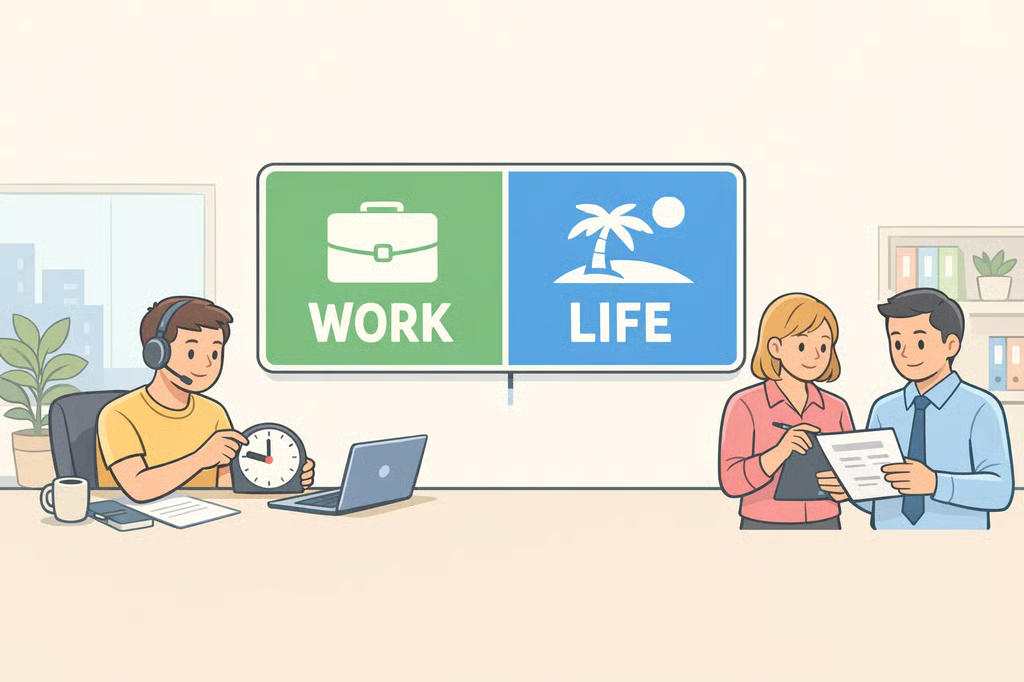
The cleanest reading of the research is not that Gen Z is lazy or disloyal. It is that this cohort has a sharper sense of separation between work and personal identity than managers are used to seeing.
Tim Elmore, in a Harvard Business Review conversation from late 2025, described Gen Z as wanting genuine connection with colleagues, meaningful work, and reassurance that they are being treated as people rather than commodities. That is his framing, not a lab result. Still, it fits the rest of the evidence better than the usual “quiet quitting” sermon.
A 2024 study in Strategic HR Review found that Gen Z has lower job satisfaction than other generations and significantly worse mental health outcomes. The same research says this group wants clear progression, clear goals and expectations, mental health benefits, diversity and equal opportunities, and regular pay reviews, while giving less weight to hybrid working than many employers assume (Strategic HR Review, late 2024). That is a fairly practical wish list. It does not read like rebellion. It reads like a cohort with standards.
The other useful wrinkle is that full remote work is the least popular option for Gen Z, and for every other generation too (Strategic HR Review, late 2024). So the issue is not that younger workers want to vanish into a screen and disappear. They want boundaries, but they also want contact. They want a job that knows where to stop.
The part managers often describe as “above and beyond” reluctance is real. The research says many Gen Z workers place enormous value on personal time and are less inclined to go above and beyond in the old, self-erasing sense (Strategic HR Review, late 2024). That is a shift in workplace expectations, not proof of a generation that does not care.
The “difficult generation” label is older than Gen Z
Before anyone declares this a uniquely Gen Z problem, it helps to remember that every new workforce cohort gets handed some version of the same diagnosis.
Harvard’s Program on Negotiation notes that the most common challenge facing newcomers is inexperience, which usually improves over time. What looks like poor effort or bad communication may actually be inadequate training (PON, 2026). That is not a flattering answer for managers, which may be part of why it tends to be ignored.
The same piece points to a familiar historical echo. Millennials, now often the people doing the complaining, were once the generation being called entitled and work-shy. PON reported this year that a 2016 Gallup report found only 29% of millennials in their twenties felt engaged at work, and many reported feeling misunderstood. The cycle is so tidy it almost feels scripted.
There is also a specific reason Gen Z may be harder to read than the cohorts before it. PON reported this year that many of these workers lacked face time and human contact at a foundational moment in their careers, and that early onsite years teach practical habits such as how to interact on a team and how to accept feedback. A 2024 longitudinal study of 1,000 respondents backs up the broader point that Gen Z’s work-related expectations were shaped mainly by cohort effects and stayed relatively stable through the turbulence of 2019 to 2022 (Economics and Sociology journal, late 2024). The differences are real. The lazy explanation is the one that fails.
The job-hopping myth is weaker than it looks
The easiest stereotype to kill here is the idea that Gen Z simply will not stay anywhere.
Research from the National Institute on Retirement Security found that workers aged 25 to 34 in 2024 had a median job tenure of 2.7 years, only slightly lower than Baby Boomers at the same age in 1983 (NIRS, September 2025). NIRS said younger workers have always changed jobs more often than older workers as they find their career path, and that pattern holds across generations.
NIRS also says the real drivers of turnover are the economy, benefits, and job opportunities, not generational differences (NIRS, September 2025). Turnover rises and falls with the state of the labor market. Public sector workers, who tend to have stronger healthcare and pension access, quit less often; manufacturing also shows better retention than retail and professional services (NIRS, September 2025). That is not a personality quiz. It is a set of incentives.
For employers, especially contractors competing for scarce labor, the point is plain enough. Retention is less about “Gen Z attitudes” than about whether the job offers career movement, decent benefits, and enough stability to make staying make sense. The research does not flatter companies here. It gives them the bill.
What employers can actually change
The evidence does not hand over a magic formula, but it does point in one direction: make the job clearer, the training better, and the deal more honest.
Job design matters more than messaging. Gen Z workers want clear advancement pathways and defined goals, not vague talk about culture (Strategic HR Review, late 2024). If a contractor cannot answer what a job leads to, or what success looks like in six months, that is not a branding issue. It is a missing structure.
Onboarding and training matter too. PON notes that what looks like a lack of effort or poor communication may reflect inadequate training rather than unwillingness. For a generation that missed a chunk of early workplace socialization, structured onboarding is not decorative. It is where the job starts to make sense.
Benefits are another lever, and not a subtle one. NIRS found that better benefits correlate with stronger retention, and that matters just as much for younger workers as it does for anyone else. Mental health support shows up repeatedly in the Gen Z research as a priority, not a nice extra (Strategic HR Review, late 2024).
There is also a management lesson in how this generation wants to be treated. Elmore says Gen Z wants to be seen as people, not commodities, while still being held to high standards and given feedback (HBR, late 2025). That is not a request for soft treatment. It is a demand for basic professional respect, which ought not to be a radical idea, though here we are.
What this says about Gen Z work identity
The useful conclusion is not that Gen Z has rejected work. It has rejected an older bargain in which work gets to consume the rest of life and still expect gratitude for the privilege.
The sources support a narrower claim with sharper edges: Gen Z workplace values tilt toward clarity, progression, mental health, fair treatment, and boundaries around personal time. They also show that many of the complaints aimed at younger workers are really complaints about newcomers who were undertrained, under-socialized, or asked to fit into systems that no longer match the labor market.
That should make employers think less about how to argue with Gen Z and more about how to design around the reality in front of them. The companies that answer the basics, what the job leads to, how people are trained, why they should stay, are likely to keep more of this generation than the ones still trying to shame them into being 20th-century employees.