
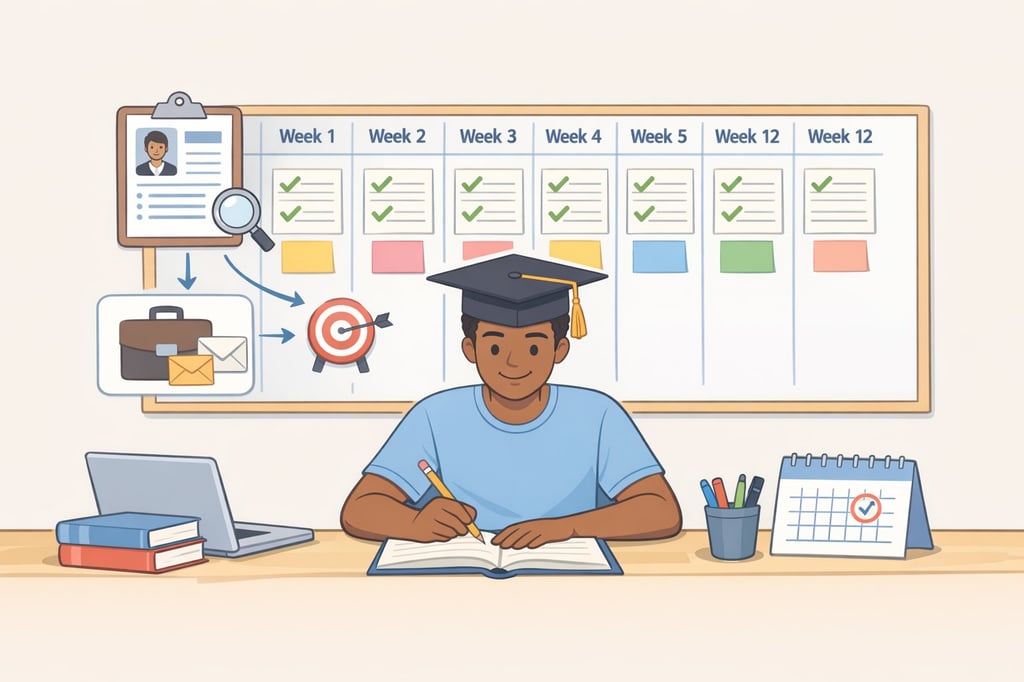
How to get a job as a new grad in 2026: week-by-week
If you’re trying to figure out how to get a job as a new grad in 2026, start with this: the usual advice is stale. By the end of this guide, you’ll have a 12-week plan for a focused new grad job search, built to help you land your first job after graduation with evidence, not optimism.
The market is rough enough to deserve plain language. Unemployment for 22- to 27-year-old bachelor’s degree holders rose to about 5.6% by late 2025, above the 4.2% overall rate, according to Entrepreneur last month. That same Entrepreneur report said full-time postings fell 16% year over year while applications per opening climbed 26%, and new graduates made up just 7% of new hires in 2024, down 25% from 2023.
The Burning Glass Institute argued in July 2025 that the problem is structural, not cyclical. AI is removing many junior tasks, staffing stayed lean after the pandemic, and the supply of degree holders keeps running ahead of degree-required openings. That means patience alone is a luxury. A job search now has to look more like a campaign.
Prerequisites: Give yourself roughly 10 to 12 weeks. You’ll also need a LinkedIn profile, access to your academic and project history, and a simple spreadsheet to track applications and outreach.
Weeks 1–2: build your target list and evidence foundation
Before you send a single application, build two things: a target list and proof that you can do the work.
Choose your targets. Pick 15 to 25 roles and companies you actually want. Treat this like research, not a wish list. Read recent company news, figure out what each organization does, and identify one real problem you could help solve.
Then sanity-check the sectors. According to Inside Higher Ed, citing NACE data in November 2025, the strongest projected hiring growth for 2026 is in miscellaneous professional services, engineering services, construction, finance, insurance and real estate, and management consulting. If your list is packed with shrinking sectors, you’re making life harder than it needs to be.
Watch the location filter too. Inside Higher Ed reported in November 2025 that more entry-level jobs are fully in-person, 50%, and only 6% are fully remote. Filtering only for remote work is a tidy way to exclude most of the market.
Rewrite your resume around proof. For each relevant experience, aim for three to five bullets that show measurable output, not just duties. “Managed social media” is a task. “Grew Instagram engagement 34% over one semester by testing post timing and format” is evidence.
That shift matters because only 42.1% of employers plan to screen GPAs in 2026, down from 73.3% in 2019, while 69.5% use skills-based hiring, according to Inside Higher Ed in November 2025. GPA is no longer the main gatekeeper. It may still show up. It is no longer the whole show.
For each target role, build a one-page skills proof sheet. Keep it simple:
- Role title and company
- Three projects you’ve done
- The tools you used
- The outcome, with numbers where possible
- One line on why it fits this role
Think of it as a cheat sheet for your own memory. When an interview starts drifting toward vague adjectives, this keeps you anchored in facts.
Clean up your digital footprint. Hiring managers Google candidates, and College Recruiter said this month that they check LinkedIn profiles, personal websites and social media accounts before interviews. Make your online presence look like one coherent person with a direction. Fix old bios, odd headlines and any profile gap that makes you look unfinished.
Weeks 3–8: apply strategically and activate your network
Once the target list and evidence are in place, the job is to get in front of actual humans, not just feed the void on a job board.
Apply like a scalpel, not a hose. Send five to ten strong, tailored applications each week. College Recruiter recommends that range, and it is a lot more sane than blasting out 50 rushed applications. Each application should point to something specific about the company and connect one piece of your proof sheet to a real need.
Use a tracker with columns for company, role, date, contact, status and next step. Apply early in the week when you can. College Recruiter notes that Mondays tend to get the most views, and hiring, for once, does not reward procrastination.
Make the resume legible to the machine. More than 97% of Fortune 500 companies now use AI-powered screening tools, according to LinkedIn Pulse in January 2026. That same source said recruiters who do engage spend 5 to 7 seconds scanning a CV before deciding whether to proceed.
So keep the file clean. Use standard headings, submit a machine-readable PDF or DOCX, avoid graphics and tables, and mirror the language of the job description where it accurately reflects your experience. The goal is not to trick the system. It is to make the system stop tripping over your resume.
Work your network like part of the job. Cold applications land you in a pool of thousands. Referrals put you in a pool of five, and referred candidates are 5 to 10 times more likely to get hired, according to LinkedIn Pulse in January 2026.
For each target company, find someone who moved from a background like yours into a role like the one you want. Then send a short note. Not a plea. A note.
Try this:
Hi [Name], I’m a recent grad interested in [role] at [company]. I noticed your work on [specific project or team detail], and it seems close to the kind of work I want to do. I’d love to ask one question about how you got started there and what skills mattered most in the first few months. If you’re open to a quick conversation, I’d really appreciate it.
That message works because it is specific, respectful and brief. College Recruiter recommends reaching out to about five alumni or professionals a day and following up within 24 hours after any conversation. That’s not networking theater. It is repetition.
Publish one useful piece a week. It can be a short analysis, a class project turned into a post, a screen recording, a write-up of what you learned, or a portfolio sample. College Recruiter says to write or record something useful once every seven days for 12 weeks. That gives you 12 pieces of professional evidence, enough for a hiring manager to scan your work in roughly eight minutes, also per College Recruiter.
If coursework is all you have, translate it into work. A class presentation can become a one-page brief. A final project can become a short case study. A lab report can become a clean summary of the problem, method and result. What matters is that the artifact looks like it belongs in the real world, not just on a grading rubric.
Treat AI like a field skill. Inside Higher Ed reported in November 2025 that about 13% of jobs require AI skills and 10.5% of entry-level jobs include AI in their descriptions. You do not need to become an AI engineer. You do need to know which tools matter in your lane and be able to say how you have used them.
Weeks 9–12: build a work sample and judge the offer
The last stretch is about proof under pressure and deciding whether an offer is actually worth taking.
Produce one real work sample. College Recruiter suggests a ride-along, a job shadow or a weekend project. Pick one that fits your field and gives you something tangible to show. A sample you made under conditions that resemble the job says more than a polished resume ever will.
If you need a faster signal, make one thing small and useful. A short analysis. A mock client brief. A process map. A screen share. College Recruiter also says to record a 90-second screen share for each target role. That is a tidy way to show how you think without making a manager sit through a seminar.
Prepare for interviews with examples, not adjectives. Employers want skills demonstrated, not described. For every claim on your resume, have a specific example ready. If the company has a visible challenge or initiative, prepare a short answer about how you’d contribute in the first 30 days.
College Recruiter also recommends proposing a 30/60/90-day plan with two SMART goals and how you’ll get feedback weekly. That is useful because it forces you to think like someone who expects to be measured, which is often exactly what entry-level hiring managers want to see.
Check the employer, not just the logo. First employers matter. College Recruiter says graduates who choose culture-strong first employers tend to accelerate faster than those who chased brand names or compensation alone. That does not mean brand and pay are irrelevant. It means they are not the whole spreadsheet.
Before you accept, look on LinkedIn to see whether people who started in entry-level roles are still there three years later. If they moved up, that’s a sign the company actually develops people. In interviews, ask managers, “Can you share an example of how someone on your team was recently recognized for their work?” College Recruiter recommends that question, and it tells you more than the job posting ever will.
A quarter of employers plan to increase hiring in 2026, mainly because of succession planning and the talent pipeline, according to Inside Higher Ed in November 2025. That means some companies are still hiring with growth in mind. Those are the ones worth finding.
What you should have by the end
Run this plan for 12 weeks and you should end up with a tighter target list, a resume built around measurable output, a clean digital presence, a network of actual contacts, a steady stream of public work and at least one sample you can walk through in an interview. That is a much stronger position than spraying applications and hoping a recruiter feels generous.
The market is not pretending to be friendly. The Burning Glass Institute laid out the structural reasons in July 2025, and Inside Higher Ed showed in November 2025 that employers are still cautious, selective and split between holding steady and hiring modestly. But the openings are there.
Start with one target list today. Then build the proof sheet. The graduates who move first tend to move best.