
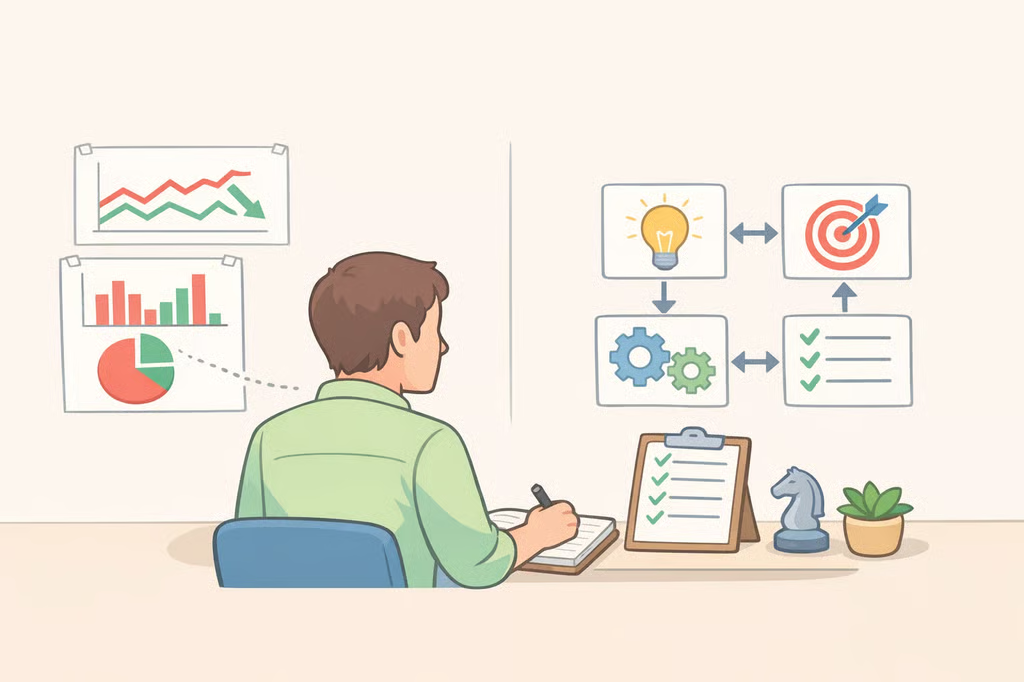
How to Stop Comparing Yourself in Business: A Framework
The problem with watching everyone else
Most business owners who obsess over competitors think they’re being disciplined. In practice, they’re usually borrowing trouble. If the question is how to stop comparing yourself in business, the answer is not to stare harder at the market. It is to get clearer about what your own business actually does well.
The evidence points that way too. McKinsey’s survey from earlier this year of more than 1,250 executives and managers found that top economic performers are more than 2.5 times as likely as others to say their organizations have a fully aligned understanding of their competitive advantage across the business (McKinsey, January 2026). The same survey found that the majority of organizations are not actively validating or managing that advantage, even though eight in ten respondents say they’re at least somewhat confident they understand it (McKinsey, January 2026).
That gap is where the comparison trap lives. It feels like strategy because it looks outward. It usually ends up replacing the harder work of figuring out why customers choose you, what they value, and where your edge actually holds.
How to stop comparing yourself in business without ignoring competitors
The trick is not to go blind to the market. It is to stop using competitors as a substitute for judgment.
A competitor brand analysis is a structured way to research and evaluate companies with similar products or target users as yours, and a pivotal part of that process is customers’ perceptions (Shopify, June 2026). That is a very different exercise from doomscrolling rival launches and wondering why someone else’s feed looks shinier.
Shopify’s guidance is refreshingly plain. For detailed reports, it recommends focusing on three to five competitors, using specific goals, and looking for unmet consumer needs rather than copying whatever happens to be working for someone else (Shopify, June 2026). The point is not to admire the competition. It is to learn where the market is still annoyed, underserved, or simply waiting for someone to do the job better.
The cautionary tale from HBR makes the same point in a different register. In a May article, the authors described Microsoft’s stack-ranking culture, where employees knew who the previous cycle’s winners were and copied them instead of focusing on the competition or on customers (HBR, May 2026). That is not healthy ambition. It is office politics with a metrics dashboard.
Why the comparison trap hurts business growth
Comparison becomes a business problem when it starts setting your priorities. It does not just distort confidence. It distorts resource allocation.
McKinsey found that most companies still track the drivers of their economic performance and competitive advantage only at aggregate levels, which means early warning signs can get flattened out and missed (McKinsey, January 2026). Top economic performers, by contrast, are nearly twice as likely as peers to monitor performance measures that are more detailed than just the business unit or geography level, looking instead at the intersections within the business (McKinsey, January 2026). They are not guessing. They are looking where the signal lives.
That matters because competitor watching often pulls attention away from the numbers that actually tell you whether your business is healthy. If a founder is spending an hour every week tracking a rival’s content cadence, that is an hour not spent looking at customer feedback, pricing response, or where the product is failing quietly. There is nothing noble about that trade.
HBR also describes a second trap worth naming: uniqueness bias, the tendency to believe your situation is more singular than it really is (HBR, March 2025). In business, that can make leaders dismiss useful comparisons entirely. So the answer is not “ignore everyone else.” It is “compare with purpose.”
A practical framework for Monday morning
A useful competitor habit should help you make one decision, not produce a pile of notes you never read again.
Here is a simple sequence that fits the research:
- Pick one decision that actually matters this month, such as pricing, positioning, or which segment to serve next.
- Ask customers what they value most and what they would pay more for, since McKinsey says top performers validate their advantage with market-level external data and customer input (McKinsey, January 2026).
- Choose three to five direct competitors and study them with a specific question in mind, not a vague urge to “see what they’re doing” (Shopify, June 2026).
- Look for unmet needs, especially places where customers are annoyed, overcharged, or settling for something flimsy.
- Review your own advantage regularly at a granular level, not just in broad summaries that can hide trouble (McKinsey, January 2026).
That last step is the one most businesses skip. They do some competitive scanning, call it insight, and move on. Then they wonder why their strategy feels slightly borrowed.
What good competitor analysis looks like
The best example in the source material is not about copying a rival. It is about noticing what the market is actually failing to solve.
In one Shopify example, a team read competitors’ reviews in the water filtration category and found that customers were not mainly angry about filtration performance. They were frustrated that the vessel kept breaking in the field, which helped identify the product’s value proposition as “having a much more durable and strong, squeezable flask” (Shopify, June 2026). That is what useful comparison looks like. It reveals the hole in the market, not the shape of someone else’s marketing team.
Shopify’s Waterboy example points the same way. Brand competitor analysis helped Mike Xhaxho, co-founder of Waterboy, refine the company’s product offerings and brand positioning, and he used that work to create a more functional product tailored to specific needs (Shopify, June 2026). The result was three different electrolyte mixes, built for weekend recovery, workout hydration, and daily hydration (Shopify, June 2026). The research did not turn into imitation. It turned into sharper segmentation.
McKinsey’s survey says something similar from a different angle: nearly two-thirds of respondents say their organizations sometimes or often miss growth opportunities, such as launching a new product or entering a new market, because competitors move first, even when their own companies were the natural owners of those opportunities and better positioned to win (McKinsey, January 2026). That is the real cost of comparison without discipline. It can make a company chase openings that were never really the rival’s to take.
The smarter habit
The healthy version of comparison is modest and specific. It asks what the market is telling you, where customers are dissatisfied, and whether your own assumptions still hold up.
McKinsey is blunt about the value of that habit. Top economic performers validate their views on competitive advantage with external data within each market, and they use that understanding to inform decisions about where to focus R&D, which geographies to enter, or whether to build a new business area or customer segment (McKinsey, January 2026). They also shift significantly more of their budget year over year to different business units, geographies, or other major projects than their peers (McKinsey, January 2026). That is not glamorous. It is just how better decisions get made.
The businesses that keep comparing themselves in the wrong way tend to lose time, clarity, and pricing discipline. The ones that stop doing that keep their attention on customers, on their own advantage, and on the decisions that move money rather than mood. That is the habit worth building.