
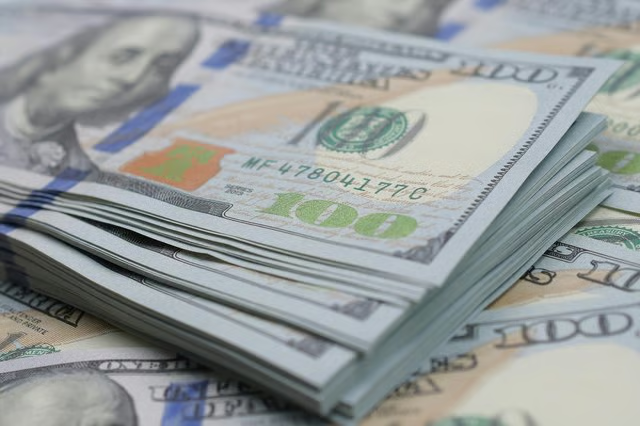


For many years, the United States backed its currency with gold. This gave citizens and foreign stakeholders more confidence that the relatively young country's money was worth something.
If you've ever heard of the U.S. government "printing money," that refers to the fact that the U.S. backs its currency differently today and so is able to issue more during difficult economic times. Learning what backs the dollar will help you understand concepts like inflation and the value of the U.S. dollar on world markets, which can impact how you invest.
Consider also: How Is the US Dollar Backed?
Being on the Gold Standard
Some politicians advocate putting the U.S. dollar back on the gold standard. The gold standard was the international practice of countries backing their currency by keeping a specific amount of gold on hand for a specific amount of currency it printed and distributed, explains the World Gold Council. This limited the amount of money a government had available to pay its bills, issue debt, pay for infrastructure improvements, fight wars and manage other financial needs.
A short history of U.S. currency will help you understand this better. If you were a consumer in the United States, for example, you could take your dollar notes and exchange them for gold – until Congress amended the Federal Reserve Act in 1934, following the Emergency Banking Act of 1933, which took the U.S. off the gold standard.
It did this because consumers and trading partners had developed enough faith in the U.S. economy and the solvency of the government that the U.S. Treasury Department could print more money without buying and holding onto more gold. President Richard M. Nixon issued an executive order in 1971 officially taking the U.S. off the gold standard.
Consider also: What Currencies Are Pegged to the Dollar?
The U.S. Dollar’s Reputation
In order to compare how valuable and stable a country's economy is, financial experts need to compare each country's currency to some type of measuring stick. Since many countries no longer keep gold on hand to back their currencies, the gold standard has shifted to a U.S. dollar standard. Financial experts evaluate foreign currencies based on their value as compared to the U.S. dollar.
That's why when you visit financial websites, in addition to seeing stock market index performances, along with gold and oil prices, you might see the U.S. dollar compared to other currencies. When a country's currency drops in value compared to the U.S. dollar, it makes its products cheaper to buy, explains Bedel Financial. When a country's currency is strong against the dollar, it makes its products more expensive to buy. Some countries, notably China, are accused of purposely devaluing their currency in order to steal trade from other countries.
Consider also: The Advantages of a Weak Dollar
How the Dollar Is Backed Today
The U.S. dollar is now considered "fiat money" because it is tied to the faith others have in the government's ability to pay back its debts. The dollar is backed by the word or promise of the U.S. Federal Reserve to put the full faith and credit of the U.S. government behind the dollar.
Stakeholders look at more than just that, however. They look at a country's Gross Domestic Product, its national debt, inflation rate and other factors that can affect whether or not a country can pay back its debt. Because the United States is probably the least likely country to ever default on its debt, the world measures other currencies against the U.S. dollar.