
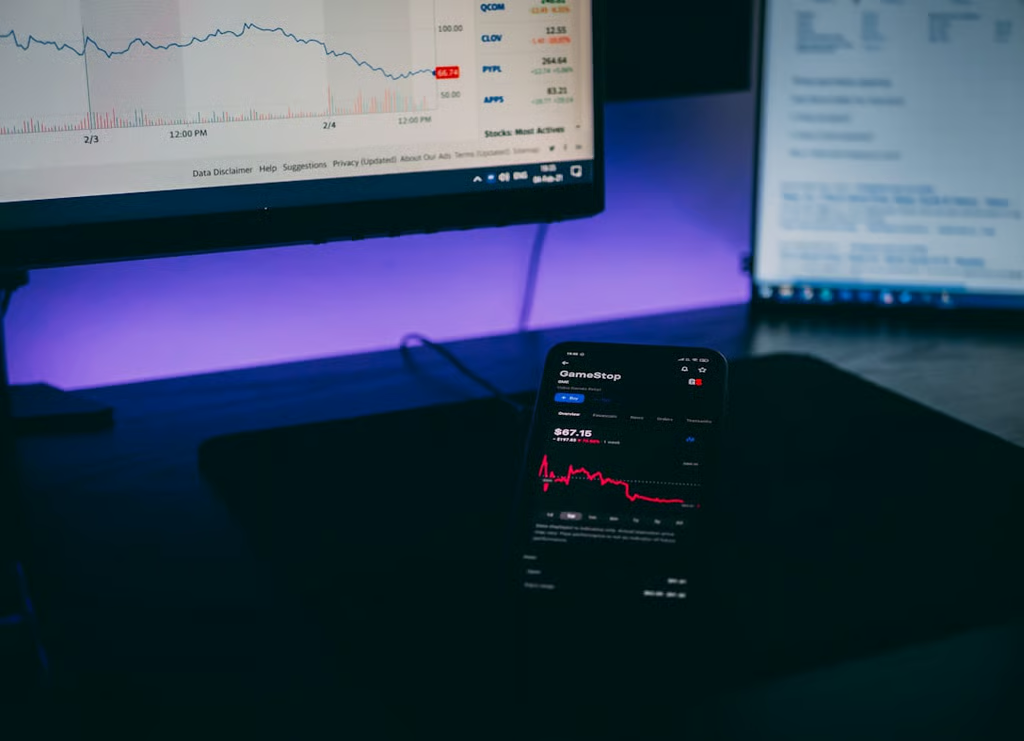
GameStop Q1 2026 earnings: profit, buyback explained
GameStop’s Q1 2026 earnings came with two big numbers: a record quarterly profit of $389.6 million and a new $2 billion share repurchase authorization. That is the headline. The trick is reading past it, because part of the profit came from digital assets and derivative gains, not just from selling games, collectibles and hardware.
That is what makes the GameStop Q1 2026 earnings story more interesting than a simple beat-and-raise release. The company had a strong quarter, no doubt, but its balance sheet and investment activity now matter almost as much as store traffic. For investors, that changes the way the numbers should be read.
GameStop Q1 2026 earnings results: the operating picture
GameStop said net sales rose 14% year over year to $835.3 million, driven by collectibles, while operating income reached $143.3 million, the highest first-quarter operating income in company history, according to the company’s release. That compares with an operating loss of $10.8 million in the same quarter a year earlier.
The company also reported adjusted operating income of $140.5 million, up from $27.5 million a year earlier, and adjusted net income of $179.3 million versus $73.1 million, Shacknews reported this week. Those are still solid gains. They just sit a long way from the headline profit figure, which is where the story gets more interesting.
GameStop said adjusted EBITDA came in at $163.4 million, up from $38.6 million in the prior-year quarter, while free cash flow increased to $333.1 million from $189.6 million, according to the company’s filing. Free cash flow is a non-GAAP measure, but it does point to a business that generated more cash this quarter than it did a year ago.
What sits behind the record profit
The catch is that GameStop’s reported net income of $389.6 million was not all earned in the usual retail sense. The company’s adjusted net income figure excludes impairments, gains on digital assets and related receivables, unrealized gains on a derivative asset, and other items, and lands at $179.3 million, Shacknews reported this week.
That gap matters because it shows how much of the quarterly result was shaped by treasury activity and mark-to-market gains. The company does not break out the exact split in the available filings, so there is no clean way to say how much came from operations versus investments. But the direction of travel is clear enough: the record profit is real, and it is also flattered by items that will not repeat every quarter.
That makes the balance sheet part of the story, not a sidebar. GameStop ended the quarter with $9.7 billion in cash, cash equivalents, marketable securities, digital assets and related receivables, and collateral pledged for a derivative asset, the company said. Of that, $8.4 billion was in cash, cash equivalents and marketable securities, up from $6.4 billion a year earlier, according to the filing.
Why GameStop announced a $2 billion buyback
Alongside the earnings release, GameStop’s board unanimously approved a new discretionary $2.0 billion share repurchase authorization that runs through June 2, 2029, replacing the prior authorization from March 2019, the company said. It is a large number. It is also, for now, only an authorization.
The timing is what makes it meaningful. GameStop said it did not repurchase shares during fiscal 2024, fiscal 2023 or fiscal 2022, and as of February 1, 2025, only $101.3 million remained under the old authorization, the company said. So the new program is not a routine housekeeping item. It is a reset.
That does not mean the company is about to spend the full $2 billion tomorrow, or next month, or at all. Repurchase authorization is not a promise to buy back stock. Still, after years of doing nothing on that front, the board’s decision signals a willingness to use capital differently than it has in the recent past.
The balance sheet is now the bigger story
GameStop’s capital allocation choices are impossible to separate from the balance sheet it has built over the last year and a half. In March 2025, the board unanimously authorized a revised investment policy and added Bitcoin as a treasury reserve asset, allowing a portion of cash or future debt and equity issuances to be invested in Bitcoin, the company said.
That matters because it changes how investors should read the earnings line. A retailer with $835.3 million in quarterly sales and $8.4 billion in liquid assets is not operating like a normal retail chain, and the earnings release reflects that odd combination. Sales still matter. So do collectibles. But so does the company’s ability to turn a vast pile of assets into reported profit.
That is why the adjusted figures are useful, even if they are less flashy. They strip out the noise and show a business that improved meaningfully in the quarter without pretending the result came only from merchandise sales. The higher net income is impressive. It is also doing some work that investors should not mistake for pure operating strength.
What GameStop Q1 2026 earnings mean from here
The next quarter will tell a better story than this one about the repurchase authorization, because that is where the hard evidence lives. If GameStop actually starts buying back stock, the market will learn whether management is treating the new authorization as a real capital return tool or simply as a way to signal confidence.
The same goes for the balance sheet mix. If cash stays high, Bitcoin stays on the books, and derivative-related gains keep appearing in reported results, then GameStop will continue to look like a retailer with a very unusual second identity. That may suit the company just fine. It just means anyone reading the GameStop earnings report Q1 2026 needs to keep one eye on store sales and the other on the treasury account.