
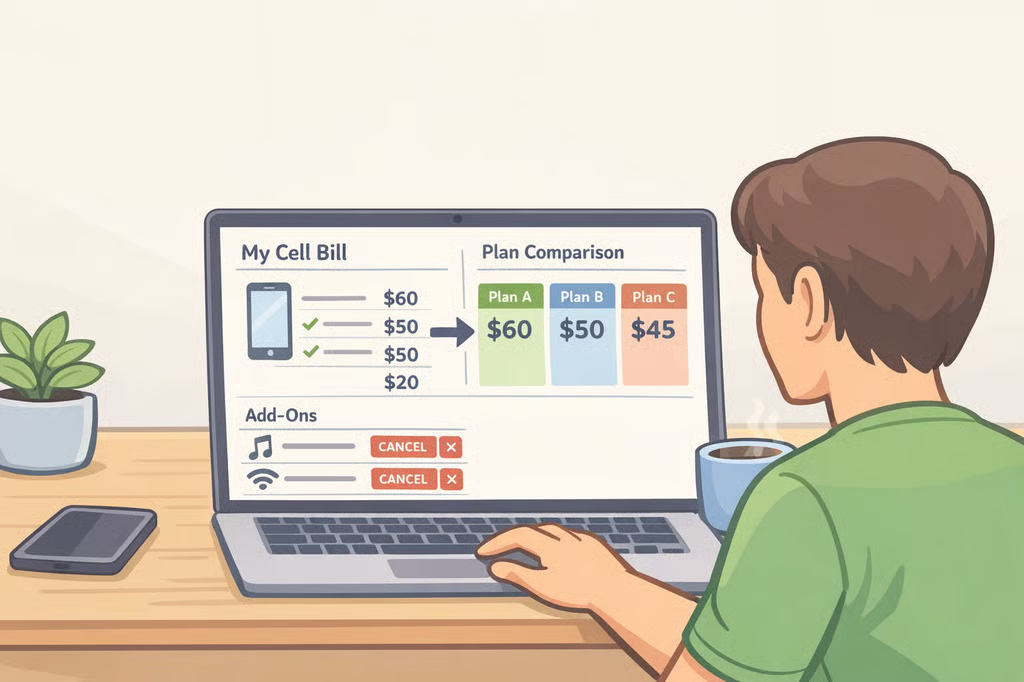
How to Lower Your Cell Phone Bill: 11 Practical Steps
Most people can lower their cell phone bill without buying a new phone, learning carrier lore, or spending a week on hold. The biggest savings usually come from dropping expensive features you do not use, then comparing cheap cell phone plan options before you renew or upgrade. This guide walks through 11 practical steps for how to lower your cell phone bill, starting with the easiest fixes and ending with the move that usually saves the most.
The average American pays about $135 a month for cell service, according to a 2024 J.D. Power survey cited by Consumer Reports (updated April 2025). That adds up fast, especially when wireless prices themselves have been drifting lower. Recon Analytics says the BLS Wireless Telephone Services CPI fell 2.2% nominally and 6.6% in real terms between January 2024 and September 2025, citing BLS data in Recon Analytics (May 2026).
Before you start: Pull up your latest bill. You need your monthly total, recent data use, and a list of add-ons such as insurance, hotspot upgrades, or international features. If you share a family plan, check each line separately. That is where the sneaky waste tends to hide.
Step 1: Audit what you are actually paying for
Start with the bill, not the marketing page. Separate the base plan from taxes, fees, device payments, and add-ons so you can see what is movable and what is not.
- Open your carrier app and check data use for the last two or three months. Note the highest month.
- Compare that number with your plan tier. Premium unlimited plans from the big three can include 30 gigabytes or more of monthly hotspot data alone, according to Consumer Reports (updated April 2025).
- If you are on an older plan, do not assume it is cheaper. Recon Analytics says AT&T raised legacy-plan prices in Q1 2025 in Recon Analytics (May 2026).
By the end of this step, you should know which parts of the bill are inflated by habit rather than need.
Cut waste on your current plan
The first real savings usually come from shrinking the plan you already have. No carrier switch required. Just less excess.
Step 2: Drop premium unlimited if your usage never gets near the ceiling
If your average monthly use stays well below the top tier, compare a mid-tier or lower unlimited plan. The price gap between tiers is often $10 to $20 per line per month.
Budget providers usually offer more flexible ranges, from 1 gigabyte to around 20 gigabytes of data a month, plus unlimited plans, according to Consumer Reports (updated April 2025). That is a better fit for a lot of people than a plan built for someone tethering a laptop at 7 p.m. on a train platform.
One caution: downgrading inside a major carrier can still leave room to save more elsewhere. Treat it as a step, not the finish line.
Step 3: Turn off cellular data for apps that do not need it
Most phones quietly burn through data on apps that only need to work when you are on Wi-Fi. Shut that off where it makes sense.
- Disable cellular access for streaming apps, social media, and app stores.
- Download podcasts, playlists, and offline maps on Wi-Fi before you leave home.
Consumer Reports (updated April 2025) recommends this as a simple way to avoid overages or keep from needing a bigger plan. It is boring. It also works.
Step 4: Kill overages before they kill your budget
If you are still on a metered plan, the overage math can be brutal. That is usually the point where people realize an “affordable” plan was never affordable.
AT&T customers on older metered plans can face $15 per extra gigabyte, and Verizon can charge $20 per extra gigabyte on some metered plans, according to Android Police (May 2025). Android Police (May 2025) also says a few video streams or app downloads can add $30 to $60 or more to a bill.
T-Mobile removed domestic overage charges on its current plans, per Android Police (May 2025). If your bill still spikes because you went a little heavy on video, the plan itself may be the problem.
Step 5: Drop add-ons you have not touched in months
Insurance, premium voicemail, hotspot upgrades, and international features are the kinds of charges that sit there, month after month, because nobody feels like checking them. Check them anyway.
T-Mobile’s device insurance plans add $7 to $25 per line per month, according to Android Police (May 2025). On a two-line plan, that can become a serious chunk of money for coverage many people already duplicate through a credit card or home policy.
International features deserve special attention. Verizon’s TravelPass costs $12 per day in most countries and activates automatically when your phone connects abroad, per Android Police (May 2025). If you are not traveling, turn it off. If you are traveling, check the fine print before the airport coffee gets cold.
Ways to lower your cell phone bill with discounts and billing changes
These are not glamorous moves. They do not make for good commercials. They do trim the bill.
Step 6: Enroll in autopay and paperless billing
Log into your carrier account and turn on autopay and paperless billing. For most carriers, that is a few clicks and a confirmation email.
Missing Verizon’s autopay and paperless discount adds $10 per line per month, according to Android Police (May 2025). On a four-line plan, that is real money, not pocket change dressed up as pocket change.
AT&T also adjusted its autopay discount structure in 2025, per Recon Analytics (May 2026). Check whether bank-account autopay gives a bigger break than credit card autopay. The rules are annoyingly specific, which is very much on brand for wireless billing.
Step 7: Avoid activation and one-time fees
Before adding a line or upgrading a device, ask whether a promotion waives the activation fee. Ask in chat or get the answer in writing so you are not depending on memory and optimism.
AT&T charges $35 for new postpaid lines and $15 for prepaid lines, with some exceptions, while Verizon charges $35 for new lines in-store and online, according to Android Police (May 2025). T-Mobile’s Device Connection Charge is $35 per line for postpaid activations and upgrades, and prepaid plans are exempt, per Android Police (May 2025).
Carriers do run occasional promotions that reduce or waive these fees. Timing a purchase around a back-to-school sale or loyalty offer is one of the easier ways to save money on your cell phone bill without changing your plan at all.
Step 8: Check for employer, union, or membership discounts
Search your carrier’s discount page using your employer email or membership group. These programs are often buried on purpose.
AT&T’s Signature Program and similar programs at other carriers can extend discounts to union members, students, AARP members, and employees of qualifying companies, according to Android Police (May 2025). That does not mean every carrier offers the same list. It means the discount you never asked for may already exist.
Compare alternatives and make the move
At some point, trimming fees stops being enough. Then the question becomes whether your current carrier is still worth the premium.
Step 9: Compare MVNO and prepaid plans against your current bill
Look at two or three budget carriers that use the same network as your current one. If your phone is unlocked, the hardware may stay exactly where it is while the bill gets lighter.
Consumer Reports (updated April 2025) says switching providers can cut a typical bill by $40 or more per month, and members who made the switch reported saving close to $500 a year. That is the kind of number that deserves attention.
A few benchmarks help. Consumer Cellular, which uses AT&T’s network, offers a two-line unlimited plan for $70 a month before taxes and fees, while AT&T’s basic unlimited two-line plan costs $122 a month plus taxes and fees, according to Consumer Reports (updated April 2025). Consumer Reports (updated April 2025) also lists Mint Mobile at $15 a month for 5GB on a 12-month plan, Google Fi at $20 a month plus $10 per GB, Ting at $45 a month for unlimited, and Consumer Cellular at $50 a month for unlimited.
There is a tradeoff. MVNOs typically share network priority with the host carrier’s own customers, so speeds can slow down in crowded areas. For most people, most of the time, that is a small price for a smaller bill.
Step 10: Switch carriers without losing your number
Do not cancel your current service first. Start service with the new company, then initiate the port through that carrier.
If you are switching providers and staying in the same geographic area, the FCC says you can keep your existing number. The old carrier cannot refuse the port even if you owe an outstanding balance or termination fee, and simple wireless ports are supposed to be processed in one business day, though changes among wireless providers can sometimes be usable within a few hours, according to the FCC (updated December 2025).
A couple of wrinkles matter. The FCC says moving to a new geographic area can affect whether you keep the same number, and wireline-to-wireless ports can take longer. Before you switch, ask the new carrier whether your 911 service will be affected during the transfer, then confirm what happens to your phone during the move.
Also check whether your device is unlocked. Consumer Reports (updated April 2025) says a provider must unlock a paid-off device in good standing, either remotely or in person. On an iPhone, go to Settings > General > About and look for “Carrier Lock.”
Step 11: Call retention before you leave
If you would rather stay put, call customer service and say you are considering canceling. That usually gets you routed to the retention department, which has more room to offer credits or plan adjustments.
Cell phone bills are harder to negotiate than some other bills, but retention can still deliver a one-time credit or a promotional rate, according to Consumer Reports (updated April 2025). Long-tenured customers and multi-line accounts tend to have the most use.
Price guarantees are worth reading closely. Recon Analytics says four of the five major carriers introduced or extended multi-year price guarantees in 2024 and 2025, but T-Mobile’s five-year lock does not cover taxes, fees, per-use charges, or add-ons in Recon Analytics (May 2026). A locked base rate is not the same thing as a locked total bill. Carrier math remains carrier math.
What to do next
Start with the audit, because everything else depends on knowing what you actually use. If your usage is low, compare two budget plans on your current network. If your bill is bloated by add-ons or overages, cut those first. If the plan still looks expensive after that, call retention, then port your number and move on.
That sequence is usually enough to reduce monthly phone bill pain without drama. The bill gets smaller. The mystery disappears. And once the number is out of the way, so is the excuse to keep overpaying.