
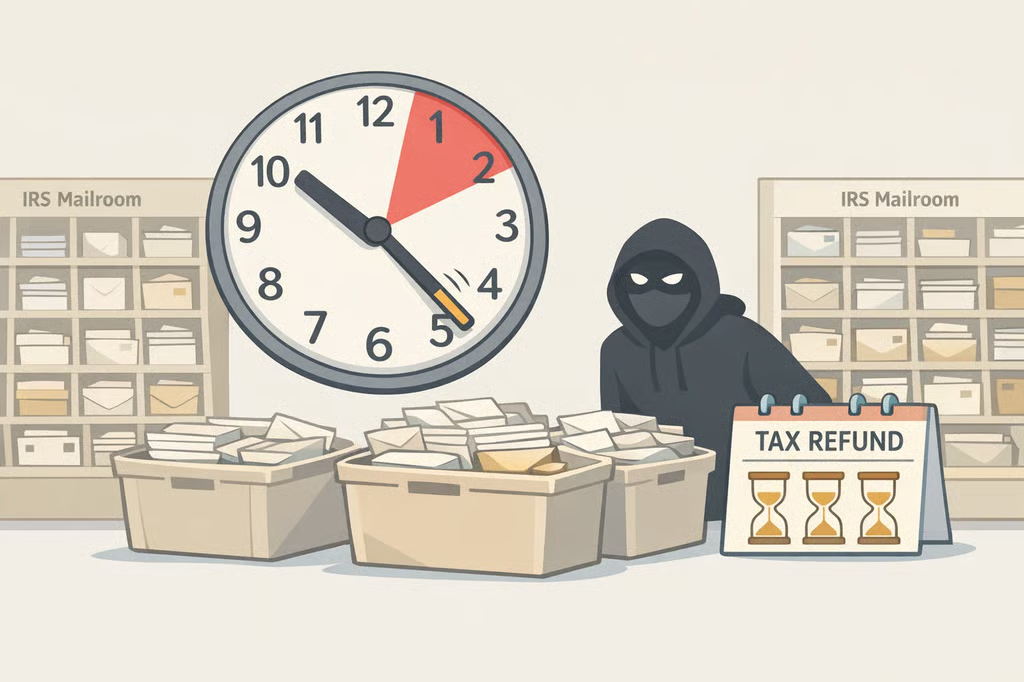
- IRS identity theft refund delays: 20 months on average
- What the watchdog found about IRS identity theft case delays
- Why IRS identity theft refund delays hit households so hard
- The IRS is improving fraud detection, but not victim wait times
- Staffing cuts and tax-law changes could make the backlog worse
- What taxpayers caught in IRS identity theft refund delays should know
IRS identity theft refund delays: 20 months on average
IRS identity theft refund delays are still stretching close to two years for taxpayers whose returns have already been stolen and filed by someone else. The IRS says identity theft cases are generally supposed to be resolved within 120 days, but its own guidance page says the average is now 611 days, a figure that still appears under a page last updated in May 2026 (IRS Identity Theft Victim Assistance: How It Works, updated May 2026).
That disconnect landed again on Wednesday, June 24, 2026, when the Taxpayer Advocate Service released its annual report to Congress and Erin Collins repeated her familiar verdict: these delays are “unconscionable” (TAS Annual Report to Congress, June 24, 2026). For the people trapped in the IRS identity theft case delays, the word is doing a lot of work.
What the watchdog found about IRS identity theft case delays
The Taxpayer Advocate Service draws a sharp line between two kinds of identity theft cases. In the first, the IRS catches a suspicious return before it is fully processed, and the agency flagged about 2.1 million of those returns during the 2025 filing season (TAS FY2026 Objectives Report, June 2025).
The second category is the ugly one. A thief has already used a taxpayer’s name and Social Security number to file a fake return, and the case is sent to the IRS’s Identity Theft Victim Assistance unit for cleanup (TAS FY2026 Objectives Report, June 2025). That is where the backlog lives.
As of the end of the filing season, the IRS had about 387,000 IDTVA cases in inventory, and the average case was taking about 20 months to close (TAS FY2026 Objectives Report, June 2025). In the latest filing season review, TAS said the average time to close IDTVA cases remained extremely high at 600 days in fiscal year 2026 (TAS Filing Season Review 27, June 24, 2026).
Those numbers are not the same measure, but they point in the same direction. One is a backlog snapshot. The other is a case-resolution average. Both say the same thing: the IRS is still nowhere near its own 120-day standard, and it has not come close for years.
Collins has recommended that the agency keep IDTVA employees focused exclusively on identity theft casework until the average resolution time falls to 90 days (TAS Annual Report 2025 Newsroom, January 2026). IRS leadership has said reducing cycle time is a priority. The cycle time has barely budged.
Why IRS identity theft refund delays hit households so hard
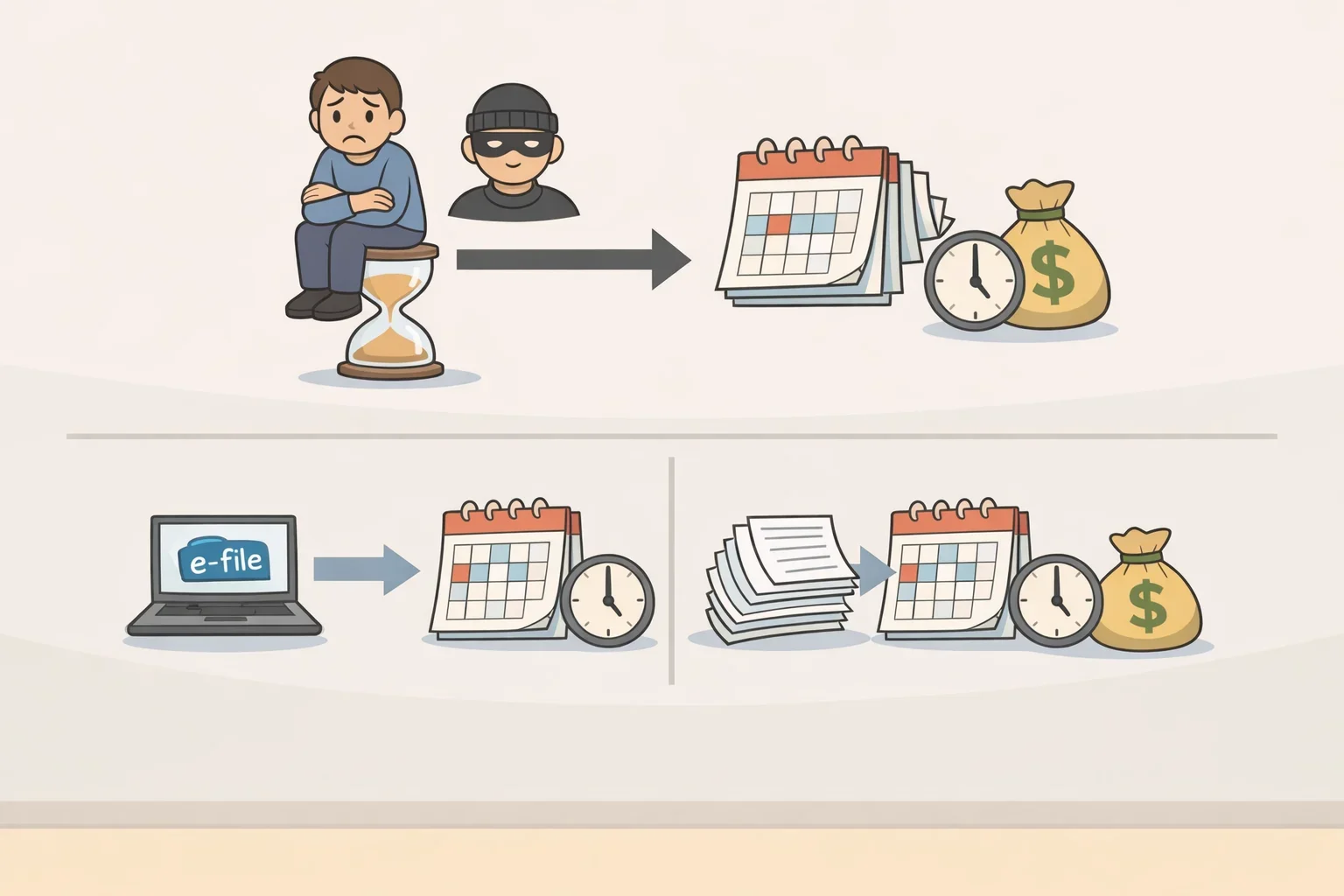
The money tied up in these cases is not pocket change. The average federal refund in 2025 was $3,167, which is real money for any household and often a critical one for lower- and middle-income filers (TAS Annual Report 2025 Newsroom, January 2026). Waiting nearly two years for it is not just annoying. It changes what gets paid, what gets postponed, and what gets skipped.
TAS says the delays disproportionately affect vulnerable taxpayers. In fiscal year 2023, 69% of identity theft victims handled by the IDTVA unit had adjusted gross incomes at or below 250% of the federal poverty level (TAS FY2026 Objectives Report, June 2025). That is not a group with much room to absorb a missing refund for 20 months.
The comparison with ordinary refund processing is striking. During 2025, the IRS processed more than 165 million individual income tax returns, about 94% of them filed electronically (TAS Annual Report 2025 Newsroom, January 2026). About 104 million taxpayers received refunds, with an average refund of $3,167, and roughly 3.6 million taxpayers waited beyond normal processing time, averaging 7 weeks for e-filers and 14 weeks for paper filers (TAS Annual Report 2025 Newsroom, January 2026).
That is slow enough to irritate people. It is not the same species of delay. The identity theft cases are a different order of problem altogether.
The IRS is improving fraud detection, but not victim wait times

The IRS has not been idle on the fraud-prevention side. On June 8, 2026, the agency and its Security Summit partners announced a new framework built around five work groups covering pre-filing detection, forecasting, prevention, detecting and reporting, and responding (IRS Security Summit announcement, June 8, 2026).
The stated goal is to stop tax-related identity theft earlier and share information faster across the IRS, state agencies, payroll partners, and tax software companies (IRS Security Summit announcement, June 8, 2026). The IRS also says the Security Summit has helped protect millions of taxpayers and prevented billions of dollars from being paid to fraudsters since it began (IRS Security Summit announcement, June 8, 2026).
That work matters. So does the fact that the threat keeps shifting. The IRS says identity thieves have increasingly moved toward stealing underlying tax and financial information to file more authentic-looking fraudulent returns, hoping to get around traditional safeguards (IRS Security Summit announcement, June 8, 2026).
But the new framework is built to prevent fraud and detect it earlier. It does not announce anything aimed at the IDTVA backlog or the speed of victim case resolution. That leaves a hard truth untouched for the taxpayers already in the queue: better front-end defenses do nothing to speed up a refund that is already trapped in the system.
Staffing cuts and tax-law changes could make the backlog worse
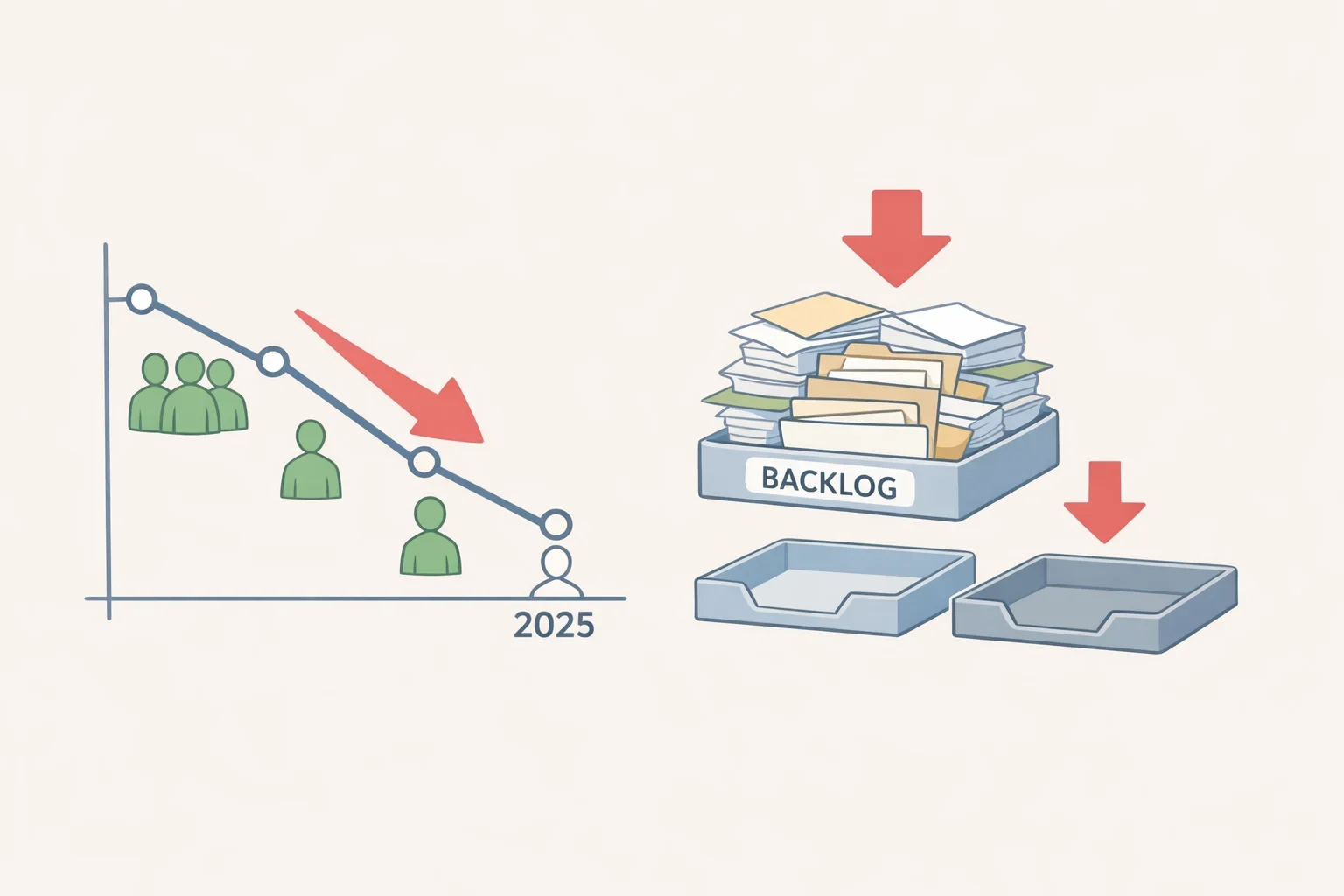
The IRS is entering this stretch with fewer people than it had a year ago. TAS said the agency started 2025 with about 102,000 employees and finished with about 74,000, a drop of 27% (TAS Annual Report 2025 Newsroom, January 2026). That matters when a specialized unit is already carrying hundreds of thousands of cases.
It gets trickier from there. Collins said the agency is also dealing with leadership turnover and more than 100 tax code changes under the One Big Beautiful Bill Act, many of them retroactive and likely to require new programming, revised forms, and taxpayer education (TAS Annual Report 2025 Newsroom, January 2026).
Those pressures do not automatically explain the identity theft backlog, but they do make it easier to see why it has been so hard to clear. If IDTVA staff are pulled toward other filing-season demands, the clock on these cases can stretch again. Collins has already warned against that.
Her recommendation remains simple: keep IDTVA staff focused on identity theft casework until average resolution time drops to 90 days (TAS Annual Report 2025 Newsroom, January 2026). At the current pace, the IRS is still about six times slower than that target.
What taxpayers caught in IRS identity theft refund delays should know
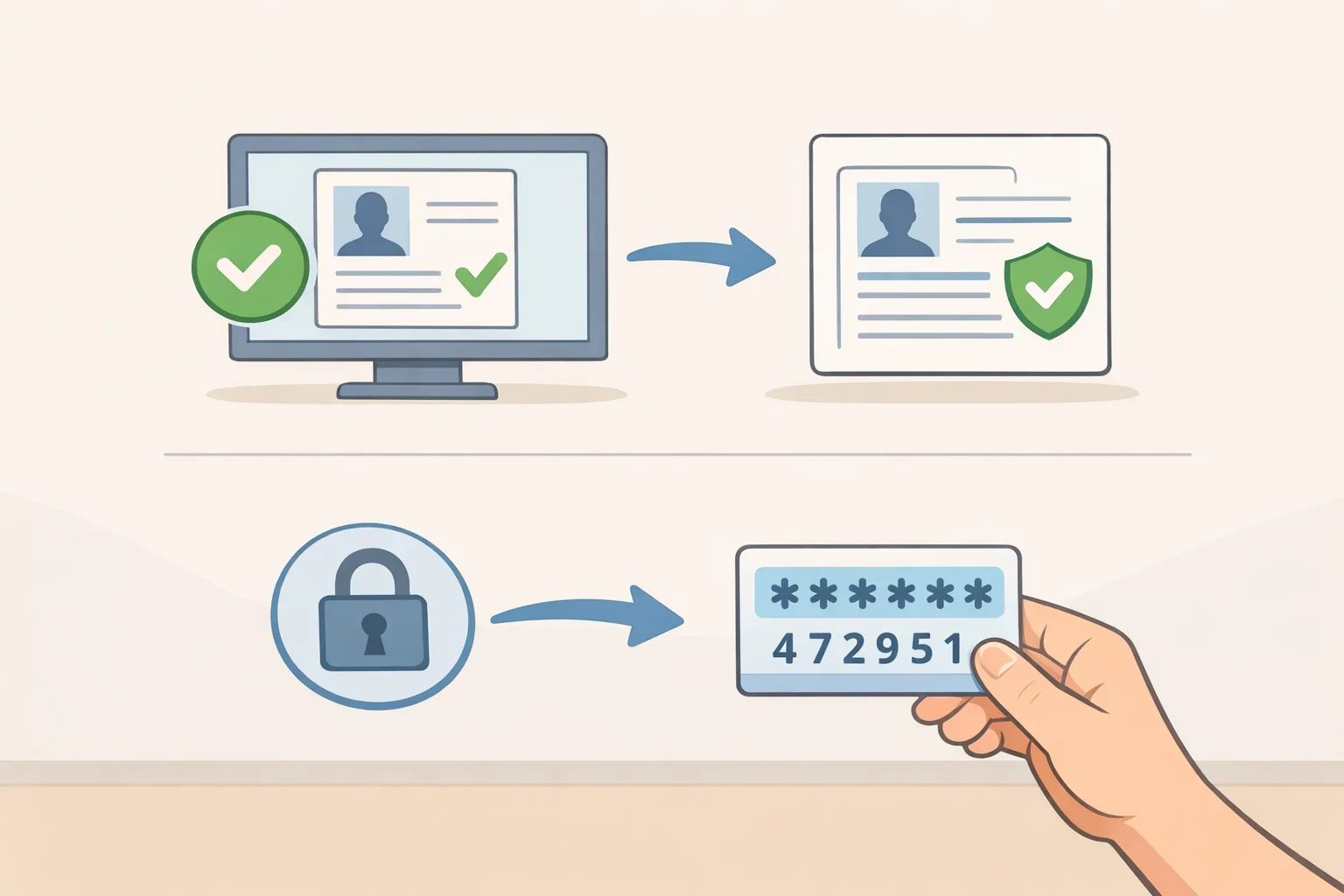
The IRS says confirmed victims will receive a letter when their case is resolved, and that resolution is generally supposed to happen within 120 days, even though the agency’s own page says the average is now 611 days because of pandemic-era inventory growth (IRS Identity Theft Victim Assistance: How It Works, updated May 2026). For now, that is the system taxpayers are dealing with.
The agency also warns against sending duplicate Forms 14039 or calling to check the status of an identity theft claim, because both can create more delays (IRS Identity Theft Victim Assistance: How It Works, updated May 2026). Once a case is completely resolved, the IRS says it will mark the account with an identity theft indicator, and confirmed victims are placed into the Identity Protection PIN program with a new six-digit IP PIN for future filings (IRS Identity Theft Victim Assistance: How It Works, updated May 2026).
That helps later. It does not help now.
The bigger question is whether the IRS can do more than stop new fraud at the gate. If staffing stays thin, the tax code keeps changing, and victim casework remains an afterthought behind prevention, the wait for people already caught in IRS identity theft refund delays is unlikely to shrink on its own. Collins has spent three years saying the same thing in different forms. The agency has now spent three years proving her right.