

How Women Can Negotiate a Higher Salary for Retirement
Women who work in jobs with employer-sponsored retirement plans may be sitting on money that does not require a windfall to unlock. The bigger question, though, is how women can negotiate a higher salary in a way that compounds over a career, because pay sets the size of nearly every retirement benefit that follows.
Women earned 85% of what men earned in 2024, according to Pew Research Center’s analysis of median hourly earnings of full- and part-time workers (Pew Research Center, March 2025). For women ages 25 to 34, the gap was narrower, at 95 cents on the dollar, or 5 cents less than men in the same age group (Pew Research Center, March 2025). That matters because every percentage-based retirement feature, from employer match to automatic escalation, starts with salary.
This guide walks through the practical steps in order. First, make sure the defaults at work are actually helping. Then, protect those gains when jobs change. Finally, use that pay baseline to negotiate with more precision.
Who this applies to: Women with access to an employer-sponsored retirement plan, such as a 401(k) or 403(b). The Saver’s Match section also applies to IRA holders who meet the income rules.
Step 1: Check that your retirement defaults are turned on

The first move is the least glamorous and the most overlooked. Log into your benefits portal and see whether you are enrolled, whether contributions are coming out of your paycheck, and whether auto-escalation is active.
That matters because participation is still a little lower for women than for men. In 2023, 64% of women workers contributed to their plans, compared with 67% of men (Wharton Pension Research Council, September 2024). The SECURE 2.0 Act now requires most 401(k) plans established after 2022 to automatically enroll new employees and default them into auto-escalation (NBER, August 2024).
The policy effect is real, but not magical. NBER found that automatic enrollment raises the equivalent constant contribution rate by 0.6 percentage points of income, and introducing both automatic enrollment and default auto-escalation simultaneously increases it by 0.8 percentage points (NBER, August 2024). That is useful. It is also small enough that opting out can wipe out the benefit in a hurry.
Auto-escalation also needs your silence. Among employees still working at firms with that default, only 40% escalate on the first escalation date, and acceptance falls further at later dates (NBER, August 2024). The default is a nudge, not a guardian angel.
What to do next is straightforward:
- Confirm you are enrolled and contributing.
- Check whether auto-escalation is on.
- Note your current contribution rate and whether it reaches the employer match.
That last point leads to the easiest money in the system.
Step 2: Negotiate your salary around the employer match
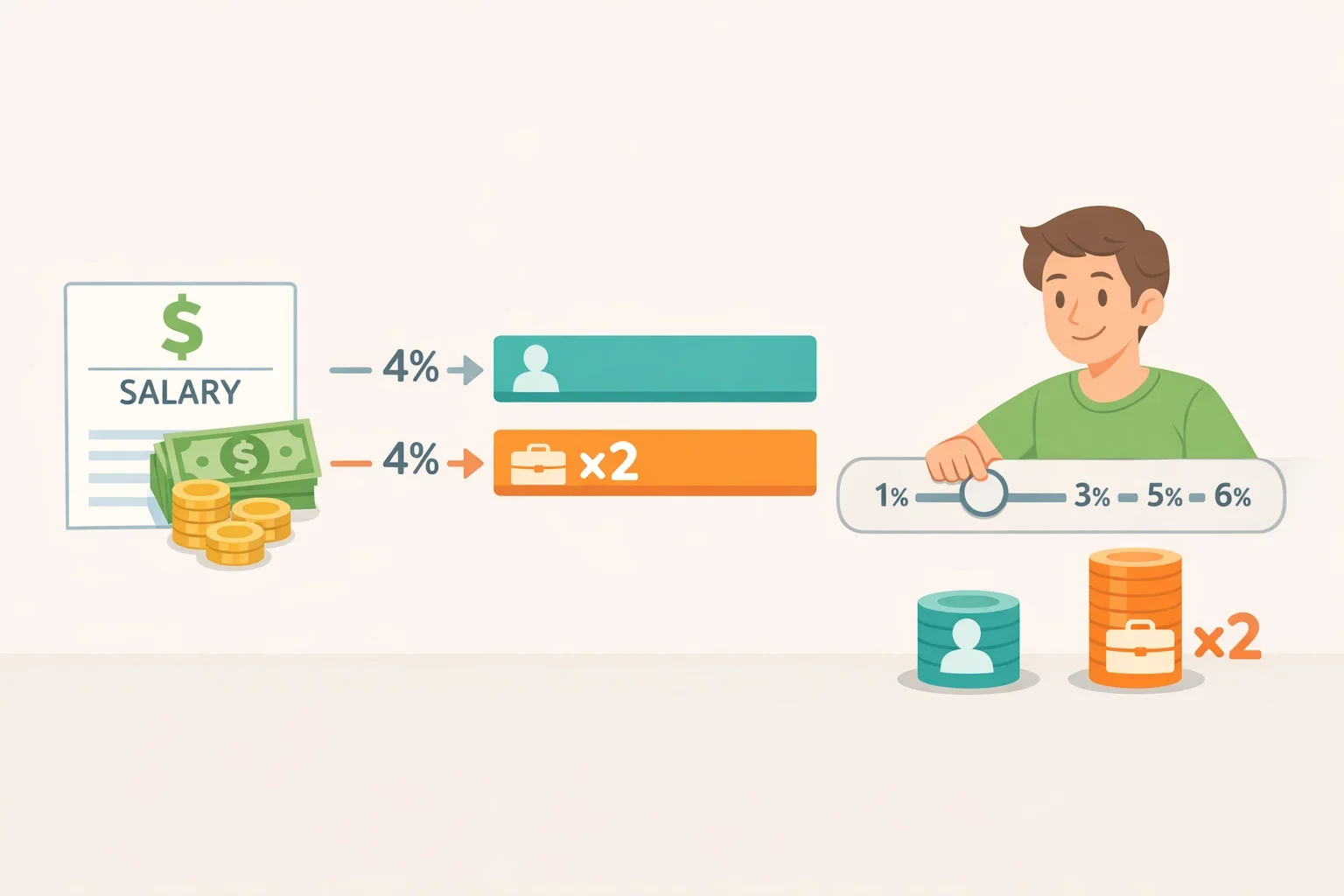
If your employer matches 50% of contributions up to 6% of salary, and you contribute only 3%, you are not saving enough to capture the full match. You are leaving part of your compensation untouched.
The math is plain. On a $50,000 salary, missing the full match can mean giving up $750 a year in employer contributions. Not a fortune, but not pocket change either, especially once compounding gets hold of it.
Starting in 2027, there will be another incentive layered on top. The Saver’s Match will offer a 50% federal match on the first $2,000 of retirement savings contributions, with a maximum federal contribution of $1,000, or $2,000 for married couples filing jointly (ASPPA/Morningstar, May 2024). To qualify, adjusted gross income must be $35,000 or below for single filers or married filing separately, $53,250 or below for head of household, or $71,000 or below for married filing jointly (ASPPA/Morningstar, May 2024).
Morningstar’s modeling suggests the program could lift the ratio of retirement balance to final salary at age 65 by 21.4% to 33.7%, depending on eligibility and behavior assumptions (ASPPA/Morningstar, May 2024). For Black females ages 25 to 34 who are eligible and do nothing beyond their baseline contribution behavior, Morningstar estimated a 10.5% increase in that balance-to-salary ratio at age 65 (ASPPA/Morningstar, May 2024).
That is the useful part of the story: there is money on the table, and some of it will arrive automatically. But first, the salary conversation has to be grounded in the right number.
How to negotiate a salary offer without underselling yourself
Start with market data, not your employer’s first offer. Use Bureau of Labor Statistics figures, pay transparency postings in your state, or industry salary surveys to anchor the ask. A raise request that starts with “I found this on a salary website” is weaker than one tied to the actual market for the role.
Then document the last year in numbers. Revenue influenced. Costs reduced. Projects delivered on time. Specifics beat vague claims about being dedicated, which is nice, but not something payroll can deposit.
The ask itself should be direct. Try: “Based on current market rates for this role and the results I’ve delivered this year, I’d like to bring my compensation to [specific number].” Then stop. Let the sentence do its job.
Pew found that half of U.S. adults say employers treating women differently is a major reason for the pay gap, and women are much more likely than men to hold that view, 61% versus 37% (Pew Research Center, March 2025). That does not make salary negotiation irrelevant. It just means the ask is happening inside a real structure, not a neutral one.
Once the salary baseline improves, the retirement system gets easier to use. Higher pay means a larger match in dollar terms, more room to hit contribution thresholds, and a better shot at the Saver’s Match when it launches.
Step 3: Protect what you have when you change jobs

This is where a lot of good behavior leaks away. Women continue to take 401(k) loans and hardship withdrawals more often than men, and 42% of 401(k) balances are cashed out when workers leave a job (Wharton Pension Research Council, September 2024; NBER, August 2024). That does not mean every departure ends badly. It means job changes are where balance sheets go to get quietly ambushed.
The pressures behind that are not imaginary. About 48% of employed women say they feel a great deal of pressure to focus on responsibilities at home, compared with 35% of employed men, and among working mothers with children younger than 18, the share rises to 67% versus 45% for working dads (Pew Research Center, March 2025). When the budget is tight, retirement accounts start to look like emergency funds. That is how leakage happens.
The fix is boring, which is usually a good sign.
- Roll a 401(k) into your new employer’s plan or a rollover IRA when you leave a job.
- Treat a 401(k) loan as a drag on future compounding, not just a short-term cash tool.
- If you have already borrowed from the plan or taken hardship withdrawals, raise your contribution rate again before the next escalation date.
The point is not purity. It is keeping the progress from Step 1 and Step 2 from evaporating at the worst possible moment. Once that protection is in place, the remaining question is what salary level you are compounding on in the first place.
Step 4: Use pay as the baseline for everything else
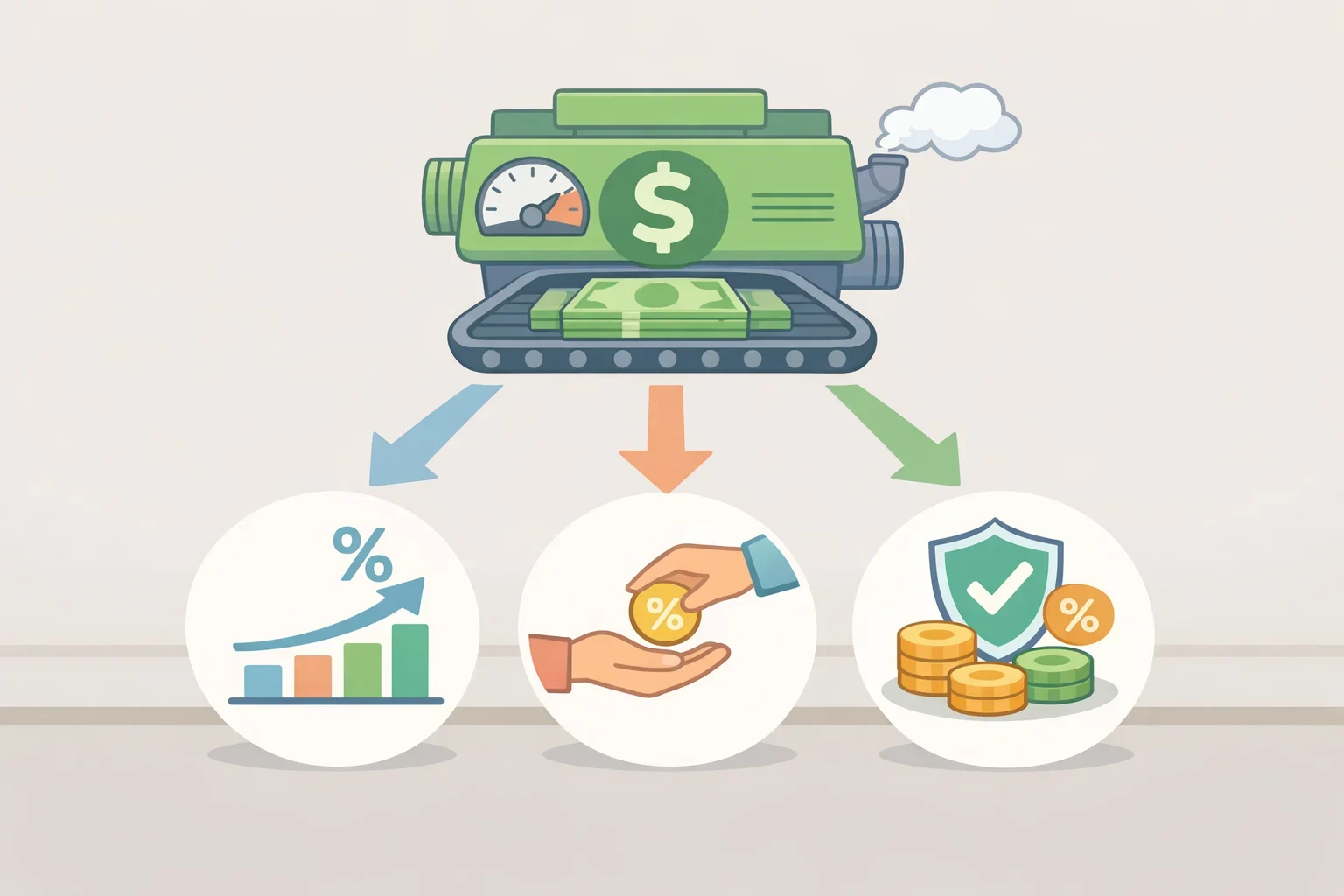
A retirement plan can only do so much with a weak salary. Auto-escalation is a percentage of pay. Employer matching is a percentage of pay. The Saver’s Match is tied to contributions coming out of pay. If the baseline is off, every percentage-based feature is working with one hand tied behind its back.
That is why the broader wage gap still matters. Pew’s estimate for all workers in 2024 was a 15-cent gap, down from 35 cents in 1982 (Pew Research Center, March 2025). Progress, yes. Fast enough? Hardly. For younger women, the 5-cent gap among workers ages 25 to 34 shows there is more room to push salary higher early and let time do some of the heavy lifting (Pew Research Center, March 2025).
That is where salary negotiation earns its keep. It is not a side quest. It is the part of the retirement plan that changes the size of the plan.
What to do this week
If all of this sounds like a lot, start with the pieces that take 20 minutes, not 20 years.
- Confirm you are enrolled in your retirement plan.
- Check your contribution rate and raise it to the employer match threshold if needed.
- Make sure auto-escalation is on.
- If you are changing jobs, roll the balance instead of cashing it out.
- If you are due for a raise, prepare the salary ask with market data and recent results.
- If your income is within the Saver’s Match thresholds, make sure you are on track to contribute at least $2,000 a year once the program begins in 2027.
The useful part of all this is that none of it depends on waiting to be rescued by a better policy or a better boss. Some of the money is already in motion. Some of it is still sitting in the room, waiting for a clearer ask.