

Credit card debt vs retirement savings: survey findings
Vanguard’s latest research on credit card debt vs retirement savings lands with an awkward little truth: plenty of investors are carrying revolving card balances while leaving free 401(k) match money untouched. That matters because the people making these mistakes are not sitting on the sidelines. They are already saving, already investing, and still getting the order wrong.
The firm found that 35% of all Vanguard investors carry revolving credit card debt, with an average balance of about $4,100. At a 21% average card rate, that balance costs more than $800 a year in interest, Vanguard reported in May.
Vanguard investors and credit card debt

The more revealing number sits a layer deeper. Among Vanguard investors with brokerage accounts who carry revolving credit card debt, 67% have cash in those accounts, in settlement funds or money market funds, that could partially or fully wipe out the balance, Vanguard research paper found in April. Thirty percent could pay it off in full.
That subset matters. Their average cash holding is $19,400, while their average revolving debt is $3,200, according to the same paper. So this is not always a story about people with no cushion. Sometimes it is a story about money sitting in the wrong bucket.
Vanguard says 57% of investors with credit card debt could pay it off by redirecting dollars earning lower returns, and the typical investor could do it in less than 18 months if that cash were redirected, Vanguard reported in May.
The broader backdrop is plain enough. The Federal Reserve found that 45% of credit card owners carried a balance at least once during the prior 12 months, the Fed reported in May. Vanguard’s investors are not unusual because they borrow. They are unusual because many of them have the means to make the debt disappear faster than they do.
When pay off credit card debt or save for retirement becomes the wrong question
The sharper mistake in Vanguard’s paper is not just slow debt paydown. It is the way debt paydown and retirement saving get separated, as if one has nothing to do with the other.
Within Vanguard-administered 401(k) plans, 50% of employees with mortgage, auto or student debt make extra payments at least once a year, and 30% of those prepayers are not contributing enough to capture the full employer match, leaving almost $1,100 a year in missed 401(k) contributions, Vanguard reported in May. That is a costly trade. Vanguard also says matches of 50 or 100 cents on the dollar are hard to beat in financial markets, which is a polite way of saying free money is still free money.
The long-run damage can stack up. Vanguard estimates that prepaying debt for 10 years while missing the full match over the same period could leave a worker with about $120,000 less at retirement, Vanguard research paper found in April.
There is another version of the same problem. Vanguard found that 30% of investors with revolving credit card debt are also making extra payments toward lower-interest debts such as mortgages or student loans. On average, they are sending $3,500 a year toward those cheaper balances while still carrying about $5,000 in credit card debt, Vanguard research paper found in April.
Vanguard calls that the “glacier” method, meaning people pay off the biggest and slowest-moving debts first, Vanguard research paper says. It feels tidy. It is also the kind of tidy that leaves expensive debt rolling along in the background.
Why financial fragility keeps the answer messy

None of this should be mistaken for a universal prescription. A lot of households simply do not have much slack.
The Federal Reserve found that 63% of adults said they would have covered a hypothetical $400 emergency exclusively using cash, savings, or a credit card paid off at the next statement, the Fed reported in May. That definition matters. It is not the same thing as saying a credit card balance counts as emergency liquidity. It does not.
Emergency savings have also not fully recovered. In 2024, 55% of adults said they had set aside enough money for three months of expenses in an emergency fund, up slightly from 54% in 2023 but down from 59% in 2021, the Fed reported in June 2025. Only 48% said they could cover a $2,000 expense using savings, the Fed said.
That is the practical tension sitting underneath the Vanguard numbers. For households with some cash, the cleanest financial move is not always the safest one. Draining reserves to kill card debt can leave a family exposed the next time the car dies or the furnace quits. That is how one problem becomes two.
Still, the debt picture has become heavier. Vanguard says household balances now approach $19 trillion, and in 2025 millennials in their mid-30s held roughly twice as much nonhousing debt as baby boomers did at a similar age, Vanguard reported in May. The firm also cites research showing only 11% of advisors currently offer debt counseling or solutions, Vanguard research paper found in April.
The order of operations still matters
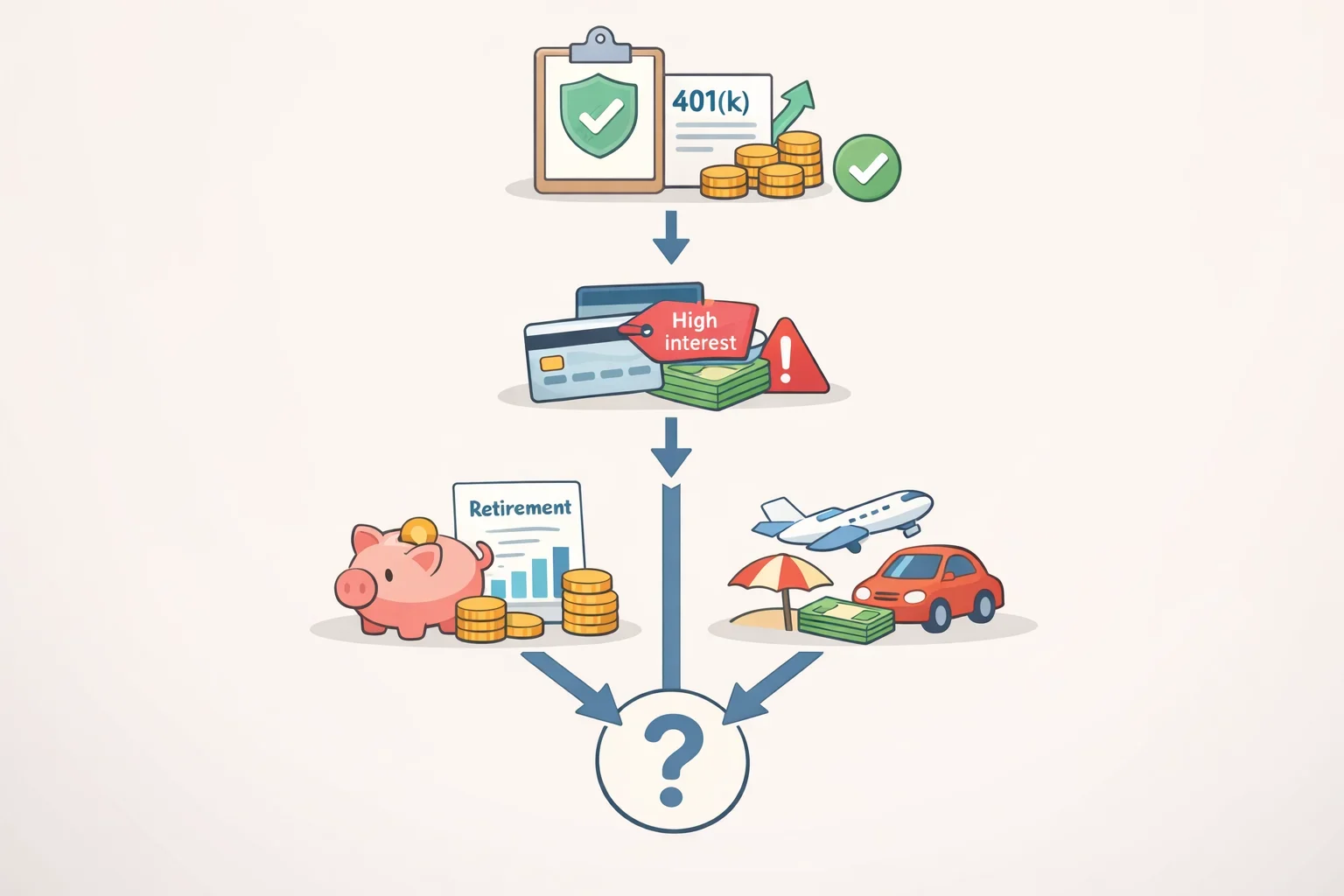
Vanguard’s own sequence is straightforward. Earn the full 401(k) employer match first. Then prioritize high-interest debt. Only after that should investors decide whether extra payments on lower-interest debt make more sense than additional retirement contributions, Vanguard reported in May.
That framework is useful because it treats borrowing and saving as parts of the same balance sheet. Vanguard’s paper puts the point bluntly: savings and investments are only half of a household’s financial picture, Vanguard research paper found in April. Debts count too.
The harder part is knowing when cash is really cash, and when it is just worry in a money market fund. The investors in Vanguard’s data often have enough flexibility to make a better move than the one they are making. Households without that flexibility need a different calculation altogether.
That is the real news in the credit card debt vs retirement savings debate. The mistake is not always reckless spending. More often, it is sequencing.