
How to Get Hired at a Late-Stage Startup: Interview Tests
By the end of this guide, you’ll know how to get hired at a late-stage startup by reading the interview correctly, preparing for the format you’ll actually face, and checking the offer with clear eyes. That matters because a Google interview and a Series A startup interview are so different that preparing for one can hurt your performance at the other, Kinda Technical reported this year.
The biggest misconception in tech interviewing is that all software engineer interviews are the same. They are not, and late-stage startup hiring is its own animal, Kinda Technical says. Big tech is built to compare thousands of candidates in a standardized way. Startups are trying to find someone who can ship features on day one.
Prerequisites: active engineering experience, familiarity with big-tech-style interviews, and a company that has raised at least a Series B round. If you are starting from scratch, this guide still helps, but the examples are tuned to experienced candidates.
Late-stage startup interview tips: read the process before you prep
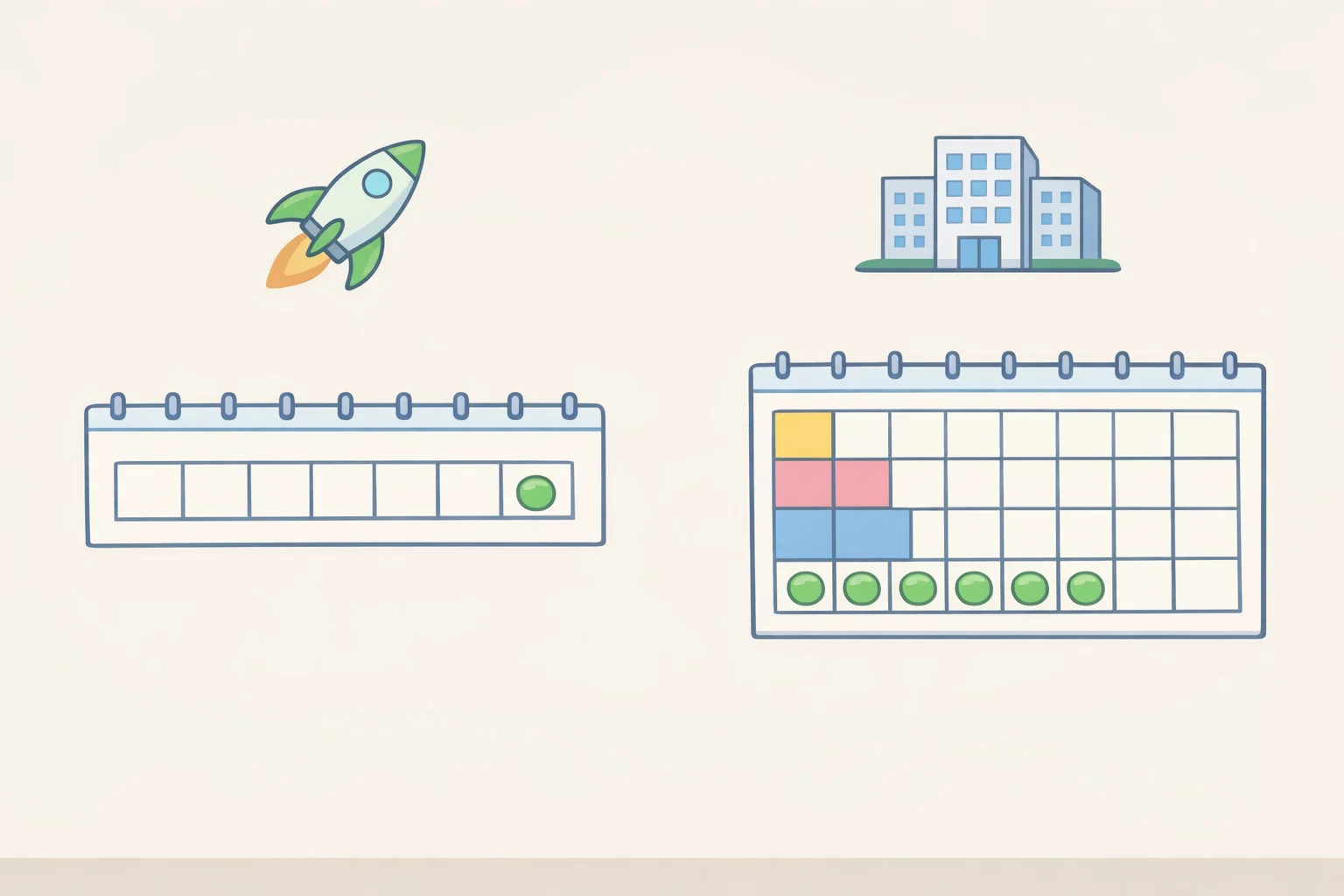
The process is usually faster, looser, and less uniform than the one most engineers are used to from large companies. Big tech interviews often run 5 to 7 rounds over 3 to 10 weeks, while startup interviews often run 3 to 5 rounds over 1 to 3 weeks, Kinda Technical shows. That gap is not cosmetic. It changes how you should prepare, how you should schedule, and how much room you have to recover from a weak round.
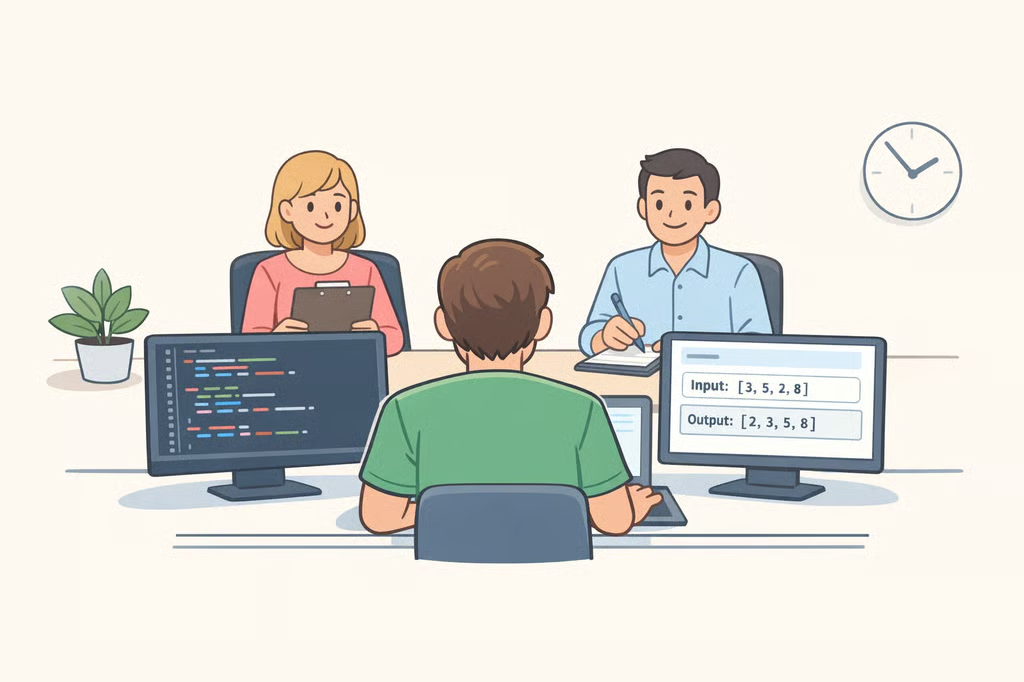
Coding rounds are usually different too. Big tech leans on LeetCode-style questions in a whiteboard or CoderPad setting, while startups tend to use take-home projects or pair programming, Kinda Technical says. System design shifts in the same direction: big tech tends to ask abstract scale questions, while startups want practical architecture for their own product.
Decision-making also changes. Big tech often routes the final call through a hiring committee. At startups, the founder or CTO is often directly involved, and the process can vary by team and candidate, Kinda Technical says. That makes the conversation feel more personal, and a little less like a machine with a rubric.
The first move is simple: ask the recruiter or hiring manager which rounds are actually on the calendar. If a take-home, pair programming, or code review round is coming, the prep plan should change immediately.
How to prepare for a startup interview

Each startup format tests a different muscle. If you prepare for the wrong one, you can look busy without becoming more hireable.
-
Build a side project you can explain end to end.
Take-home projects usually run 4 to 8 hours and test whether you can write production-quality code, structure a project cleanly, handle edge cases, write tests, and document your work, Kinda Technical says. A side project gives you something concrete to defend, which is better than vague confidence and a hope-filled resume. Some startups even hand candidates a real feature from their product roadmap, Kinda Technical notes. Treat that as if it could ship. If the requirements are fuzzy, show how you handled the ambiguity instead of pretending the ambiguity never existed. -
Practice code review on public repositories.
Startups sometimes use a code review round, where you look at an anonymized pull request from their codebase, identify bugs, suggest improvements, and discuss trade-offs, Kinda Technical says. The point is not to catch every flaw. It is to show judgment, clarity, and the ability to talk through trade-offs without turning the room into a seminar. Open GitHub, pick an active project in your area, and review a few real pull requests out loud. Focus on why something feels risky, not just whether it is technically wrong. That is the part interviewers are listening for. -
Do pair programming with someone who pushes back.
Pair programming sessions usually run 60 to 90 minutes and test collaboration, communication, and how you approach problems in real time, Kinda Technical says. It is closer to daily work than whiteboard coding, which is partly why startups like it. Choose a partner who will interrupt you and ask why you made a particular call. If you can’t explain your choices under mild pressure, the interview will surface that very quickly. Technical skill matters, but startup interviews are usually listening for how you work with other humans while the code is moving. -
Calibrate system design to the company’s actual scale.
Before the interview, ask about current traffic and expected growth over the next 12 months. Then design for roughly 10x the current scale, not 1,000x, Kinda Technical says. That framing keeps you from proposing infrastructure built for a company that does not exist yet. For a startup with 5,000 users, saying “we should use a PostgreSQL database with read replicas” is the kind of pragmatic answer the source recommends. Saying “we need a distributed NoSQL cluster with eventual consistency” for the same company is a red flag that you do not understand startup constraints, Kinda Technical says. A monolith that can be split later is often the right answer. Quietly elegant beats theatrically overbuilt. -
Prepare a direct answer to “why a startup, why now.”
Startup culture fit is more personal and less predictable than big-tech behavioral rounds, Kinda Technical says. The founder or CTO may ask why a startup instead of Google, how you handle wearing multiple hats, or what you would do if the main product thesis turns out to be wrong. Growth-stage hiring leaders say they look for curiosity, tenacity, and an eagerness to take on new challenges, First Round reported in 2023. A strong answer names a specific product problem that is interesting, then acknowledges what is being given up by leaving a larger employer. A vague answer sounds like resume strategy. Nobody is fooled by that for long.
Why big-tech candidates stumble at startups

The failure mode is often less about raw ability than about the frame a candidate brings into the room. One founder quoted by Pragmatic Engineer said that some hires from Google wanted to replicate Google’s process and culture, and that they failed because they missed what made the startup work, Pragmatic Engineer reported in late 2024.
That same reporting says some leaders see big-tech candidates struggle on basic engineering best-practice questions because they are used to a different environment. One leader told the newsletter that they do not ask LeetCode questions and found that candidates from Meta, Google, and Stripe had a hard time with basic system design and coding questions, Pragmatic Engineer reported in late 2024. The point is not that those engineers are weak. It is that the signal being tested has changed.
There is also a habit problem. Big-tech experience can train people to treat code quality and architecture as the whole job. At a startup, especially earlier in the growth curve, leaders may care more about shipping something useful, then improving it later, Pragmatic Engineer reported in late 2024. Andy Budd put the other side of the argument plainly in early 2025: once a startup matures, post-Series B expertise in scaling systems and managing teams can be invaluable, Andy Budd wrote. That is the sweet spot. The challenge is showing that scale experience without dragging along big-company assumptions.
Before you sign: verify the offer like a financial decision

This is where a lot of candidates get fuzzy, and fuzzy is expensive. Startup equity is not the same thing as RSUs at a public company. At big tech, RSUs are basically cash you can sell when they vest. Startup options are a bet, and most startup options expire worthless, Kinda Technical says.
That does not mean the upside is imaginary. It means the offer needs real numbers before it can be judged. As of this week, the checklist is the same one Kinda Technical lays out: total shares outstanding, your options as a percentage of the company, the current 409A valuation, the preferred share price from the last funding round, and the liquidation preferences, Kinda Technical says. Without them, the grant cannot really be valued. If a company will not share them, that is a useful signal on its own.
Compensation timing matters too, especially if the move is from big tech. Pragmatic Engineer reported in late 2024 that senior software engineers in the US can earn $400,000 to $600,000 in total compensation, with staff engineers at $600,000 to $800,000, Pragmatic Engineer reported in late 2024. The same source says Google and Meta both pay annual bonuses in March, and that stock vests on set schedules, which can create real friction if a candidate leaves at the wrong time. Map the bonus and vest calendar before setting a start date. Otherwise, the timing tax lands after the decision, which is usually the least charming moment for one.
The practical move
The cleanest way to approach a late-stage startup search is to run two tracks in parallel. One track is interview performance, which means preparing for take-homes, pair programming, code review, practical system design, and a less-scripted culture-fit conversation. The other is offer diligence, which means understanding equity, vesting, and what you are giving up to take the risk.
If a company feels vague about the interview process and vague about the money, that is not a puzzle. It is the answer. The candidates who do well are the ones who prepare for the process in front of them, then read the offer with the same discipline they brought to the interview. That is how to get hired at a late-stage startup without wandering in with the wrong map.