

Common Ventures Common Path scheme explained: UK tech access
UK tech has long sold itself on meritocracy. Common Ventures’ Common Path scheme, launched this week, is a more useful test: can startups actually open their doors to lower-income graduates, or does the sector’s habit of hiring from the same schools and networks keep winning?
The answer matters because the class gap is not small. Common Ventures says just 9% of people working in UK tech come from low-income backgrounds, compared with 29% in financial services and 26% in law, while only 18% of startup founders come from working-class backgrounds even though such people make up around 45% of the UK population Sifted, this week; Tech.eu, this week.
The new programme is designed to move recent graduates from lower-income backgrounds into startup jobs. It is backed by the Sutton Trust, the Hg Foundation, Atomico, Phoenix Court and upReach Sifted, this week.
The scale of the UK tech social mobility gap

The evidence behind Common Path points to a bottleneck at the point where ambitious people try to get in, not at the point where they are doing the work. SMV, the predecessor organisation to Common Ventures, analysed more than 4,000 founders, cross-referenced the data with Crunchbase funding rounds and supplemented it with 300 interviews. It found that 40% of stealth-stage founders are state educated, but that figure falls to 25% by pre-seed SMV/Substack, November 2025.
That does not prove the gate is the only problem, but it is a clear clue. The drop-off happens before the first serious round of funding, when access to early capital, advice and introductions starts to matter most.
The same dataset found that state-educated founders are 23% more likely than privately educated peers to say investor relationships are a barrier to fundraising, and are more likely to delay launching because they do not have enough personal financial runway SMV/Substack, November 2025. Separate research from Pathfounders, republishing SMV material, says working-class founders are three times less likely to have access to friends-and-family capital, while private school founders are 18% more likely to access venture funding in their early growth stages Pathfounders, November 2025; SMV/Substack, November 2025.
The Sutton Trust’s Tech Future Taskforce, convened earlier in 2025, pointed to the same kind of barriers from the hiring side: informal referral networks, unpaid internships that are hard to afford, and the upfront cost of interview travel Sutton Trust, March 2025. Those filters cut people out before any hiring decision is made. Clean, efficient, and deeply anti-meritocratic.
Why the bottleneck is access, not ability

The founder data is not the same thing as early-career hiring data, so it should not be overread. But it is the best available proxy for what happens when less-privileged people do get through the door.
Once state-educated founders are in the venture pipeline, they appear to do at least as well as their privately educated peers. SMV’s analysis found that 25% of state-educated founders reach Series A and beyond, compared with 19% of privately educated founders SMV/Substack, November 2025. At Series C, 42% of UK founders are state educated, while 13% attended private school, with the rest educated internationally Pathfounders, November 2025; SMV/Substack, November 2025.
That is why Common Ventures cofounder David Houghton keeps framing the issue as access rather than talent. “We’re not asking founders to lower the bar,” he says. “We’re asking them to stop recruiting solely from the same postcodes, schools and networks” Sifted, this week.
The point is not that founders and graduate hires are interchangeable. They are not. The point is simpler: when less-privileged people make it into a sector that claims to reward ability, they do not seem to underperform. The problem is getting in.
How the startup scheme for lower-income graduates works
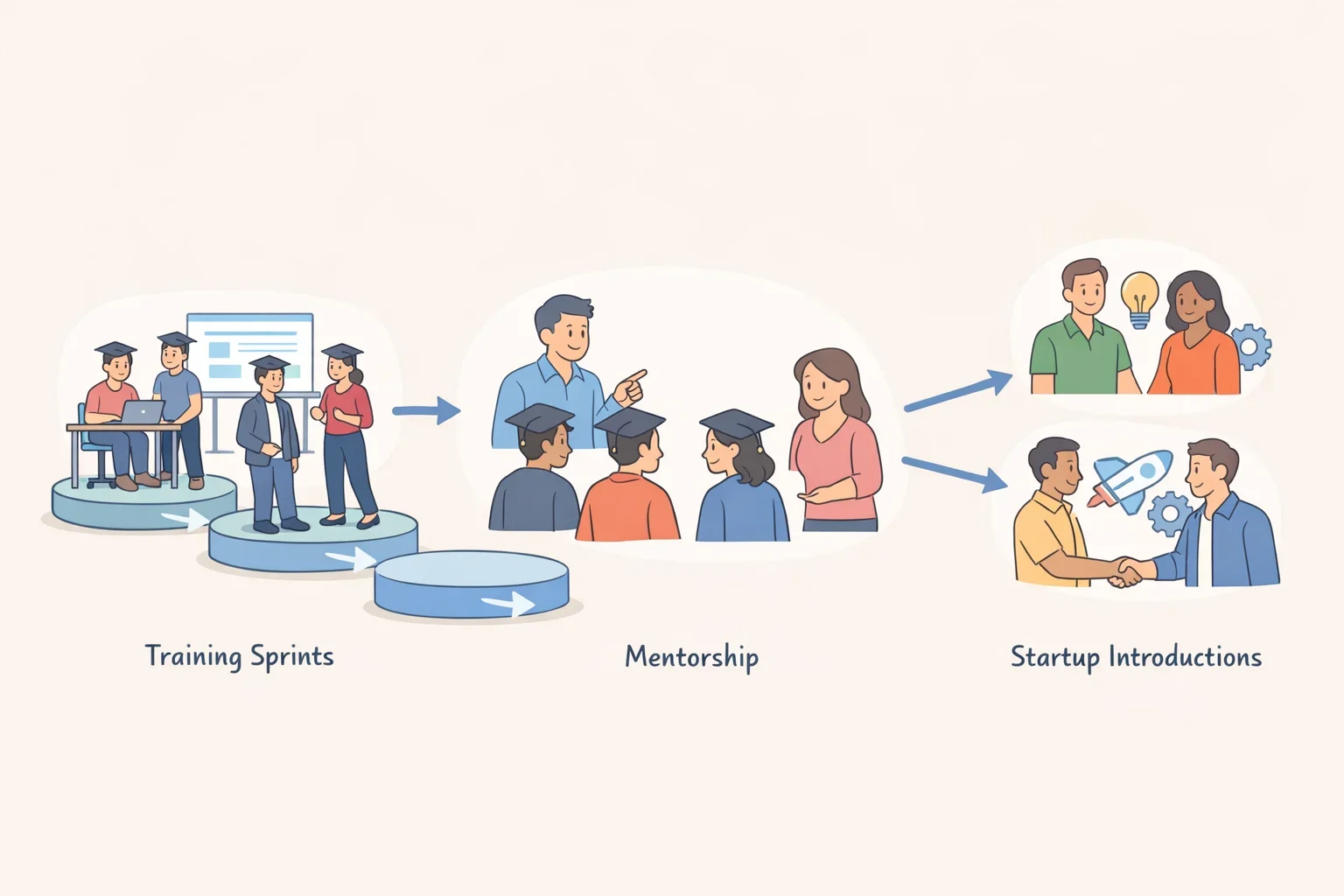
Common Path will recruit cohorts of 15 to 20 recent graduates from lower-income backgrounds Sifted, this week. Applicants will be selected on resilience, self-awareness and mental agility, rather than school pedigree or personal networks Tech.eu, this week.
The programme then runs four intensive week-long training sprints covering product, growth, operations and startup culture Tech.eu, this week. That is the practical bit. It is meant to replace the startup fluency that well-connected candidates often absorb through internships, family contacts or the sheer accident of who they know.
After the training, participants are matched with mentors and introduced to startups hiring early-career talent Tech.eu, this week. Graduates and employers can register interest at common.ventures/talent Tech.eu, this week.
The coalition behind the scheme matters too. The Sutton Trust and the Hg Foundation bring social mobility credibility, while Atomico and Phoenix Court give it venture weight Tech.eu, this week. Common Ventures, formerly Social Mobility Ventures, says the launch is part of a longer-term pipeline into the startup ecosystem Sifted, this week.
What Common Path still cannot prove

For all that, the scheme is not yet evidence of success. Common Ventures has not published placement rates, offer conversion figures, salary data or role types, so it is impossible to know whether the programme is actually landing jobs, what those jobs pay or whether they lead anywhere Sifted, this week.
The applicant pool looks broad. Common Ventures says around 40% of applicants have been Asian or Asian-British, 30% Black or Black British, and about 50% female Sifted, this week. That suggests the scheme is reaching people overlooked by the usual channels. It does not yet tell us who gets selected, who gets hired, or whether they stay.
There is also a selection question hiding in plain sight. “Resilience” and “mental agility” sound admirable enough, but Common Ventures has not explained how those traits are assessed in practice. That matters, because the scheme is trying to replace one set of status markers with another.
Common Ventures Common Path scheme is now the test
The core case for Common Path is straightforward. UK tech is underrepresenting lower-income people in both hiring and founding, and the gap shows up long before anyone talks about “merit” Sifted, this week; SMV/Substack, November 2025. Common Ventures is betting that a structured pipeline, backed by names the industry respects, can widen access in a way that vague inclusion pledges never quite manage.
The hard part is that this is now measurable. Common Path has a cohort size, a training model and named backers. It should be possible to track who enters, who gets placed and what happens next.
That is the real point of the launch. If Common Ventures is right, the programme will show that the talent was always there and the doors were the problem. If it is wrong, the data will show that too. Atomico’s Niklas Zennström has already put the case in blunt economic terms: equal access to entrepreneurship is “a growth strategy” for UK competitiveness SMV/Substack, November 2025.
Startups and graduates can register interest at common.ventures/talent Tech.eu, this week. The scheme is live. Now it has to produce more than a good argument.