
Why is Intuitive Machines stock up? NASA lunar contracts explained
Intuitive Machines stock is up because two NASA lunar reconnaissance awards landed just after a much stronger first quarter and a bigger backlog. That mix made LUNR look less like a one-off moonshot and more like a company with repeat NASA work coming through the door.
The latest spark was a pair of three-year prime contracts for lunar imaging support, one for the Lunar Reconnaissance Orbiter Camera, or LROC, and one for ShadowCam, the camera aboard South Korea’s lunar orbiter, according to the company last week (May 18, 2026). The contracts total $20 million, split between a $15.5 million LROC award and a $4.5 million ShadowCam award, both cost-plus-fixed-fee deals.
That is not much money in isolation. It matters as a signal, though, because it arrived four days after Intuitive Machines said first-quarter revenue hit $186.7 million and backlog reached $1.1 billion, per its SEC filing (May 14, 2026).
Why is LUNR stock rising after the NASA awards?
The new contracts give Intuitive Machines a role in work that has been running since 2009. Since LRO’s launch, LROC has captured more than 2.6 million narrow-angle images and more than 640,000 wide-angle images of the lunar surface, and that archive makes up a significant portion of the more than 1.8 petabytes stored on NASA’s Planetary Data System, according to the company (last week).
Now the company is leading imaging operations, data storage and analysis, and mission support for both instruments, the release said last week. It also plans to interpret and integrate the publicly available LROC archive into its planned lunar data relay satellite constellation to provide orbital and surface navigation services across government and commercial exploration, per the same release (last week).
That is the part investors seem to be leaning on. The contracts are small, but they push Intuitive Machines deeper into the lunar communications and data chain. In the company’s own framing, the LROC team, KinetX navigation expertise, and the planned relay network are being assembled into foundational infrastructure for secure, sustained lunar operations, according to the company (last week).
The NASA contract trail behind the Intuitive Machines stock surge
The reconnaissance awards did not come out of nowhere. They follow a run of NASA work that has steadily widened Intuitive Machines’ footprint.
In August 2024, NASA awarded the company a $116.9 million CLPS task order to deliver six payloads to the Moon’s south pole, and the company described it as its fourth CLPS award, according to the release (last year). In March, NASA followed with a $180.4 million fifth CLPS task order, this time requiring a larger cargo-class Nova-D lander and targeting Mons Malapert near the lunar south pole, per the company (two months ago).
That mission matters for more than its dollar value. The company said Mons Malapert offers continuous Earth visibility, stable illumination conditions, and access to permanently shadowed regions, characteristics that make it appealing for future communications, navigation, and surface infrastructure, according to the March release (two months ago).
NASA has also been buying Intuitive Machines’ communications services. In December, the company said it received additional Near Space Network contracts for Direct-to-Earth services covering highly elliptical orbit and deep-space operations, along with a previously disclosed award to deploy and operate a lunar data relay satellite constellation, according to the company (last year). Those contracts sit within a vehicle with a $4.82 billion maximum potential value, per the release (last year).
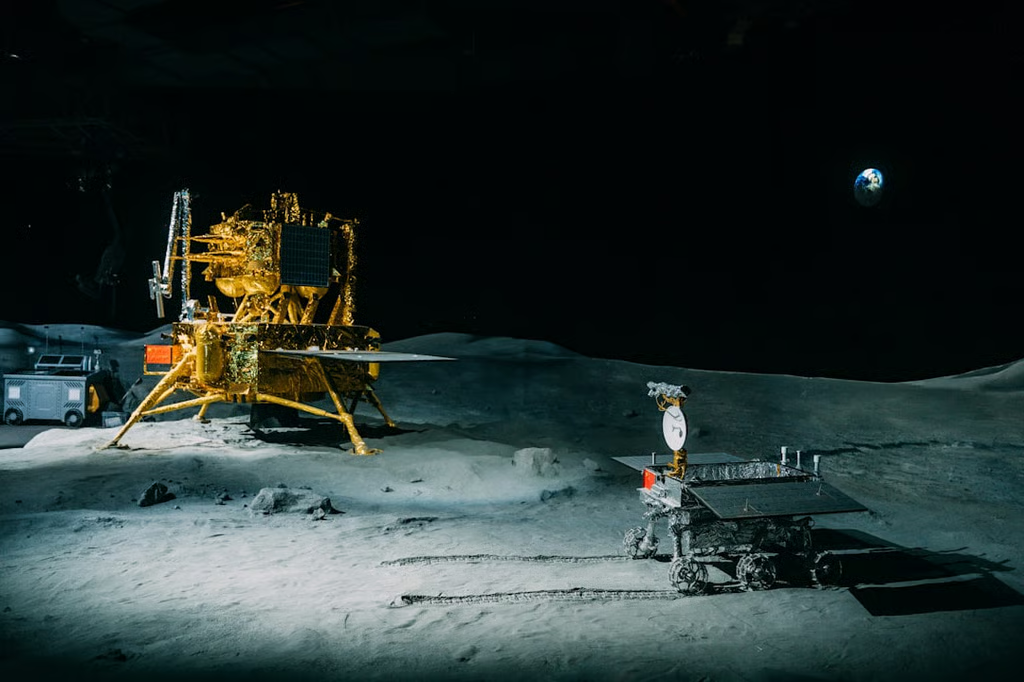
The company’s operational record helps explain why NASA keeps coming back. Intuitive Machines said it landed its Nova-C lander Odysseus on the Moon in 2024, returning the United States to the lunar surface for the first time since 1972, and that IM-2 achieved the southernmost lunar surface operations ever, per the March release (two months ago). The company also said it has built over 300 spacecraft and delivered over 260 kilograms of payload to the lunar surface, according to the May 18 release (last week).
What the financials add to the stock move
The financial story was already improving before the reconnaissance announcement. Intuitive Machines reported record first-quarter revenue of $186.7 million, nearly triple the year-ago figure, driven by the Lanteris acquisition and continued execution across CLPS, OMES, and NSNS programs, per the SEC filing (two weeks ago).
It also posted positive adjusted EBITDA of $2.7 million, according to the filing (two weeks ago). That does not settle every question about the business, but it does show the company is moving beyond the kind of early-stage burn investors usually tolerate only when the story is exciting enough.
Backlog is doing a lot of work here. At quarter end, Intuitive Machines said it had $1.1 billion in backlog, up $842.4 million from year-end 2025, per the same filing (two weeks ago). The increase included $612.8 million of acquired backlog from Lanteris and $428.9 million in new awards, mainly the IM-5 mission and a government defense contract, according to the filing (two weeks ago).
That is why a $20 million reconnaissance contract can still help the stock. By itself, it is a small line item. In the context of rising revenue, positive adjusted EBITDA, and a much larger pipeline of awarded work, it reinforces the idea that Intuitive Machines is building a recurring NASA business rather than chasing one mission at a time.
One caution: adjusted EBITDA is a non-GAAP measure, and the available research does not include GAAP profitability or free cash flow results. It also does not show how much capital Intuitive Machines will need to keep building landers, relay satellites, and the rest of the lunar network.
What investors will watch next
The next test is execution, not another headline. Investors will be watching the IM-5 mission targeting Mons Malapert, the progress of the relay satellite constellation, and whether the Lanteris acquisition continues to support the backlog and revenue growth management has pointed to, per Q1 earnings (two weeks ago).
That is where the story either compounds or stalls. For now, the market seems willing to pay for the former.