
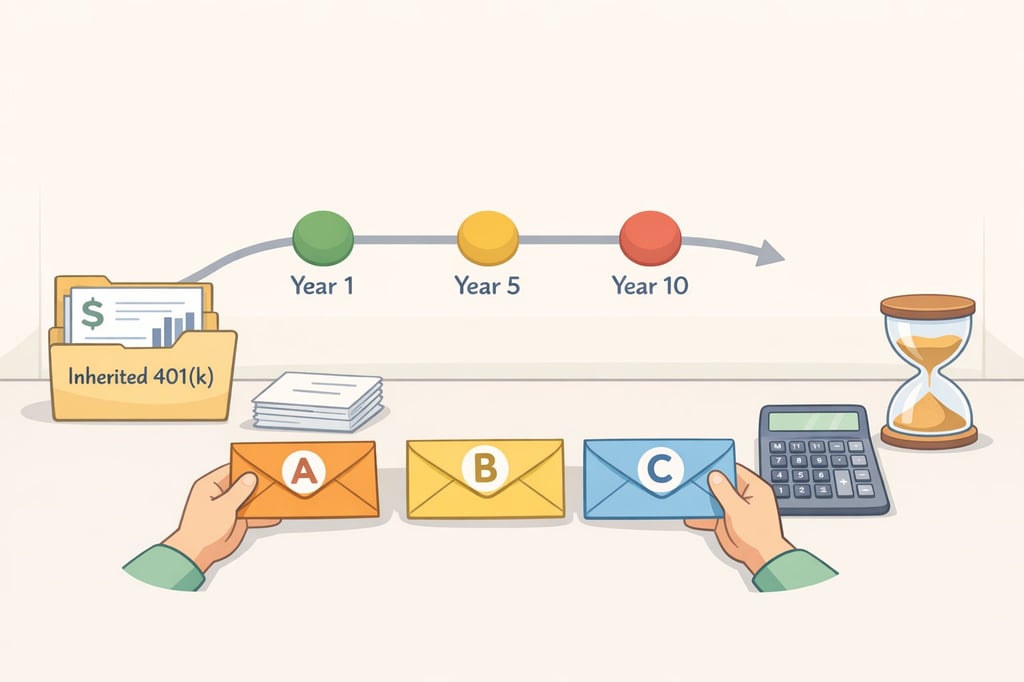
Inherited 401(k) 10-year rule: Non-spouse actions
If you inherit a 401(k), the first question is not how much is in the account. It is what kind of beneficiary you are, when the owner died, and whether the account is traditional or Roth. Those three facts decide whether the inherited 401(k) 10-year rule applies, and how much room you actually have to move the money.
For most non-spouse heirs, the old stretch IRA approach is gone. Forbes reported this month that in most cases the account must be drained within 10 years, but that is not the whole story. Some beneficiaries are exempt, and some beneficiaries subject to the 10-year rule also face annual withdrawal requirements along the way.
Who has to follow the inherited 401(k) 10-year rule
Start with the beneficiary category. The IRS beneficiary page says the 10-year rule applies to a designated beneficiary who is not an eligible designated beneficiary. That sounds like tax code, because it is.
A surviving spouse has the most flexibility. The IRS RMD FAQs say spouses are exempt from the 10-year rule and may have other options, including treating the account differently from a non-spouse heir. The same IRS guidance also lists other exemptions: a child who has not yet reached the age of majority, a disabled or chronically ill person, and someone who is not more than 10 years younger than the account owner.
That leaves the rest of the crowd, the adult child, sibling, niece, nephew, partner, and most other non-spouse heirs. Forbes says they generally fall under the 10-year rule. Think of the exemption list as a short guest list. If you are not on it, the clock starts.
The inherited 401(k) 10-year rule and the RMD date
The next question is where the owner stood on required minimum distributions, or RMDs. The required beginning date is the date an account owner must make their first RMD, according to the IRS RMD FAQs. That date matters because the inherited payout rules are not identical on either side of it.
If the owner died before their required beginning date, Forbes says the beneficiary generally must empty the account by the end of year 10. During years one through nine, the beneficiary may not need to take annual RMDs. The money can come out on the beneficiary’s timetable, so long as the account is gone by the deadline.
If the owner died on or after the required beginning date, the picture gets tighter. Forbes says beneficiaries who are subject to the 10-year rule generally must take annual RMDs during years one through nine and then fully distribute the remaining balance by the end of year 10. That is not the same as “wait nine years and yank everything out in year 10,” no matter how tempting that sounds.
The age on the owner’s death certificate can change the entire schedule. Forbes says many account owners now begin RMDs at age 73, while younger owners, generally those who reach age 74 after 2032, start at 75. A parent who died at 68 and a parent who died at 76 leave very different inheritance headaches for the same beneficiary.
There is one more wrinkle. The IRS beneficiary page says it did not treat some beneficiaries of inherited accounts as having failed to take the correct RMD for 2021 and 2022 under the 10-year rule. That relief was narrow, and it does not change the current framework. The final regulations now apply for distribution calendar years beginning on or after January 1, 2025, according to the Federal Register final rule.
Traditional versus Roth changes the tax bill
The 10-year rule is only half the problem. The other half is income tax.
Forbes says distributions from a traditional account are generally taxed as ordinary income when withdrawn. So if a non-spouse beneficiary already has wages, bonuses, or other taxable income, inherited withdrawals land on top of that. The timing can matter as much as the amount.
That is why two beneficiaries can follow the same rule and still end up with very different tax results. Taking money out steadily over 10 years is not the same thing as leaving it alone and emptying the account at the end, even if both approaches satisfy the deadline. The code does not care about your feelings, but it does care about brackets.
If the account includes after-tax contributions, Forbes says those dollars create an inherited basis, which can reduce the taxable portion of distributions. That is worth checking before any money moves.
Inherited Roth accounts follow a different tax pattern, but not a different timing rule. Forbes says inherited Roth accounts are still subject to post-death distribution rules, generally the same 10-year distribution rule, even though most qualified Roth distributions are income-tax-free. There is one catch: if the original owner did not hold the Roth for at least five years before the beneficiary takes a distribution, the earnings portion may be taxable. That five-year clock belongs to the original owner, not the heir.
Charities get a cleaner outcome. Forbes says a charity generally pays no income tax on retirement-account proceeds, and the estate may receive an estate tax charitable deduction if the account is included in a taxable estate. When multiple beneficiaries inherit one account, separate accounts may need to be set up so each beneficiary gets the best payout treatment available. In this area, paperwork is not decoration. It is the game.
How to move the account without creating a tax mess
A non-spouse beneficiary generally cannot roll an inherited 401(k) into their own IRA. Forbes says the usual path is a direct trustee-to-trustee transfer into an inherited IRA, if the plan allows it. That gives the beneficiary more flexibility than many employer plans, but the plan document still controls the menu.
The transfer method matters. If the plan sends a check made payable directly to the beneficiary, Forbes says that distribution is treated as taxable income, and the beneficiary generally may not be able to undo it by putting the money back into an IRA. The safe version is boring and not very dramatic, which is usually how tax law prefers it: direct custodian to custodian, no detour through the beneficiary’s hands.
Missed annual RMDs can also get expensive. Forbes says the default excise tax is 25% of the shortfall, with a possible reduction to 10% if corrected on time. That penalty sits on top of ordinary income tax when the money is eventually distributed.
The IRS relief for missed 2021 and 2022 RMDs under the 10-year rule was real, but temporary. The IRS beneficiary page said those failures would not be treated as missed RMDs. The final regulations now apply for distribution years beginning in 2025, per the Federal Register final rule, so that old grace period is not the current playbook.
What beneficiaries should do next
The cleanest way to handle an inherited account is to work through the questions in order: who the beneficiary is, whether the owner died before or after the required beginning date, whether the account is traditional or Roth, and what the plan document allows. Forbes says getting the order wrong is one of the easiest ways to make a costly mistake.
That sequence is not busywork. It determines whether the beneficiary has a simple 10-year deadline, annual RMDs during the first nine years, or a different exemption altogether. It also tells you whether the money should move by direct transfer or whether the plan will force another path.
Then there is the tax question, which is where the real strategy lives. A traditional inherited account produces ordinary income when withdrawn, per Forbes. That makes timing a planning issue, not just a compliance issue. Years with lower income may be the better place to take larger withdrawals, but any meaningful plan should be checked against the beneficiary’s broader tax picture before the first distribution.
The IRS RMD worksheets and beneficiary guidance page are the right places to start. From there, the details are mechanical, but they are not forgiving.