
- Social Security earnings test special rule: Monthly
- What the annual earnings test does, and why it trips people up
- How the Social Security earnings test special rule works
- The self-employment trap
- What counts as earnings, and what doesn’t
- What happens to benefits that are withheld
- What retirees should do with this rule
Social Security earnings test special rule: Monthly
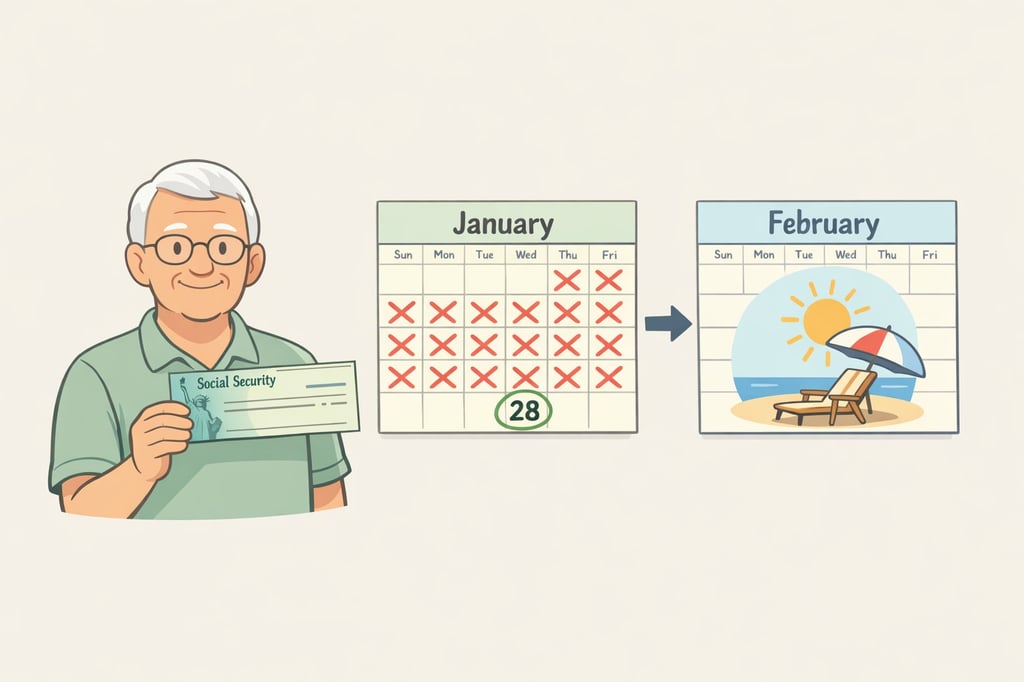
Many retirees who leave work mid-year assume they’ve already earned too much to collect Social Security for the rest of the year. That assumption can cost them several months of checks they were entitled to receive. The Social Security earnings test special rule is the exception: in your first year of retirement, it can still pay a full benefit for any whole month you’re considered retired, even if your annual earnings are already over the usual limit.
That distinction matters because Social Security uses two different tests, and people mix them up all the time. The annual earnings test looks at your income for the year. The special monthly rule, which applies in a grace year, looks at each month on its own.
What the annual earnings test does, and why it trips people up
If you are younger than full retirement age, Social Security can reduce benefits when your earnings go over the yearly limit. For 2025, that limit is $23,400, and SSA deducts $1 from benefits for every $2 earned above it (SSA FAQ, January 2025). In the year you reach full retirement age, the formula changes to $1 for every $3 above a higher limit, and only earnings before the month you reach full retirement age count (SSA FAQ, January 2025).
Once you reach full retirement age, the earnings test stops applying. Starting with the month you reach that age, SSA will not reduce benefits no matter how much you earn (SSA FAQ, January 2025). That part is straightforward. The trouble starts before then, when someone retires in the middle of the year and assumes the annual limit has shut the door for good.
Say a worker quits in July and has already earned a healthy salary through the last paycheck. Under the annual test alone, that person may look over the line and think no more Social Security checks are coming that year. But SSA has a separate rule for that exact situation, and it can keep benefits flowing for months the annual math would otherwise erase (SSA FAQ, March 2024).
How the Social Security earnings test special rule works
The special rule applies for one year, usually the first year of retirement. Under it, SSA can pay a full benefit for any whole month you’re retired and your earnings are below the monthly limit, regardless of what you make over the full year (SSA FAQ, March 2024). Think of it like a monthly reset button, but only for that grace year and only if you actually meet the retirement test for that month.
For 2026, if you are under full retirement age for all of 2026, SSA considers you retired in any month your earnings are $2,040 or less and you did not perform substantial services in self-employment (SSA Benefits Planner, January 2026). If you reach full retirement age in 2026, the monthly limit is $5,430 for the months before full retirement age, again only if you did not perform substantial services in self-employment (SSA Benefits Planner, January 2026).
SSA’s own example makes the point cleanly. John’s earnings for the year substantially exceed the 2026 annual limit of $24,480, but he still receives a Social Security benefit for July, August, and September (SSA Benefits Planner, January 2026). That happens because his earnings in each of those months are less than the $2,040 monthly limit for people younger than full retirement age, and he was not self-employed (SSA Benefits Planner, January 2026).
Beginning in 2027, the deductions are based solely on John’s annual earnings limit (SSA Benefits Planner, January 2026). That last detail is easy to miss. The special rule is temporary. Once the grace year ends, SSA goes back to the ordinary annual earnings test (SSA Benefits Planner, January 2026).
The self-employment trap
Self-employed retirees get a more complicated version of this story, because low income is not enough by itself. SSA also looks at whether you performed substantial services in self-employment during the month. Under SSA’s rule, that means more than 45 hours a month in the business, or between 15 and 45 hours in a highly skilled occupation (SSA Benefits Planner, January 2026).
That “highly skilled” detail matters. It is not a vague label meant to flatter consultants into thinking the rules are beneath them. It is part of the threshold SSA uses to decide whether the work was substantial enough to disqualify the month (SSA Benefits Planner, January 2026).
John’s example shows the difference. He gets paid in July, August, and September because he is not self-employed and his earnings are below the monthly cap in those months (SSA Benefits Planner, January 2026). He does not receive benefits for October, November, or December because he worked in his business more than 45 hours per month in all three months (SSA Benefits Planner, January 2026). That is the part a lot of people miss when they tell themselves, with admirable optimism, that a “light” return to the business should be harmless.
SSA’s policy manual backs that up. In a grace year, full benefits are payable for any month only when the retiree neither exceeds the monthly wage limit nor performs substantial self-employment services (SSA POMS RS 02501.021, April 2024). Both conditions have to be satisfied.
What counts as earnings, and what doesn’t
The earnings test is narrower than many retirees expect. SSA counts only wages from a job or net earnings from self-employment (SSA FAQ, January 2025). Pensions, annuities, investment income, interest, veterans benefits, and other government or military retirement benefits are not counted (SSA FAQ, January 2025).
That can be reassuring for someone living partly on savings and a pension. It also means a retiree with multiple income streams needs to look carefully at what actually triggers the test. A brokerage account can keep busy all year and still not affect Social Security one bit. A part-time job, though, absolutely can.
Bonuses, commissions, and vacation pay do count as wages (SSA FAQ, January 2025). So a retiree who stopped regular work in spring but receives a large bonus later in the year can still run into the earnings limit. SSA also counts wages at the earliest of three points, when you receive them, when they are credited to you, or when they are set aside for your use (SSA OP_Home, February 2025). Net self-employment income is counted on a taxable-year basis (SSA OP_Home, February 2025), which is one reason the timing gets messy fast.
If earnings change, SSA says the update cannot be reported online. It has to be reported by phone or by contacting a local office (SSA FAQ, January 2025). That is not especially modern, but it is the system.
What happens to benefits that are withheld
Withheld benefits are not simply gone. SSA tracks months in which a full or partial benefit was withheld because of excess earnings, and those become crediting months (SSA POMS RS 02501.021, April 2024). Once the retiree reaches full retirement age, those crediting months trigger a benefit adjustment that raises the monthly payment going forward (SSA POMS RS 02501.021, April 2024).
SSA describes that adjustment as removing some or all of the reduction factors from the original benefit calculation (SSA POMS RS 02501.021, April 2024). The result is a higher monthly benefit for the rest of life. That is why the earnings test is better understood as a timing issue than as a permanent penalty, at least for people who live long enough to collect the larger check.
There is still a catch, because there always is. If someone dies before the higher benefit has had time to make up for the withheld months, the math does not magically balance itself. Social Security does not do sentimental accounting.
SSA also checks earnings records every year to see whether additional earnings should increase the monthly benefit, and if there is an increase, it sends a letter with the new amount (SSA FAQ, January 2025). No separate claim is required.
What retirees should do with this rule
The Social Security earnings test special rule is designed for the retiree who assumes the year is already lost. That is often the wrong assumption. If you retire mid-year in 2026 and your monthly wages stay at or below $2,040 in any month after retirement, you may still be entitled to a full benefit for that month, even if your annual earnings already exceed the yearly cap (SSA Benefits Planner, January 2026).
Self-employed people need to be more careful still. Hours matter, not just income. More than 45 hours a month in a business can disqualify the month, and in a highly skilled occupation the line can move down to between 15 and 45 hours a month (SSA Benefits Planner, January 2026). If that sounds annoyingly specific, that is because it is.
The cleanest move is to look at the remaining months of the year before assuming benefits are gone. The special rule only lasts for the grace year, but during that stretch it can make a real difference. A few qualifying months can be the difference between no checks at all and several checks that were there for the taking.
For anyone retiring in 2026 and trying to map out the rest of the year, the key question is not just how much has been earned so far. It is which months still qualify under the Social Security earnings test special rule, and whether self-employment services change the answer. SSA can be reached at 1-800-772-1213 to report expected earnings and confirm eligibility under the special rule (SSA FAQ, January 2025).