
- Should I Open a High-Yield Savings Account?
- Why open a high-yield savings account now
- What a high-yield savings account actually is
- Traditional savings account vs high-yield savings account
- Why your emergency fund belongs in one
- When a CD or Treasury bill makes more sense
- A simple way to decide where the cash goes
- Before you open one
- The decision, stripped down
Should I Open a High-Yield Savings Account?
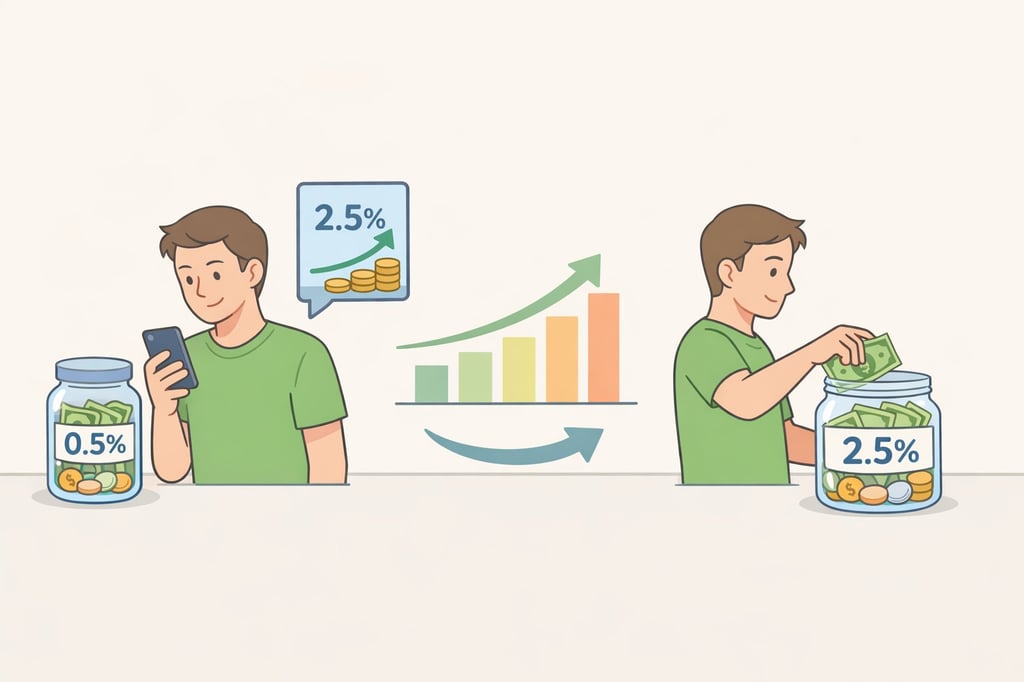
If you have cash sitting in a regular savings account, the answer is probably yes. should I open a high-yield savings account is the right question when the alternative is earning next to nothing while prices keep climbing. A standard savings account paid 0.39% APY as of August 2025, according to FDIC data cited by Experian (Sep. 2025), while inflation was running at 3.3% in April 2026, more than a full percentage point above the Federal Reserve’s 2% target (CBS News, Apr. 2026).
That gap is the whole story at first. A high-yield savings account, or HYSA, is still a savings account, just one that pays a better rate and is built for money you may need soon. The trick is knowing when that flexibility matters more than squeezing out every last fraction of a point.
Why open a high-yield savings account now
The appeal is blunt. HYSAs from online banks were paying 4.0% to 4.5% APY in early 2026, according to WealthCalc (Mar. 2026). That is not a small upgrade. It is the difference between cash that mostly sits there and cash that at least does a little work.
A HYSA is also uncomplicated, which counts for more than people admit. The account is federally insured, balances are protected up to $250,000 per depositor per institution, and the money remains available when you need it (Honest Credit, Oct. 2025). The rate is variable, so it can change, but that cuts both ways. If the Fed lowers rates, HYSA yields can fall quickly, and if rates stay elevated, the account keeps earning a competitive return (WealthCalc, Mar. 2026).
There is one reality check. Even the best HYSA rates have still been running a bit below inflation, so the account is not a magic shield against higher prices (CBS News, Apr. 2026). But compared with a traditional savings account, it is the better place to park cash you want to keep safe and reachable.
What a high-yield savings account actually is
Think of an HYSA as a standard savings account with a better engine. It works the same way, deposits go in, interest accrues, and you can move money out when needed. The difference is that online banks and some credit unions pay much more because they have lower overhead than branch-heavy banks, and they pass part of that savings along to depositors (Experian (Sep. 2025).
The account is not meant to replace investing. It is meant to hold cash that should not be exposed to stock-market swings, but also should not sit in a checking account earning nothing. SavySaver (Feb. 2026) puts it plainly: the best place for emergency cash is somewhere liquid, insured, and separate from daily spending.
That said, the details matter. Some HYSAs require a minimum opening deposit or balance, some limit the number of withdrawals, and some tie the advertised rate to direct deposit or another condition (Experian, Sep. 2025). Read the terms before you open one. The fine print is where savings accounts become less charming.
Traditional savings account vs high-yield savings account
This is where the comparison gets embarrassingly lopsided. A traditional savings account was paying 0.39% APY as of August 2025, according to FDIC data cited by Experian (Sep. 2025). By contrast, HYSAs were paying around 4.0% to 4.5% in early 2026, according to WealthCalc (Mar. 2026).
The money difference is not theoretical. On a $10,000 balance, a 0.39% account generates about $39 before tax over a year, while a 4% account earns about $400. You do not need a whiteboard for this one.
The other difference is access. CBS News (Apr. 2026) noted that a traditional savings account is increasingly hard to justify when rates are under 0.40% and variable, while HYSAs do not carry the same lockup that CDs do. That matters because the best savings account is not the one with the highest headline number. It is the one you can actually use when life gets annoying.
Why your emergency fund belongs in one
Emergency savings have one job: be there. Experian (Sep. 2025) describes an emergency fund as money set aside for unexpected costs like medical bills, car repairs, or a family emergency. Honest Credit (Oct. 2025) adds the useful rule of thumb that most people should build toward three to six months of essential expenses.
That money belongs in a place that does not punish you for using it. SavySaver (Feb. 2026) says the highest rate is meaningless if the cash is hard to reach when the bill arrives. A HYSA fits the job because it keeps the funds liquid, insured, and separate from everyday spending.
There is a practical starting point for people who are not yet fully funded. Honest Credit (Oct. 2025) recommends beginning with $500 to $1,000, then building toward one month of essentials and eventually three to six months. That is a lot more realistic than pretending everyone can conjure six months of expenses out of thin air by Friday.
Some savers split the fund into layers. SavySaver (Feb. 2026) says one approach is to keep the first layer in an immediately accessible HYSA and place a second layer in a short-term CD if the rate is attractive and the penalties are reasonable. That can work, but it only makes sense after the first layer is already safe and ready.
When a CD or Treasury bill makes more sense
Once the emergency fund is in place, the question changes. If the cash will not be needed for a while, paying for instant access may be unnecessary. That is where CDs and Treasury bills enter the picture.
CDs, or certificates of deposit, pay a fixed rate for a set term. WealthCalc (Mar. 2026) said competitive CDs were paying 4.0% to 4.75% APY in early 2026, and CBS News (Apr. 2026) noted that rates are locked for the full term. That can be a smart move if you expect rates to fall later this year or in 2027. The tradeoff is access, because early withdrawal usually costs you several months of interest (WealthCalc, Mar. 2026).
Treasury bills and notes are the cleaner answer for some savers, especially in high-tax states. WealthCalc (Mar. 2026) said Treasury securities were yielding 4.0% to 4.5% in early 2026, and Treasury interest is exempt from state and local income tax. On $50,000 held for a year, WealthCalc calculated net returns of $1,677 for a 1-year T-bill, $1,620 for a CD, and $1,530 for a HYSA at a 22% federal and 6% state bracket (WealthCalc, Mar. 2026).
That tax edge is real, but it is not universal. If the balance is smaller, or the tax rate is low, the extra hassle may not be worth it. Experian (Sep. 2025) notes that T-bills are sold in $100 increments and come in maturities from four to 52 weeks, but they still require a bit more attention than a plain HYSA. Some people love that sort of thing. The rest of the population would rather not turn cash management into a side project.
A simple way to decide where the cash goes
The cleanest framework is this:
- HYSA: keep the first three to six months of essential expenses here, or at least your starter emergency fund. WealthCalc (Mar. 2026) and Honest Credit (Oct. 2025) both put emergency cash in an insured, liquid account first.
- CDs: use these for money you know you will not need for a set period and can live with locked terms.
- Treasuries: use these when the tax math improves the outcome, especially in a higher-tax state or on a larger balance.
That is the whole hierarchy. Easy cash first, locked cash second, tax-efficient cash third.
Before you open one
A few checks save headaches later. Confirm the APY and whether it depends on direct deposit, a minimum balance, or a balance threshold. Experian (Sep. 2025) also notes that some HYSAs limit monthly transfers, and Honest Credit (Oct. 2025) recommends testing transfer speed before you actually need the money.
Also check deposit insurance. FDIC or NCUA coverage generally protects up to $250,000 per depositor, per institution, per ownership category (Honest Credit, Oct. 2025). If a balance is getting close to that ceiling at one institution, split it.
Finally, automate the transfer. Even $25 or $50 per paycheck builds the habit and keeps the account from becoming a forgotten corner of your finances. Money that arrives by accident tends to leave by accident too.
The decision, stripped down
If the money is for emergencies or may be needed soon, a HYSA is usually the right answer. It offers the useful combination of better yield, insurance, and access, which is exactly what cash is supposed to do when it is behaving itself. If the money can stay put for longer, CDs and Treasuries deserve a look, especially while rates remain elevated in early 2026 (WealthCalc, Mar. 2026).
The point is not to chase the highest rate like it is a hobby. It is to put each dollar in the place that matches its job. Emergency money needs freedom. Idle cash does not.