
Should you use one credit card for everything?
If you pay in full, one credit card for everything is often enough. If you carry a balance, the card count barely matters, because interest does the real damage. That is the blunt answer behind the question of should you use one credit card for everything.
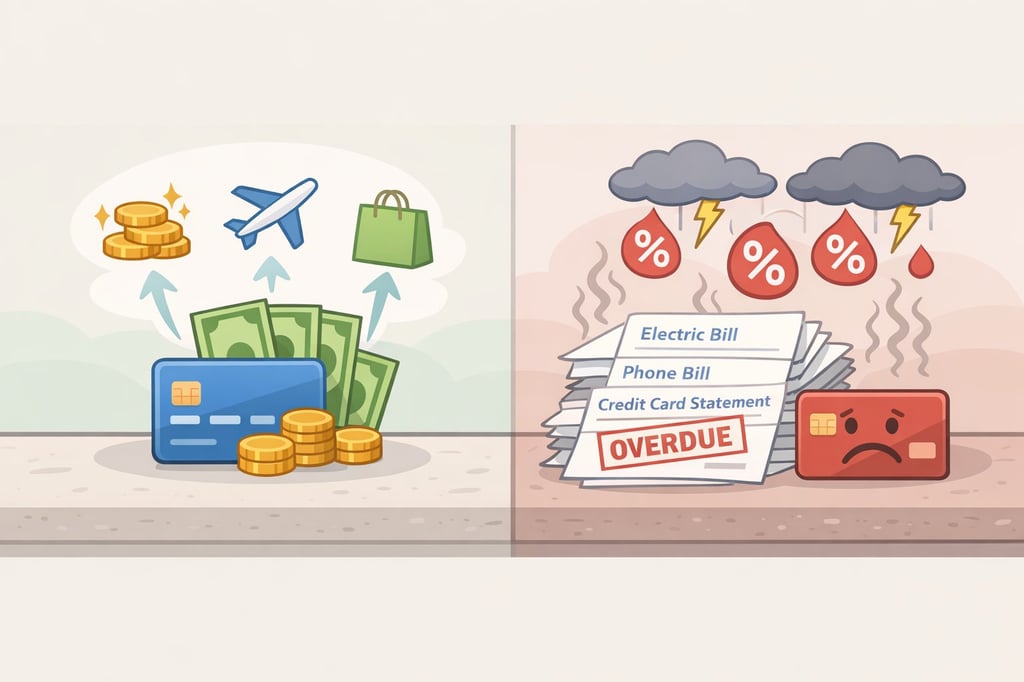
A flat 2% cash-back card used on every purchase returns about $240 a year on $1,000 in monthly spending, but if you carry a $3,000 balance at 25% APR on that same card, you end up down roughly $510 on net (CardSavvy, February 2026). That is the whole argument in one line. Rewards look smart until debt shows up.
CardSavvy also says the Federal Reserve has found that roughly half of credit card holders carry a balance at least some of the time (CardSavvy, February 2026). For that group, the more urgent question is not whether to use one card or several. It is whether rewards are even worth discussing yet.
Should you use one credit card for all purchases?
The simplest answer is yes, if you pay in full, want low friction, and do not spend enough for complex reward math to matter much. CardSavvy says that if you spend less than $500 a month on cards, a simple flat-rate 2% cash-back card captures most of the available value (CardSavvy, February 2026). On $400 a month, the difference between that and an optimized multi-card setup is only roughly $5 to $10 a month (CardSavvy, February 2026).
That is not a life-changing sum. It is a nice dinner, not a financial strategy.
Experian says 25% of consumers in the United States use only one credit card, and they tend to have better credit and lower debt balances than people with multiple cards (Experian, October 2025). So the single-card approach is not some beginner mistake. For plenty of people, it is the cleaner setup.
The appeal is obvious. One statement. One login. One autopay. Fewer chances to forget a payment or let a fee-heavy card sit in a drawer collecting dust. Citi says multiple cards can add flexibility, but they also add missed-payment risk, annual fees, and more complicated tracking (Citi, November 2025).
If that is the world you live in, use the simplest card that still makes sense. U.S. News said many people are not willing to juggle multiple monthly bills, and travel expert Scott Mayerowitz put it plainly: “Many folks aren't willing to have multiple monthly bills” (U.S. News, December 2024). That kind of honesty is refreshing. It also happens to be practical.
A good single card should do three things: charge no annual fee, or one that clearly earns its keep; offer at least a flat 2% back across purchases; and avoid foreign transaction fees if travel is part of your life (U.S. News, December 2024). If a card cannot cover the basics cleanly, it is not a one-card solution. It is just a complication with a nice welcome bonus.
When a second card earns its place
A second card makes sense when your spending is high enough, and concentrated enough, that the extra reward beats the extra hassle. CardSavvy says a flat 2% card plus one category card for your biggest spending bucket captures roughly 80% of the value of a fully optimized wallet (CardSavvy, February 2026). For many people, that is the sweet spot.
U.S. News said most consumers can benefit from having two or three cards, while Experian says there is no single number that works for everyone (U.S. News, December 2024; Experian, October 2025). That is less exciting than the maximize-everything crowd would like, but it is more useful. Card strategy should fit the person, not the other way around.
Annual fees are where a lot of people get seduced by shiny math. Fiyr says if a card gives 5% versus a 2% baseline in a category and charges a $95 annual fee, you need roughly $3,167 in that category each year just to break even (Fiyr, December 2025). Spend less than that, and the fee eats the advantage. Spend more, and the card may be worth it.
The same discipline applies to perks. CardSavvy says to count only credits you would actually use without changing your behavior, and that a $300 hotel credit has $0 value if you do not stay in hotels (CardSavvy, February 2026). That sounds obvious until a statement credit arrives and suddenly people are booking trips they never wanted.
At the far end of the spectrum sits card churning, the practice of opening a card, collecting the welcome offer, and closing it soon after. NerdWallet Canada says repeated applications can add hard credit checks, shorten average account age, and make it harder for your score to recover (NerdWallet Canada, December 2024). It also notes that some card providers limit welcome bonuses to once per lifetime (NerdWallet Canada, December 2024). The upside narrows fast once the gamesmanship starts.
The budgeting problem card count will not fix
A lot of people blame the wrong villain. The issue is not always having one card or three. It is bad tracking.
Fiyr describes a common mistake in which a budgeting app records card charges as spending and then records the card payment as spending again, making a $2,800 budget look like $3,400 (Fiyr, December 2025). That is not budgeting. That is accounting with a blindfold on.
The fix is simple: treat the card like a passthrough. Budget purchases when they happen, not when the bill gets paid, and keep the payment itself out of spending categories (Fiyr, December 2025). Fiyr says that when one profiled user cleaned up category mapping and set autopay to pay in full, the phantom overspend disappeared and savings rate rose by four points (Fiyr, December 2025).
That is one of the strongest arguments for using one credit card for all purchases. Fewer cards mean fewer places for category confusion, forgotten subscriptions, or an old card still quietly billing after a move. It also means one place to see fees and interest, instead of letting them vanish into a vague “miscellaneous” bucket.
Fiyr flags a few other traps worth keeping in view: refunds recorded as income instead of expense reversals, business and personal swipes mixed together, and subscriptions lingering on cards you barely check (Fiyr, December 2025). None of those problems improves just because the wallet got more crowded.
The one-card default, and when to leave it alone
A sensible default is a flat-rate card, used for everything. CardSavvy recommends that approach for people whose monthly spend is under $1,000 or who want zero friction (CardSavvy, February 2026). That is a good fit for a lot of households. Simple systems tend to survive contact with real life.
If spending rises and starts clustering in one area, a second card can be worth the trouble. CardSavvy’s example is straightforward: one flat 2% card plus one category card in your biggest spending bucket can deliver most of the upside without turning the wallet into a hobby (CardSavvy, February 2026). Beyond that, the returns get smaller and the management burden gets larger.
There is no prize for collecting the most plastic. Experian says there is no specific number of cards that is right for everyone, and that the right number depends on how well you can manage limits and due dates (Experian, October 2025). That is the part people skip when they start comparing multipliers and lounge passes. But it is the part that matters.
What matters more than the number of cards
Whatever setup you choose, a few rules still matter. Pay the statement balance in full, keep balances low relative to your limits, and do not apply for cards in a pile-up. Experian says spacing applications out by about six months is generally a good idea to reduce the combined effect of hard inquiries (Experian, October 2025). It also says keeping balances below 30% of available credit can help maintain strong credit (Experian, October 2025).
That last point is a threshold, not a magic spell. Lower is usually better. The model is not sentimental.
The bigger lesson is that the right card setup depends on the part of the problem you are actually trying to solve. If the issue is debt, no rewards structure will rescue it. If the issue is simplicity, one well-chosen card may be perfect. If the issue is extracting value from a stable spending pattern, two cards may be enough.
So, should you use one credit card for everything? For many people, yes. It is the clean default, especially if spending is modest and rewards chasing would add more friction than value. When spending is larger and concentrated, a second card can earn its keep, but only if the numbers clear the annual fee and the setup still feels manageable.
For readers who want to go deeper, the next step is not collecting more cards. It is running the math on actual spending and asking whether the added complexity is paying rent.