
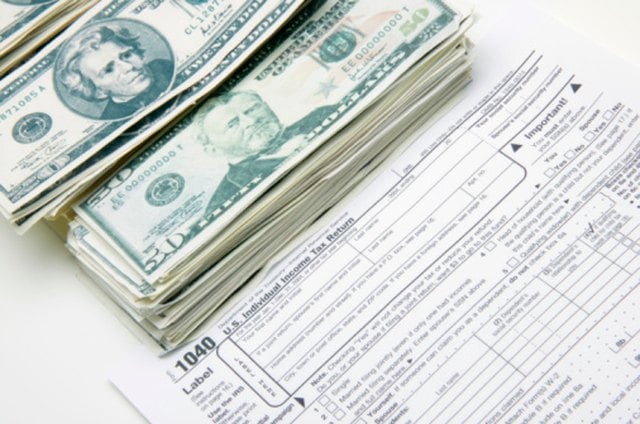


SS EE is an acronym for federal Social Security taxes paid by employees. All employees in the United States pay these taxes out of every pay check, at least up to a certain amount of income. The employer has the obligation to withhold those taxes from each paycheck, and pay the taxes to the IRS. Along with Medicare taxes, Social Security taxes are also called payroll taxes, wage taxes or FICA taxes.
Social Security
The "SS" taxes stand for Social Security taxes. Sometimes the taxes will appear as OASDI taxes instead of SS taxes. OASDI refers to the official name of social security, which is Old Age, Survivors, Disability, and Hospital Insurance. Both employers and employees pay Social Security tax on the first $106,800 of the employee's wages during the year. Any annual wages beyond $106,800 are not taxed for Social Security. The designation "EE" stands for the Social Security taxes paid by the "employee," as opposed to the Social Security taxes paid by the employer, which are designated as SS ER.
Medicare Taxes
The other type of wage, payroll or FICA tax is Medicare tax. Again, both employers and employees pay Medicare taxes on the employee's wages. However, unlike Social Security taxes, Medicare taxes apply to all wages earned by the employee, no matter how high the income is.
Rates
The Social Security tax rate for 2011 is 4.2 percent for employees and 6.2 percent for employers. This means the employee pays $4.20 in Social Security taxes (SS EE) for every $100 earned, while an employer pays $6.20 in Social Security taxes (SS ER) for every $100 paid to the employee. As for Medicare taxes, the rate in 2011 is 1.45 percent for both employer and employee. So for every $100 earned by an employee, the employer pays $1.45 in Medicare taxes, and the employee also pays $1.45 in Medicare taxes.
Self-Employment
Self-employed individuals pay self-employment tax, which is 13.3 percent of earnings, as of 2011. The 13.3 percent self-employment tax theoretically covers both the employer side and employee side of Social Security and Medicare taxes (6.2 plus 4.2 plus 1.45 plus 1.45).