
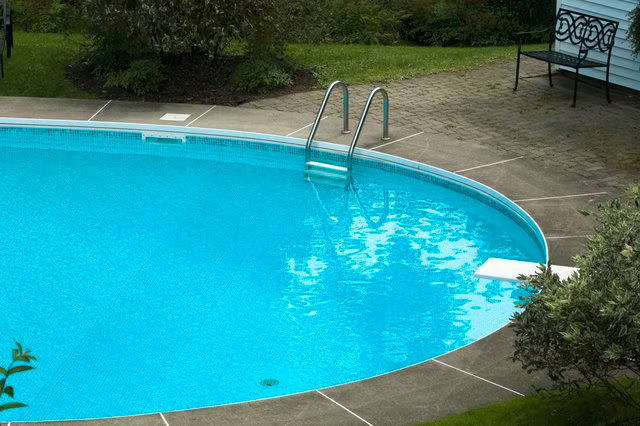


In-ground pools tend to increase property values, which causes corresponding property taxes to increase. An in-ground pool will often require higher insurance coverage limits as well, which increases homeowners insurance premiums. Finally, the cost of an in-ground pool increases your basis in the property, which might increase your taxable gain when you sell the home.
Property Taxes
An in-ground pool will likely trigger a reassessment of your home value and a corresponding increase in your annual property tax bill. Exact practices vary by state and county, but most jurisdictions will reassess your home's value when it is first constructed, at each resale, and when improvements such as adding an in-ground pool are made. The amount your property bill will increase depends on the assessor's computation of your new property value and your jurisdiction's property tax rates. According to U.S. News & World Report, you can usually expect an in-ground pool to increase your property value by 6 to 11 percent.
Homeowner's Insurance
Along with property taxes, an in-ground pool can increase your homeowner's insurance premiums. That's because if someone wanders into your backyard and injures himself or drowns in your pool, you can be held personally liable for damages. You'll probably want to increase your homeowner's insurance coverage to protect yourself, which means higher premiums. To mitigate these risks, insurance companies recommend enclosing pools by a fence that's at least four feet high and keeping any gates to the pool area locked.
Tax Basis in the Home
When you make improvements and additions to a home, it adds to your basis in the home. Your basis in a property when you sell it determines the amount of gain or loss you incur for tax purposes. Installing an in-ground pool might increase the taxes paid when you sell your home, depending on the sales price. For example, if you install a pool for $20,000 and are able to sell the house for $30,000 more as a result, your gain is $10,000. If the pool installation doesn't increase your property value at all, there is no gain.
Taxes Paid on Home Sale
Constructing an in-ground pool may or may not impact your overall income tax bill. Homeowners are allowed to exclude the first $250,000 of gain on the sale of their homes and can't deduct any losses from the sale of the home. However, investment property owners and rental property owners do pay taxes on the gains and get a tax break for the losses. For these taxpayers, an increased gain due to a new pool means a higher tax bill.