
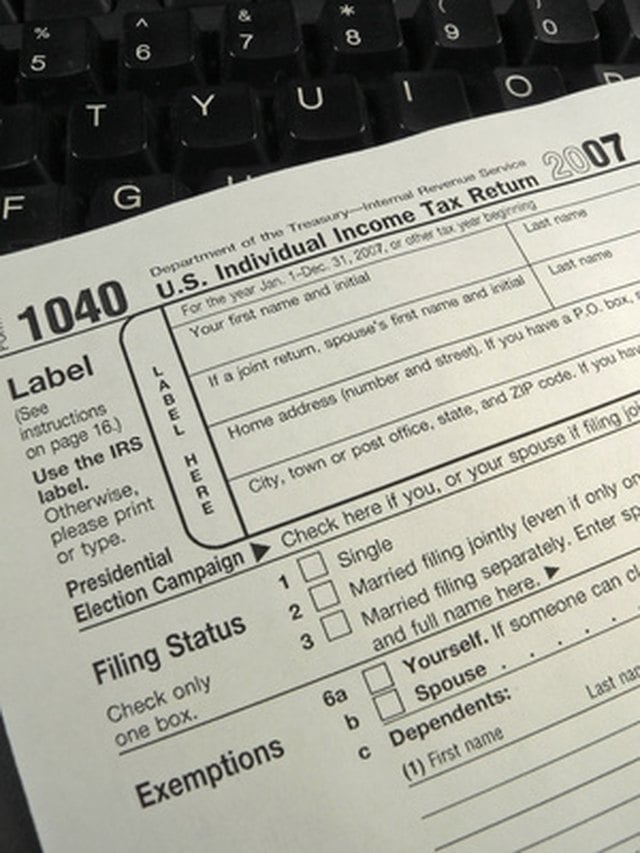


The Internal Revenue Service (IRS) generally considers an individual an independent consultant or contractor if he or she controls the means in which work is accomplished. The IRS treats independent consultants as self-employed for tax purposes. As an independent contractor, you generally must pay self-employment tax and report your business income and deductions on Schedule C of the individual tax return, Form 1040.
Instructions
Step 1
Complete Schedule C or Schedule C-EZ as applicable. You may use the C-EZ if you had $5,000 or less in expenses and meet several other qualifications listed in the form's instructions. The EZ Schedule allows you to list your revenues and expenses in totals rather than by line items. If you do meet all of the requirements for the EZ form, then you must file the full Schedule C.
Step 2
If filing the full form Schedule C, you will need to complete Parts I and II, Income and Expenses. Use Part V to report additional expenses that do not fall into any of the preprinted categories. You will only need to complete Part III, Cost of Goods Sold, if you have inventory. Complete Part IV, Information on Your Vehicle, if you do not file Form 4562, Depreciation, and claim a deduction for automobile expenses.
Step 3
Determine your self-employment tax. If your net income is less than $400, you, are not required to file Schedule SE or pay any self-employment tax. Transfer the net profit or loss from Schedule C, line 31, or Schedule C-EZ, line 3, to line 2 of Schedule SE. You will file either the short or long form, depending on if you meet the criteria listed in the flowchart on the first page of the form.
Step 4
Enter one-half of the amount of your self-employment tax on Form 1040, line 27. The IRS allows one-half of your self-employment tax as a deduction to arrive at adjusted gross income.