
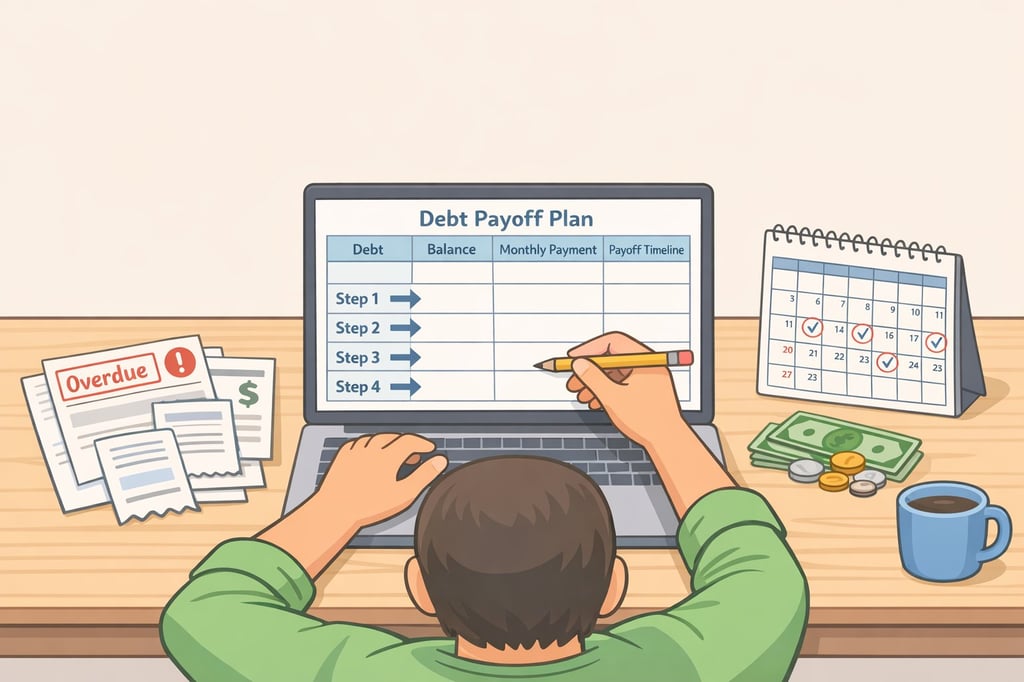
- How to Create a Debt Payoff Plan From Scratch Step-by-Step
- Step 1: Build your complete debt inventory
- Step 2: Build a realistic budget and find your payoff margin
- Step 3: Rank your debts before you choose a method
- Step 4: Choose your debt payoff strategy
- Step 5: Lower the cost of your debt while you pay it down
- Step 6: Know when to bring in outside help
- What comes next
How to Create a Debt Payoff Plan From Scratch Step-by-Step
Most people who want to pay off debt start by googling “snowball vs. avalanche” and end up with half a plan. The method only works once the foundation is solid: every debt on the table, a real budget, and a clear understanding of which debts carry consequences beyond a late fee.
This guide walks through how to create a debt payoff plan step by step, from the first inventory to choosing a repayment strategy to knowing when to ask for outside help.
- Americans collectively carry more than $17 trillion in consumer debt across mortgages, credit cards, auto loans, and student loans (Lake Trust Credit Union, late 2024, citing Experian). That number reflects how ordinary this situation is, and why a workable plan matters more than a perfect one.
- Missing minimum payments for 4 to 6 months can trigger a creditor “charge-off,” which can hurt your credit score even though the debt still remains (FTC Consumer Advice, December 2025).
- A budget can help you see where you spend your money and how you might spend it differently, which is the part that makes debt repayment possible (FTC Consumer Advice, December 2025).
Prerequisites: You’ll need current loan and credit card statements, a rough sense of monthly take-home income, and about 30 to 60 minutes to get the first two steps done properly.
Step 1: Build your complete debt inventory
Before choosing a strategy, list every debt in one place. This is the step most people skip, then wonder why the plan keeps slipping off the rails.
Record this for each debt:
- Creditor name
- Current balance
- Interest rate, or APR
- Minimum monthly payment
- Due date
- Debt type, such as credit card, auto loan, student loan, or mortgage
Writing down the due dates, payoff amounts, and minimum payments gives you a fuller picture of what you owe and which loans make sense to tackle first (Lake Trust Credit Union, late 2024).
Separate secured debt from unsecured debt. That matters because some lenders can move faster than others if payments stop. Most car financing agreements allow repossession when a borrower is in default, and the lender does not have to give notice (FTC Consumer Advice, December 2025). If you’re behind on a mortgage, contact the lender immediately, because waiting can lead to foreclosure (FTC Consumer Advice, December 2025).
Federal student loans deserve their own line in the inventory, too. If you have federal loans, the U.S. Department of Education has repayment and forgiveness programs that may help, and applying for them is free through StudentAid.gov or your servicer (FTC Consumer Advice, December 2025).
What you should see when you’re done: A single list that can be sorted by balance, by APR, and by payment size. That list is the raw material for the payoff order.
Step 2: Build a realistic budget and find your payoff margin
A debt payoff plan needs fuel. The budget is where you find it.
Start with four numbers:
- Monthly take-home income
- Fixed essential expenses, such as housing, utilities, insurance, groceries, transportation, and minimum debt payments
- Variable spending, such as dining, subscriptions, clothing, and entertainment
- What’s left after expenses are subtracted from income
That last figure is your payoff margin. It may be small. It still counts.
Budgets work because they show where money is going and where it can be redirected (FTC Consumer Advice, December 2025). Some people find room in subscriptions. Others find it in food delivery or automatic charges they forgot were still running.
Any amount above the minimum payment helps. Whether it’s five dollars or five hundred, extra payments can reduce interest charges and help you pay debt off faster (Lake Trust Credit Union, late 2024).
Don’t give every dollar to debt, though. If your emergency cushion is zero, one car repair or medical bill can shove you straight back onto a credit card. That’s not a plan. That’s a trap with better branding.
If your budget shows you can’t cover minimum payments on everything, call your creditors now, before a debt collector gets involved (FTC Consumer Advice, December 2025). Tell them what’s going on and ask whether they can lower your payments, reduce your interest rate, or offer a payment plan you can manage (FTC Consumer Advice, December 2025). Get any agreement in writing and keep it.
Step 3: Rank your debts before you choose a method
This is the practical bridge between “I have a spreadsheet” and “I actually know what to pay first.”
Start with the debts in your inventory, then sort them in this order:
- Secured debts that could lead to repossession or foreclosure if ignored
- Federal student loans, if you want to compare free repayment options first through StudentAid.gov
- Unsecured debts, such as credit cards, medical bills, and personal loans
From there, choose the order based on your repayment method.
If you use the debt avalanche method, sort the remaining debts by APR, highest to lowest. The idea is simple: pay minimums on everything, then throw extra money at the highest-rate debt first, because lower interest rates can shorten the repayment timeline and reduce what you pay over time (Earnest, February 2026). That’s the math.
If you use the debt snowball method, sort the remaining debts by balance, smallest to largest. You still pay minimums on everything else, but the extra money goes to the smallest balance first (Earnest, February 2026). The appeal is psychological, not mathematical, and there’s nothing wrong with that. Debt repayment is part math, part stubbornness.
A simple ranking rule helps keep the plan usable. Secured debts go on top if they’re in danger of default. After that, avalanche means highest APR first, while snowball means smallest balance first.
Step 4: Choose your debt payoff strategy
There are two primary debt payoff strategies that can be used to eliminate debt, the debt snowball method and the debt avalanche method (Earnest, February 2026).
Debt avalanche
- Pay minimums on all debts
- Put every extra dollar toward the highest interest rate
- Move to the next-highest rate once that balance is gone
This method may save the most money on interest charges over time, and lower interest rates can significantly shorten your repayment timeline (Earnest, February 2026). It’s also the cleaner choice if the rate gap between debts is wide enough that the savings matter.
Debt snowball
- Pay minimums on all debts
- Put every extra dollar toward the smallest balance
- Roll that payment into the next-smallest debt
Snowball is built around early wins. Paying off a smaller balance first can make it easier to stay motivated over a long payoff stretch (Lake Trust Credit Union, late 2024; Earnest, February 2026).
A straightforward example from the research makes the idea concrete. If you pay $400 a month on a car loan and $100 on a credit card, paying off the car loan first frees up $400 a month. That turns the credit card payment into $500 a month instead (Lake Trust Credit Union, late 2024).
If the difference between your highest and lowest interest rates is small, snowball’s motivational edge may be worth more than the math of avalanche. If one card is sitting at a much higher APR than the rest, avalanche becomes harder to ignore. The spreadsheet will tell you one thing. Your habits will tell you the rest.
Step 5: Lower the cost of your debt while you pay it down
Paying more is one lever. Lowering the cost of the debt is another.
Talk to your credit card company or private lender and ask whether they can lower your interest rate or fees (FTC Consumer Advice, December 2025; Earnest, February 2026). The FTC says to suggest a payment plan you can afford, and to keep good records of who you spoke to, what you agreed to do, and the next steps (FTC Consumer Advice, December 2025). Ask for a written version of any agreement and save it until the debt is paid.
Debt consolidation can simplify monthly payments and may reduce interest rates if you have multiple high-interest loans (Earnest, February 2026). A personal loan can serve that purpose, and balance transfer offers can do the same for credit cards if the promotional rate and transfer fee still make the numbers work (Lake Trust Credit Union, late 2024).
Refinancing federal student loans is the place to slow down. If you refinance into a private loan, you lose federal benefits tied to the original loans, including income-driven repayment plans, deferment, Public Service Loan Forgiveness, and other deferment and forbearance options (Earnest, February 2026). That tradeoff can be permanent. Check the free federal options at StudentAid.gov first.
Term length matters too. Refinancing to a longer term may lower your monthly payment, but it can increase the total interest you pay (Earnest, February 2026). A smaller payment is not automatically a better deal. Banks are very good at making that look convenient.
Step 6: Know when to bring in outside help
If budgeting and a payoff method still won’t get you there, structured help exists. The key is knowing which kind.
A nonprofit credit counselor can help you make a budget and create a plan to repay your debts (consumer.gov, late 2024). If a debt management plan fits, you make one monthly payment to the counseling agency, and the counselor pays your unsecured debts according to the plan (FTC Consumer Advice, December 2025; consumer.gov, late 2024). These plans are generally designed for unsecured debt, not debts secured by collateral like houses or cars (FTC Consumer Advice, December 2025).
Debt management plans typically take three to five years or more to complete, and they can include reduced interest rates and waived fees (NFCC, mid-2024; FTC Consumer Advice, December 2025). The first counseling session is generally free, and some agencies charge a setup fee of $75 or less plus a monthly fee between $25 and $50 (NFCC, mid-2024). The fees are not nothing, but they’re also not mysterious, which is refreshing.
Debt settlement is different. For-profit companies typically offer settlement programs to people with significant credit card debt, and the process often involves stopping payments while money accumulates in a designated account (FTC Consumer Advice, December 2025). Consumer.gov notes that many people who use debt settlement plans end up owing more money, not less (consumer.gov, late 2024). A debt settlement company cannot charge fees before settling a debt (FTC Consumer Advice, December 2025).
Bankruptcy is the last lane, but it is still a legal tool, not a moral verdict. Chapter 13 can let people with steady income keep property like a mortgaged house or car while they repay some debts in three to five years, and Chapter 7 generally involves liquidating non-exempt assets for a faster discharge (FTC Consumer Advice, December 2025). Bankruptcy stays on a credit report for 10 years, and filing fees are several hundred dollars, with attorney fees extra (FTC Consumer Advice, December 2025).
If you’re comparing outside help, start with a nonprofit credit counselor rather than a for-profit settlement shop. The FTC says you do not need to pay a private company for these services, and you can negotiate directly with creditors yourself for free (FTC Consumer Advice, December 2025).
What comes next
By now, the debt inventory is built, the budget is in place, the debts are ranked, and the payoff method is chosen. If rate reduction or consolidation makes sense, those moves can run alongside the plan. If the numbers still don’t work, nonprofit counseling or bankruptcy may be the more honest answer.
The important part is not elegance. It’s motion.