
- Small cap meme stock rally explained: unprofitable leaders
- Why the small cap meme stock rally took off
- What the Russell microcap index surge is really showing
- The real divide: improving small caps versus attention stocks
- What meme trading behavior says about this move
- Why history still favors caution
- What this rally tells us now
Small cap meme stock rally explained: unprofitable leaders
The small cap meme stock rally is not behaving like a normal rotation. The Russell Microcap Index is surging, yet 57.4% of its members lost money in 2025, according to LSEG data cited by Morningstar in February.
That matters because it changes the question. This is not just investors rediscovering smaller companies after years of megacap dominance. It is also money flowing toward the least profitable corner of the market, where attention can matter more than cash flow.
Over the past six months, microcaps and small caps have outperformed large caps, even though the Russell 1000, with the fewest loss-making constituents at 12.5%, has lagged both Morningstar reported in February. That odd mix of breadth and speculative excess is the heart of the move.
Why the small cap meme stock rally took off
Some of the rally has a perfectly ordinary macro explanation. In July 2024, softer inflation data revived hopes of a Federal Reserve rate cut, and the Russell 2000 jumped 7% in a single week on that thesis, FT reported at the time. Smaller companies generally carry more floating-rate debt than large caps, so lower rates can matter more to them.
The move also looked broad at first glance. More than 1,500 of the nearly 2,000 companies in the Russell index rose during that stretch, while the equal-weighted S&P 500 climbed almost 3% even as the cap-weighted version fell, FT reported in July 2024. That is usually what breadth looks like before people start arguing about whether breadth really counts.
But there was a catch. Bank of America analysts said short covering was a important driver of the Russell 2000 rally, with heavily shorted stocks among the strongest performers, FT reported in July 2024. That does not make the rally fake, but it does make it more brittle. A move powered by short covering can run fast and still leave very little behind.
That distinction matters when the market’s attention shifts from small caps in general to the smallest, sketchiest names in particular. A rate-sensitive rotation and a speculative stampede can happen at the same time. They are not the same thing.
What the Russell microcap index surge is really showing
At the far edge of the market, the names drawing the most attention do not look like classic recovery stories. FT noted in July 2024 that the most-traded US stocks by volume included a roughly $2 million Chinese tea-shop chain with plans to mine bitcoin, a loss-making scrap-metal merchant, and an electric vehicle maker that had sold just four cars. Those are not the sort of companies that usually appear in a sober discussion of fundamental improvement.
The sub-$1 universe was swelling fast too. Trading in shares below $1 accounted for 14% of all US volume that year, almost double its 2022 level, FT reported in July 2024. As of that Thursday, there were 448 exchange-listed companies trading below $1, up from 108 a year earlier and 67 two years before, according to S&P Global Market Intelligence data cited by FT.
That is a lot of penny-stock terrain. It also changes the market’s texture. Once a large enough pool of tiny, fragile names exists, it becomes easier for a wave of trading to look like a broad rally even when the underlying businesses are doing very different things.
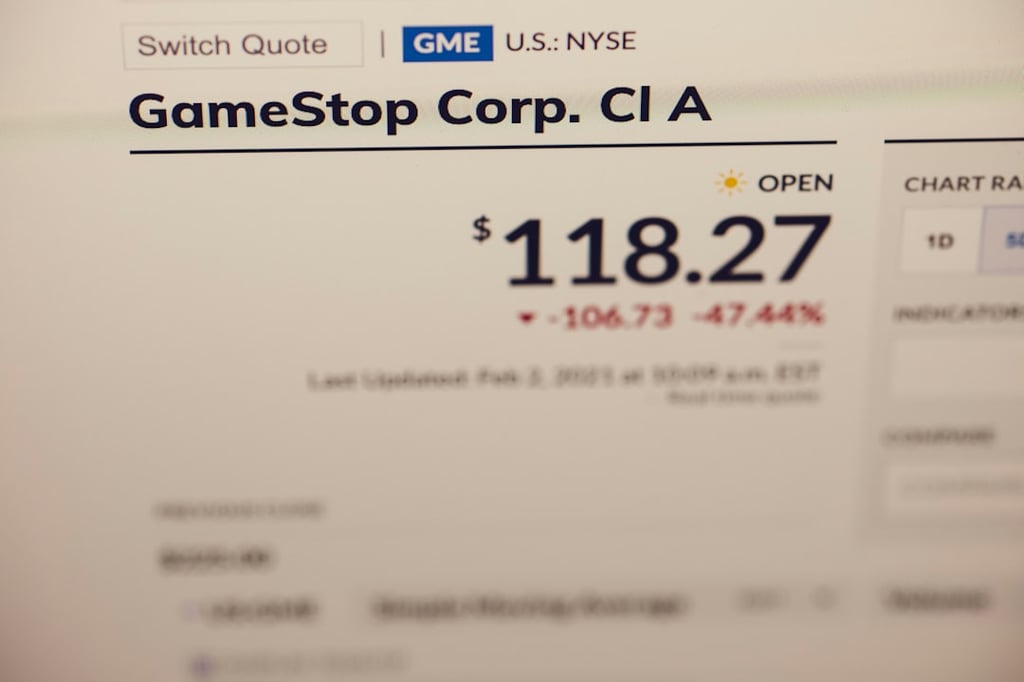
GameStop’s return to the headlines in June 2024 showed the same dynamic in miniature. The stock rose 101% and then fell 39% on Friday to finish flat on the week, Morningstar reported, after the company disclosed a 29% year-over-year sales decline and its second capital raise in a month. That is not a price chart built on conviction. It is a price chart built on reflex.
The real divide: improving small caps versus attention stocks
The best way to read this rally is to separate two different kinds of small-cap behavior that often get blurred together.
One group is macro-sensitive but still fundamentally legible. These are the businesses that can benefit if borrowing costs ease, if financing gets cheaper, or if earnings finally stop lagging the rest of the market. Bulls make a fair case that years of megacap dominance left parts of the small-cap universe looking cheap, and Fidelity’s Jurrien Timmer said in July 2024 that investors suddenly had “a larger menu to choose from,” FT reported.
The other group is much messier. These are the names where trading volume, online chatter, and the prospect of a quick squeeze matter more than the balance sheet. When Morningstar says investors are favoring microcaps that are losing money, that is the important clue. It suggests the rally is not just reaching into smaller companies. It is reaching into the least defensible ones.
That is why the current move feels more like a hybrid than a clean recovery. There may be a genuine rotation under way. There is also a speculative tail wagging it hard enough to blur the picture.
What meme trading behavior says about this move
The machinery behind meme trading did not vanish after 2021. It got embedded. Research in the Southern California Law Review argues that the rise of meme stocks is part of a longer structural shift in trading and investing: zero-commission brokerages lowered entry and exit costs for retail investors, while social media made it easier for dispersed traders to coordinate around stories that have little to do with fundamentals (SSRN, April 2024).
That does not mean every retail trader in a fast-moving stock is chasing a lottery ticket. The account-level evidence from Korean markets is more nuanced. In a May 2024 paper on meme-style trading, researchers found that 50% of position-clearing trades were closed within 10 days and 22% within two days, while median profits were close to zero and longer holding periods were associated with worse outcomes (SSRN, May 2024). The paper suggests many retail participants behave more like short-term swing traders than true bag holders.
That is useful, with one caution. Korean market data is informative, but it is not the same as US market data. Still, the pattern fits what is visible in American microcaps: fast turnover, short holding periods, and price moves that can persist long enough to become self-reinforcing even when the underlying business case is thin.
Put differently, a stock can rise because enough traders decide it should, not because the company has become healthier. Those are very different engines. Markets often pretend otherwise for a while.
Why history still favors caution
History does not forbid a small-cap recovery. It does, however, make a distinction between quality and junk that investors tend to rediscover only after the trade has already crowded in.
In February 2026, Morningstar reported that since 1957, portfolios of companies that were profitable, growing and well managed outperformed the smallest stocks in its “junk” bucket, meaning unprofitable, stagnant and poorly managed companies, by 4.7 percentage points annualized. They also did it with 40% less volatility. That is a long record, and it is not subtle.
The recent macro backdrop complicates the bullish case as well. GDP growth slowed to a 1.4% annual rate in the fourth quarter from 4.4% in the third, Morningstar reported in February 2026. That does not kill the case for smaller companies, but it does make a sweeping narrative about broad economic acceleration look a little too neat.
So the real issue is not whether small caps can rally. They clearly can. The issue is what is leading the rally, and whether that leadership is built on improving fundamentals or on speculative energy sloshing around the market’s cheapest names.
What this rally tells us now
The small cap meme stock rally is real in price terms, but it is not a straightforward vote of confidence in small businesses. It is a rotation with a speculative edge, and at the smallest end of the market that edge is doing a lot of the work.
The structural ingredients are still there. Zero-commission trading and social coordination lowered the barriers to meme trading, and SSRN argued in April 2024 that those changes make this kind of behavior durable, not temporary. Meanwhile, the pool of sub-$1 stocks has expanded sharply, FT reported in July 2024, giving speculative flows more places to land.
That does not mean every small cap is a trap. It means investors need to separate businesses that are improving from businesses that are merely being traded. A company can be small and real. It can also be small, unprofitable, and one social-media burst away from becoming the week’s punchline.
The index headline will not tell the difference. The balance sheet usually does.