



Those who work for a living are understandably very interested in improving their own household cash flow and, hence, their quality of life. Employers who wish to retain optimal talent in their ranks have this in mind as they try to work out a careful balance of salary and benefits. Too much generosity in either area usually costs a company more than it can afford or is willing to pay at any rate.
One way to negotiate between too much and too little is the flexible savings account (FSA). Targeting out-of-pocket medical expenses, the FSA funds are excluded from annual taxable income.
How Does an FSA Work?
Working in tandem with an employer-provided health care plan, the flexible spending account consists of money set aside to cover costs not normally addressed by traditional health benefits. Such expenses include co-payments, insurance deductibles, over-the-counter medicines and first-aid supplies. FSAs can also cover diagnostic meters for blood sugar readings and medical assists, like crutches.
Like medical insurance premiums, FSA monies are withheld from regular wages and held in a separate account. No more than $2,850 is allowable for an employer to hold on behalf of an individual employee. Any unspent FSA money in a given year usually reverts back to the employer, but some plans allow grace periods and rollovers.
How Do FSAs Benefit Employers?
On the face of it, there does not seem to be an upside for the employer to offer the FSA program to its associates. After all, there is a cost of about $60 per employee annually to service the program. Still, when workers elect to curtail their wages through FSA, it lowers the payroll tax, which goes to fund Social Security and Medicare, according to the amount the employee opts to divert to FSA. In the long run, an employer can save more than it pays for FSA.
Do FSA Funds Appear on the W-2?
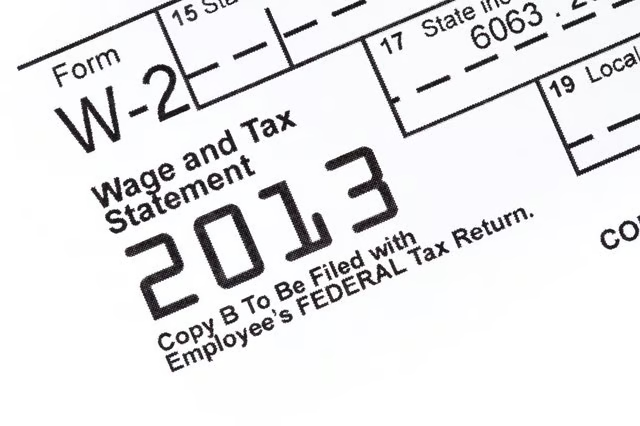
There is no designated W-2 FSA box. In fact, employers are not obliged to report FSA disbursements on the W-2 at all. FSA funds are voluntary salary reductions on the part of the employee and are, therefore, not included as taxable wages. It follows that they do not qualify as deductible.
However, some employers may opt to reveal these amounts in the W-2 box 14 labeled "Other," but they do so for informational reasons only. The bottom line is that no money in FSA counts is taxable income. This is logical, since FSA financial resources may or may not be used at all.
What Is a Dependent Care FSA?
In contrast to a health care FSA, a dependent care FSA assists an employee with the increasing costs of child care. Larger companies more often have dependent care FSAs available for their staff members. The maximum set-aside dollar figure is $10,500 per household.
It must apply to children under the age of 13, and both parents must work, or at least be searching for employment. Recipients of these funds include day care centers, after-care programs, nannies, babysitters and summer day camps. Tax rules are the same for dependent care FSAs in terms of what is flex on W-2 forms.
The W-2 and FSAs
The important point to remember is that a W-2 form tells the taxpayer and the government what a firm has taken from earned income to satisfy government obligations like income tax and payroll tax. Since the FSA is the employee's choice to reduce income in favor of the health account, the IRS is not involved.