
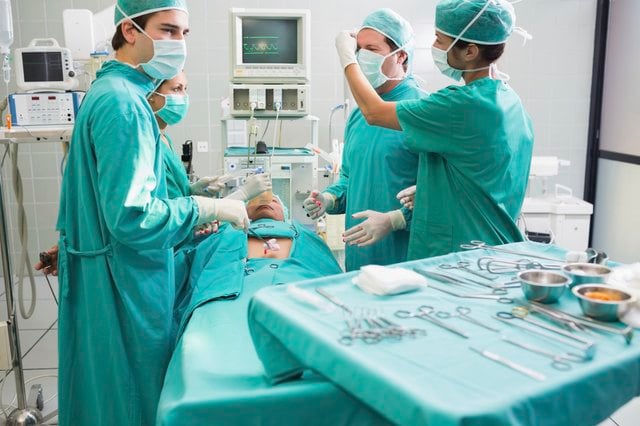

A student considering a career in surgery may only consider the advantages of the job. The U.S. Bureau of Labor Statistics expects employment opportunities for physicians and surgeons to increase 18 percent between 2012 and 2022, faster than the average of all careers. Surgeons also have much higher earnings than many other professions. However, in spite of the availability of jobs and the high incomes, a career as a surgeon has some disadvantages.
Length of Education
A surgeon needs years of post-secondary education before practicing. A physician needs at least three years of undergraduate studies and four years of medical school, though typically this education takes eight years. Following successful completion of the medical licensing exam, a medical school graduate must complete an internship plus years of residency. The length of time a surgeon spends in residency and internship programs depends upon the specialization.
Cost of Education
The cost of a surgeon's education can be excessive. On average, indebted 2013 med school graduates owed $169,901 at graduation, and 7 percent owed $300,000 or more, according to the Association of American Medical colleges. The average cost of medical school for tuition and fees for the 2013 to 2014 school year was $32,993 in public colleges and $52,456 in private ones. Even with scholarships and financial aid, the debt a surgeon has after graduation can give pause to some considering a career in surgery.
Life and Death Responsibility
As a surgeon, you literally hold a person's life in your hands, and mistakes can kill your patients. This responsibility can be too much for some surgeons. Depending on their specialty, surgeons work long, demanding hours, according to the University of California's School of Medicine. The physical and emotional requirements of their careers can lead to a surgeon changing his specialty before retirement. Changing your specialty can require additional time in residency and internship programs.
Risk of Injury
Surgeons work with many sharp objects, including needles and scalpels. They are at risk of injury and exposure to infectious diseases if they receive a cut or needle stick. Exposure to airborne pathogens is a risk to anyone involved in surgery, but the surgeon's exposure is particularly high because he works directly over the patient. Even though all hospitals and surgery centers have safety standards in place, accidents can place a surgeon at risk.