


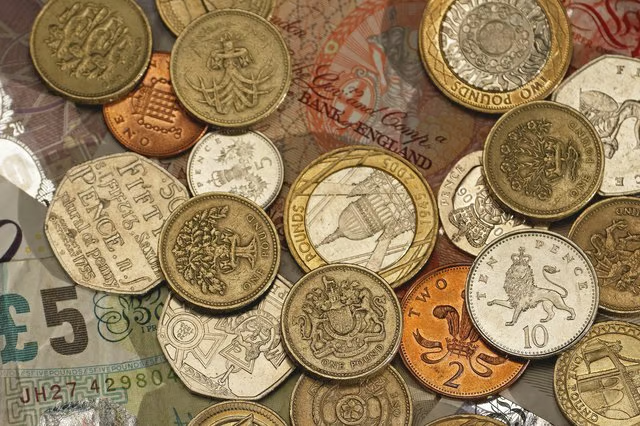

Taking a short position in any asset can be done for hedging purposes, or as part of a speculative investment based on the belief that the asset's price will decline. You have access to a number of investment vehicles you can use to short the pound, which is the British unit of currency equivalent to our U.S. dollar.
Derivatives
The futures market is the primary derivatives market for trading contracts on underlying currencies. At the Chicago Mercantile Exchange, the minimum contract size is 100 contracts, each holding 62,500 pounds. You can short the pound by selling contracts, and exit the position by reversing it through the purchase of the same number of contracts. For example, if the pound is trading at a 1.5 pound-spot rate and you sell 100 contracts, you've taken a short position of 100 contracts multiplied by 62,500 pounds at 1.5 per pound, or 9,375,000 pounds. If you reverse the position when the pound's spot rate falls to 1.48, you've exited at a value of 9,250,000 pounds. Your profit, before transaction costs, is: 9,375,000 minus 9,250,000, or 125,000 pounds.
Exchange-Traded Funds
The futures market is dominated by institutional players. Fortunately, exchange-traded funds, which you can buy and sell like stocks using the same brokerage accounts, have greatly proliferated. Using ETFs, you have a wide variety of low-cost choices for shorting the pound. Numerous ETFs track the pound's spot price and increase or decrease in value in tandem with the pound. There are ETFs specifically for individuals who want to short the pound.
Online Trading Platforms
Open an account with foreign exchange trading brokers, such as DirectFX or FXCM, that have created online trading platforms that make currency trading virtually the same as trading stocks. They are very flexible and user friendly. One of the advantages of trading through these platforms is that they don't subject you to as many restrictions, such as contract sizes, that apply when trading futures. It is a very simple, direct way of trading currencies.